
Text by Jeremy Cuff/www.ja-universe.com
Photography by Jeremy & Amanda Cuff/www.ja-universe.com
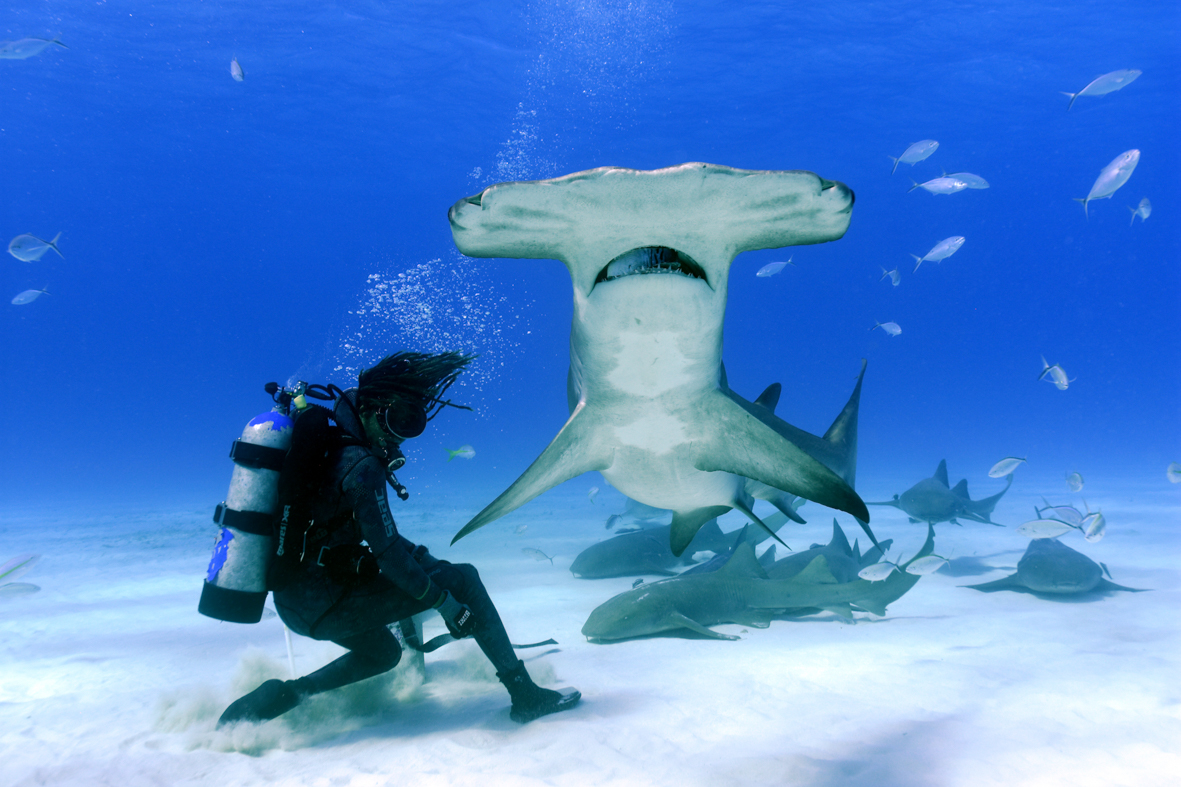
Any fans of Formula One racing will be familiar with Lewis Hamilton’s Mercedes race engineer Bono (Chris Bonnington) telling his driver over the radio that it’s “Hammertime”, the time in the race for Lewis to unleash a succession of the hottest laps. But in terms of scuba diving, the phrase “Hammertime” means something very, very different, but no less exciting and rewarding. Here’s our story about how we got to experience our version of “Hammertime”…
Two years ago, in 2023, after the disruptions of the Covid-19 pandemic, we headed to Grand Bahama in search of some specific shark action, having been diverted away from our original plan of travelling to the island Bimini thanks to the chaos that ensued.
Put simply, our dive operator decided to pull out of Bimini due to a combination of things; reduced sightings of Great Hammerheads at that time (though its’ increased again since), coinciding with the operational difficulties of running their trips amidst the pandemic restrictions and uncertainties. Something had to give, and it did.
With our plans having changed, our re-scheduled trip took us to the Tiger Shark mecca of Tiger Beach off Grand Bahama, where in addition to the “Tigers” themselves, other big shark encounters were entirely possible, including with the Great Hammerhead. For it was the Great Hammerhead that was our intended target species, and something at the top of our mutual “bucket lists”.
Of the other (non-Tiger) sharks we encountered at Tiger Beach in 2023, there were Caribbean Reef Sharks, Lemon Sharks and Bull Sharks, but sadly for us, no Great Hammerheads, including a huge female known as Queen, nor were any other Great Hammerheads seen during our visit, except by one of the crew who reported seeing a “non-feeding Hammer” from the boat whilst divers were in the water; nobody glimpsed it. From that time on, it seemed that the “Hammers” had largely stopped visiting Tiger Beach on a regular or reliable basis, even though their absences may not be permanent. Only time will tell.
For us, it was a shame, but it would be churlish to be unhappy about “only” diving with the Tiger Sharks, one of the ocean’s most awesome predators. But, to turn our slight negative into a positive, the non-appearances of Hammerheads at Tiger Beach had set the scene for a return visit to the Bahamas. We would roll the dice one more time for getting our Great Hammerhead encounters, and if it was going to happen, it was going to happen in Bimini. Upon returning home, we promptly made a booking with the Bimini based Neal Watson Scuba Centre for 2 years’ time.
As with most encounters in the world’s oceans, success is also about timing, as there’s no point turning up at Bimini in, say, July or August expecting to get the sighting. The Great Hammerhead “season” starts in November (usually) and ends around mid-April (usually), but it’s probably best to go there in the middle of that period of time, around late January/February to put yourself in the pound seats, and thus avoid the risk of late arrivals, or early departures of the sharks from the area.
It is thought that they visit the area during this time for a combination of reasons; the abundance of food (such as their favoured prey of Stingrays, which are common), and water temperature. There’s no sound evidence of mating or giving birth, but it’s possible; at least one of the females we would encounter was heavily pregnant. In the Summer months, they are known to move North with the rising water temperatures up the East coast of the USA.
So, we travelled out there in February 2025, benefitting from direct flights to the Bahamas from the UK, rather than going via somewhere in Florida, such as Miami. As we’d done two years previously, we chose to spend a couple of nights in Nassau (the Bahamian capital) before travelling over to Bimini on one of the regular internal flights.
Bimini is the westernmost island group in the Bahamas, and is quite remote from the other islands, facing the open sea of the Florida Strait, with Miami and Fort Lauderdale about 50 plus miles away across the water. In fact, some Floridian visitors even come across to Bimini on day trips by either plane or ferry.
Over on Bimini, the Neal Watson team are based at the Bimini Big Game Club, a well set-up but informal resort inhabited mostly by divers, fishermen and other assorted “sea dogs”. It’s got decent accommodation, a bar and restaurant with a view over the lagoon and mangroves, a swimming pool, a shop, and a marina that shelters boats from the elements. It also has the distinction of once hosting Martin Luther King as a guest in 1964, who reputedly honed his now famous speech during his stay there.
The resort and dive centre are located on North Bimini, whereas the airport is on South Bimini. To get from the airport to the resort involves a minibus ride followed by a short ferry ride between the islands, followed by another (short) minibus or taxi ride, though you could walk the last stint to the resort if your baggage is minimal (unlike us). In the Bahamas, you’ll pay rather a lot for minibuses, ferries and taxi transfers, but there’s not much you can do about it, so best accept it and go with the flow. There aren’t many alternatives in most cases.
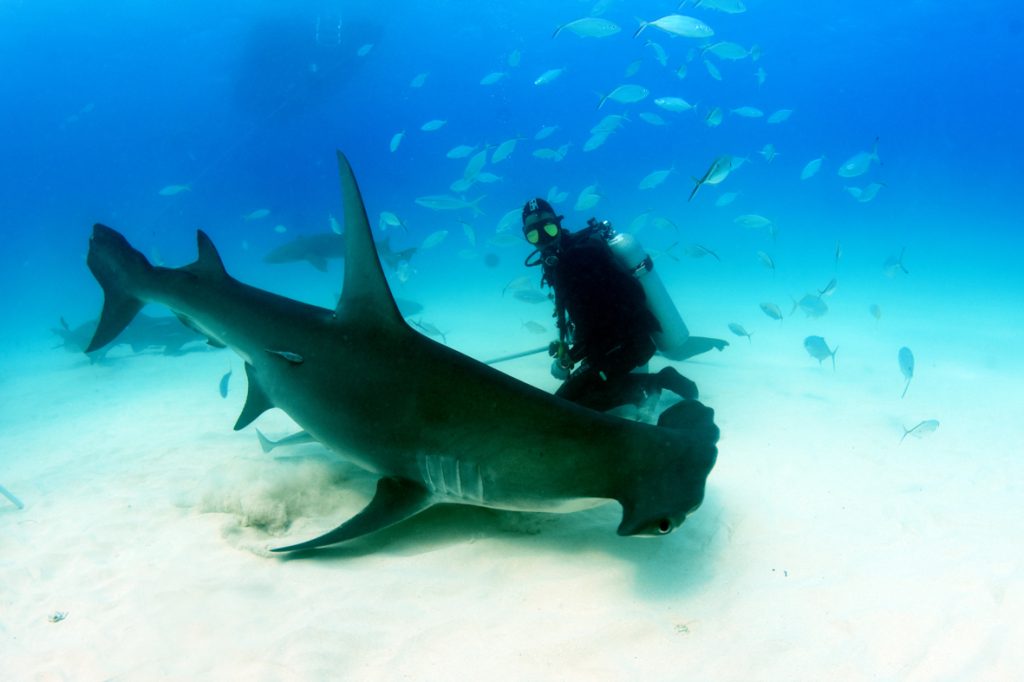
In terms of the diving itself, we’d already been fortunate enough to see the spectacle of schooling Scalloped Hammerheads on dives around Darwin Island in the Galapagos, but Great Hammerheads (the largest of all the Hammerhead shark species) are a different proposition, being more solitary, rarely encountered on dives, and so far as anyone knows, not known to form schools like their smaller counterparts. Added to that, they’re now sadly designated as Critically Endangered.
Given our previous lack of success in encountering the Great Hammerheads at Tiger Beach, we left nothing to chance, booking six solid days of Great Hammerhead diving (which the Neal Watson team call the “Great Hammerhead Safari”), even though the other diving offered there and is reputedly good. We didn’t want our goal to be thwarted this time, whether by non-appearances or unhelpful weather events resulting in cancellation (which can happen). We gave ourselves the best possible chance.
The location for the Hammerhead Safari dives is a short boat ride out of the lagoon, to a shallow sandy area off the Western side of South Bimini. As this area faces the open waters of the Florida Strait, swells are possible, so it’s worth taking sea sickness tablets as a precaution, especially if you have a long stint before getting in the water, whilst waiting for sharks.
The dives themselves are a continuous two-hour immersion in around 8 -10 metres of water throughout which the sharks are continually baited and fed. Each diver has the use of two tanks, which can be changed by going up to the boat at any time during the two hours, unless of course, you can eke out a tank for two hours (Amanda managed it, I didn’t, so I got twelve logged dives to her six!).
One of quirks of this kind of shark diving (where you need to be firmly planted on the bottom) is the need to be heavily overweighted, which if you’ve never experienced it before, takes a bit of getting used to. You particularly need to manage your descents, to avoid plummeting at high speed to the bottom and being unable to equalise your ears quickly enough. Ensuring you enter the water with a fully inflated BCD and gradually dumping air is the way to go, combined with using the line to hang onto. It’s also important to ensure that your weight belt is done up tightly, as they have a habit of slipping down thanks all the extra lead.
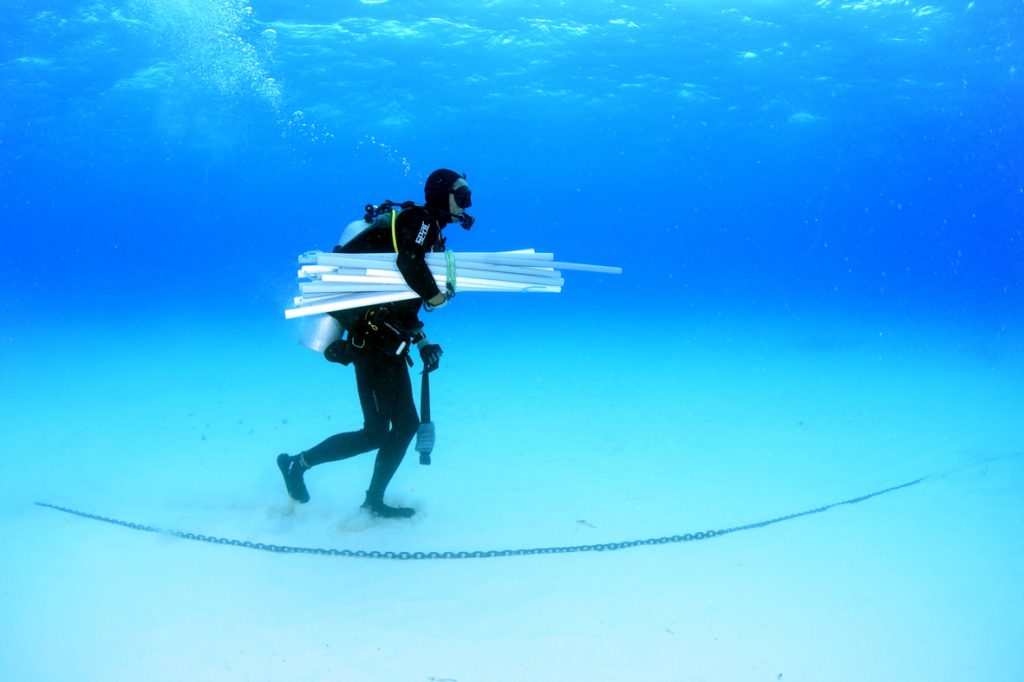
Whilst everything is being set up, the all-important dive briefing is given to all participants, where a member of the dive crew gives a detailed description of what to expect in the water, and what to do if a circumstance arises, such as using the supplied plastic poles (one per diver) to prevent a Hammerhead swimming between divers. They’re also helpful for stabilising yourself against any current that may be present.
For most of the dives on our trip, we had Sean Williams give the briefing; Sean possesses huge knowledge about the area and the sharks themselves, and enjoys sharing it with visiting divers. He’s been visiting Bimini for many years including time working at the Bimini Shark Lab (the Bimini Biological Field Station), a conservation and shark research group based on the island.
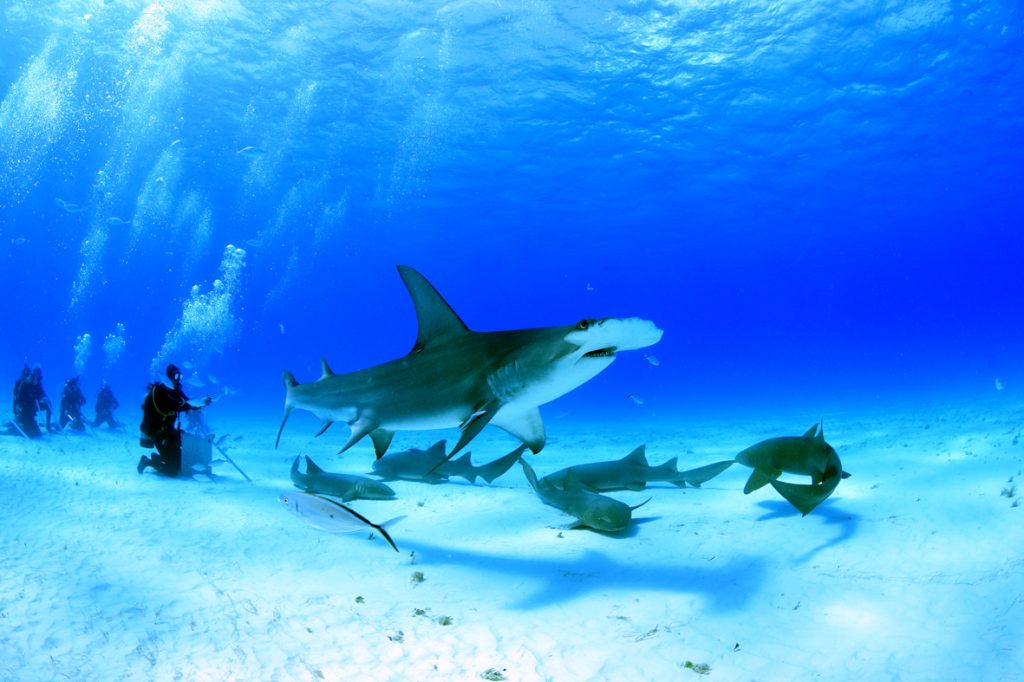
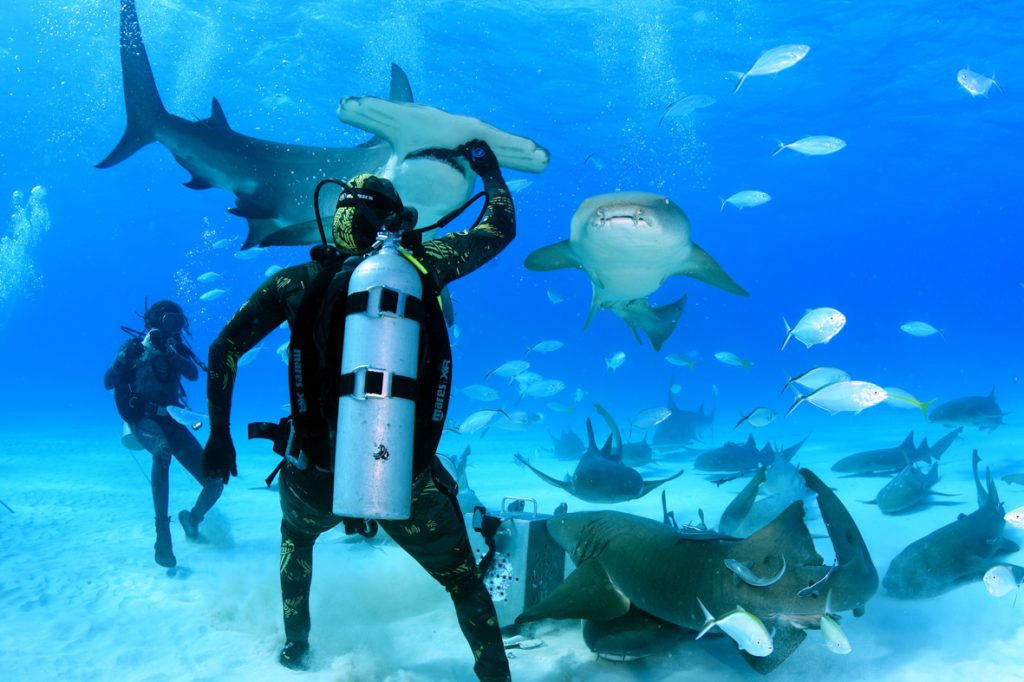
Once the boat is secured, members of the dive team locate the holed metal bait box in a suitable spot on the sandy expanse, assess the conditions in terms of visibility and current, and then position everyone in a tight semi-circle up-current from the bait box, and safely out of the chum trail (the shark’s “scent highway” to the bait), and wait for sharks to turn up, which usually doesn’t take long, though we once waited for an hour. Divers don’t get into the water until sharks are present, thus not wasting long periods of the 2-hour dive just waiting on the bottom burning through air.
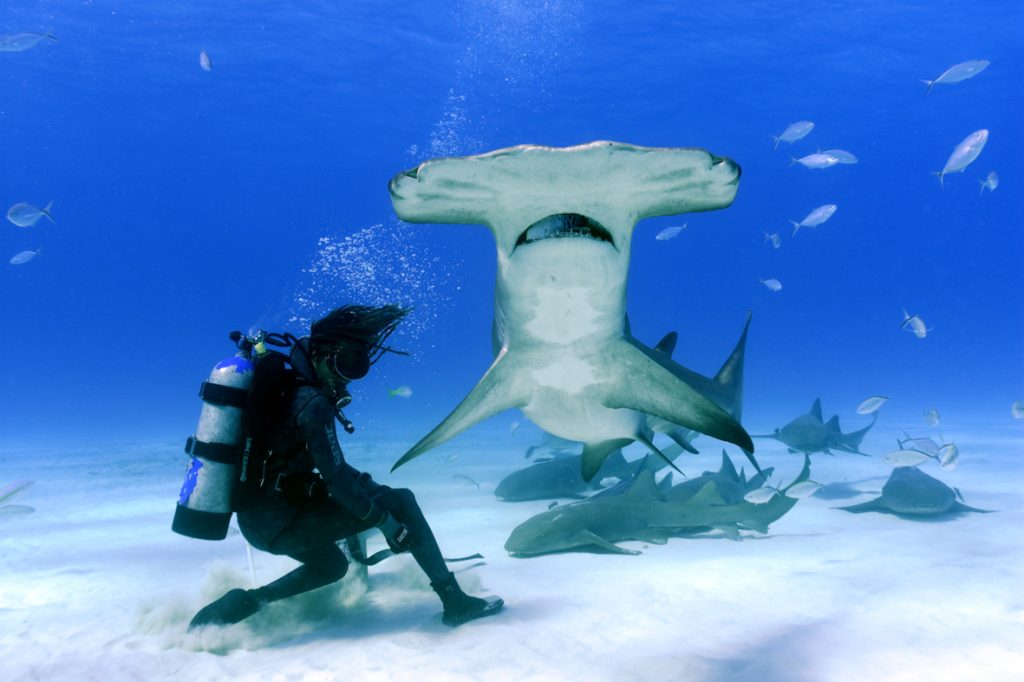
With the briefing done, it’s then a case of divers entering the water and finding a spot in the semi-circle (each spot denoted by a plastic pole) and soaking up the action. As with the Tiger Sharks of Tiger Beach, these dives are a huge experience and it’s at once awe-inspiring and humbling to see these unique and incredible predators up-close and personal.
Most of the “feeders” (the sharks that participate in the feed) are known to the dive crew and have been given names to aid recognition. Among them are two enormous specimens (both females) measuring around fourteen feet in length such as Queen (the same shark that had also been visiting Tiger Beach) and Gaia. Other sharks we “met” were Atlas, Aceso, Atalanta, Enyo, Selene, Rhea, Cora, plus a couple of “new” sharks.
The shark action was spectacular and continued pretty much without stop on each dive for the duration of our 2-hour stints underwater (save for an occasional lull). In fact, the season was going well, and on one special day we got eleven different Great Hammerheads visiting the feeding site, the highest count for the 2024/2025 season from a single dive. After the worrying drop in sightings during the early 2020’s, clearly things had swung back in favour of Bimini, even if it was at the expense of other places such as Tiger Beach.
We all know that nothing in the ocean stays the same forever, a truism that applies to the Bahamas as much as anywhere else. Things change, and can change quickly. And they can also change back again. Nothing is 100% certain, nor could it ever be. But for the last twenty-five years and for now at least, Bimini is absolutely the place to go if you want to dive with the spectacular and rarely encountered Great Hammerhead shark. There’s not really any other place where you can see this species reliably, so make the journey out there.
We loved every minute of it, we totally recommend it, and we had experienced our own version of “Hammertime”…
A WORD ABOUT THE BULL SHARKS
Anyone arriving on the harbourside next to the dive centre will quickly be taken aback by the sharks hanging around in the shallows where the dive boats are moored.
There’s usually a gaggle of Nurse Sharks, including one called “Squiggles” named after its’ crooked tail that was once broken in some “incident”, but it’s the Bull Sharks that take you aback; they’re huge, and there’s perhaps eight to ten individuals looking for opportunities. This isn’t a place to fall into the water after too many rums at the bar, as the sharks congregate there for the reasons of food.
Over the years, the dive centre developed a “side hustle” of offering cage dives with them; basically, a dive centre employee feeds them to keep them near the cage whilst the participant is inside. The air supply is surface fed and it’s 20 minutes in duration. I did it, and thought it worthwhile.
You will also have high probabilities of seeing Bull Sharks at the Great Hammerhead feeds (we did), though the dive crew won’t allow them too close to the feed to avoid it becoming a Bull Shark dive rather than a Great Hammerhead dive. If any come too close, the crew chase them off, literally.
A SPECIAL THANKS; We’d like to give a special thanks to shark enthusiast and conservationist Sean Williams from the Neal Watson dive team, who kindly gave up his time to share his considerable knowledge about the sharks of Bimini, and especially the Great Hammerheads. His dream is of a Great White being attracted to the shark feed one day. Maybe it’ll happen, as the “ocean is the ocean”…
DIVE CENTRE & ACCOMODATION – Links