
Text by Jeremy Cuff/www.ja-universe.com
Photography by Jeremy & Amanda Cuff/www.ja-universe.com
A fortnight to dive and photograph western Australia’s excellent Ningaloo Reef from Coral Bay and Exmouth. Was it enough? Of course it wasn’t!
It had been a long held ambition of mine to visit Ningaloo Reef in western Australia, a 260 km fringing reef system that stretches from North West Cape at the tip of the Cape Range peninsula south to an area close to Amherst Point, south of the remote holiday resort of Coral Bay.
Unlike the Great Barrier Reef, Ningaloo is close to the shore for the vast majority of its length, visible from the deserted beaches of the Cape Range National Park and Coral Bay. It’s also less well known – when telling non-diving friends about our upcoming diving trip to Australia, most assumed that we were going to the Great Barrier Reef. They hadn’t heard of Ningaloo. Amongst the diving fraternity, however, Ningaloo is now well and truly on the map since the discovery of the annual whale shark visitations in the early 90’s.
To reach Ningaloo, we travelled to western Australia’s capital city of Perth with Singapore Airlines who we found to be sympathetic and helpful with the large amounts of camera equipment in our hand luggage. The flight from London to Singapore is in excess of twelve hours. The onward flight to Perth is another five hours.
We opted to drive up to Ningaloo, which is a great experience if you have the time. It also gives the traveller an indelible impression of the sheer vastness of Australia as one passes through mile after mile of uninhabited outback, especially north of Geraldton. If time is short, it’s also an option to fly up from Perth to Ningaloo, to Learmonth Airport near Exmouth. Whether by road or by aeroplane, the journey is about 1200 km, more if you take detours.
Diving is busy at Coral Bay and Exmouth throughout April. It’s the Whale Shark season from late March to June and the April school holidays bump up the numbers to full capacity as many families head up from Perth and other areas of the southwest. Booking in advance for both the diving and accommodation is essential, particularly in Coral Bay.
For us, the original attraction of visiting Ningaloo was the annual influx of Whale Sharks, but more research into the area told us that any prospective dive traveller could be rewarded with, well, almost anything! Whale Sharks, Wobbegongs, Manta Rays, Reef Sharks, Turtles, Dugongs, Dolphins and Humpback Whales are all features of most travel literature and diving websites. Surely there must be a catch?
There isn’t really a “catch”, but Ningaloo is seasonal and it’s important to “do your homework”, ask questions and give yourself as much time as possible in the area. There are also differences between the southern and northern areas of the reef. And timing is everything – we met a diver who was visiting Ningaloo for the second time. He didn’t see a Whale Shark on his first visit. The reason was because he turned up in November! He was four months too early. He hadn’t done his homework.
We chose to dive with Exmouth Diving who conveniently have bases in both Coral Bay and Exmouth itself. We found them to be friendly, helpful and professional. Of the boats, “VFB” (Very Fast Boat) at Coral Bay isn’t ideal for photographers, especially when full, with no dry areas except for a tiny cupboard. Tim, the skipper, was very accommodating to us by helping to store the cameras safely and will wait for film changes before moving off to the next site.
The other boats, such as those used for the Whale Shark adventures, the North Reef safaris from Coral Bay and the Muiron Islands from Exmouth are larger with dry areas that make handling cameras easier. At Exmouth, one of the skippers, Steve Gibson, is an accomplished underwater photographer and keen to assist anyone with cameras. Also, there are no camera rinses for large housings, such as my Subal/F100 set-up.
Our first taste of Ningaloo was at Coral Bay, a small, remote and pleasant resort towards the southern end of the reef. The Exmouth Diving shop is located in the shopping centre where all divers gather to “check in” and load their gear onto the minibus for a short ride to the boats, which are moored just off the beach. There’s no jetty, so everyone has to help and wade out to the boat with tanks and equipment.
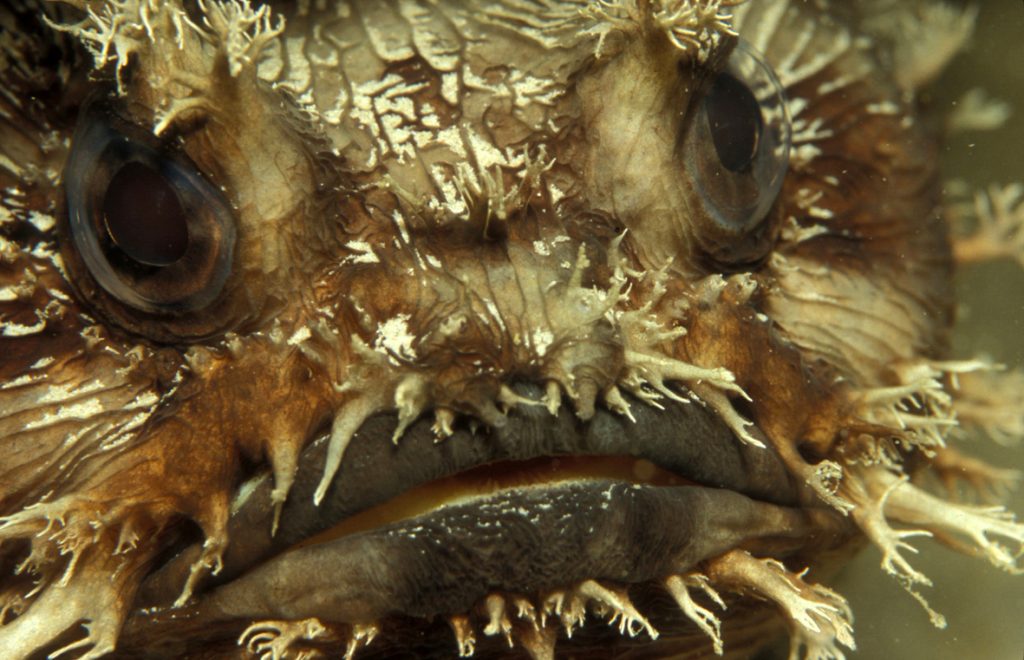
Most of the dive sites of Coral Bay are relatively shallow and Lottie’s Lagoon is no exception. It’s a flat sandy area littered with coral heads that is more suited to macro photography. It was here that we made our first acquaintances with the endemic Sailfin Catfish. It’s a distinctive fish with a blackish or dark chocolate brown colouration. It’s an infuriatingly difficult subject to photograph – its dark colouration causes the auto focus to search, it’s constantly on the move and is seldom completely in the open, more often underneath a ledge where positioning strobes is awkward – so although commonly encountered, it’s rare that a really good image of the species is captured. I certainly didn’t get anything that I was pleased with.
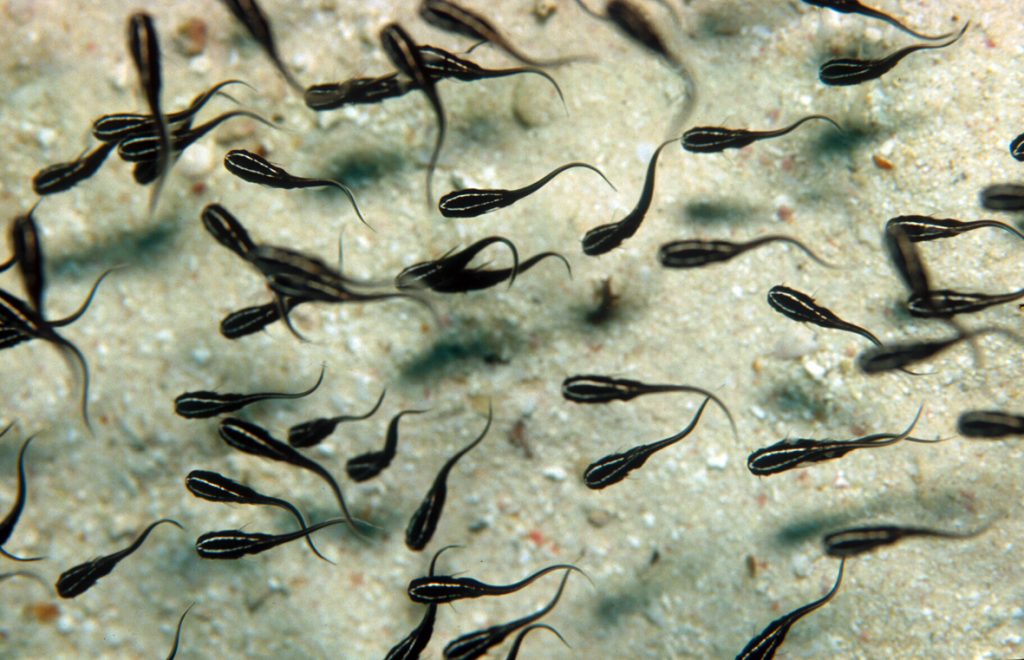
Gregarious Striped Catfish are also fairly common on the reefs of Ningaloo. We discovered a group of adults in a small hole at Lottie’s Lagoon. They responded to our close attentions by stirring up a fog of fine sand, rendering good photography almost impossible. The juveniles of the species, however, present easier opportunities as they can often be found (certainly at the time of our visit) in tightly packed groups. To help matters, these groups can be corralled into more suitable positions by a photographers hand and sometimes swim in the relatively open water, particularly where the reef adjoins a sandy area.
Big Blue, Canyon and Asho’s Gap are impressive reef dives with immense coral structures dominating the underwater scenery. There are reputedly around 130 species of coral in this area alone. Particularly memorable were the stag, brain and cabbage corals. On these sites we encountered large mixed schools of trevally and barracuda. Other logbook additions included sailfin catfish, octopus, scorpionfish, spangled emperors and even a northern wobbegong. There are also shark cleaning stations to visit where, most commonly, grey reef sharks can be found, although it’s very difficult to get a really close unless you spend the whole dive there.
For photographers, the dives that return to the same starting point are the easiest as you can hang back from the non-photographers if good subjects are found. For “A to B” dives such as from Big Blue to Canyon it’s much more difficult for photographers to concentrate as you’re forced to dive at the pace of the group in order to reach to destination mooring.
Heike’s Ledge (also spelt Hicker’s or Hiker’s depending on the dive staff you ask!) is an excellent dive site on the outside of Ningaloo Reef, facing the open ocean. It’s an area that isn’t frequently dived as the conditions have to be right – often the swells, currents and surges prevent safe diving. It consists of a sandy expanse, home to stingrays and blue spotted rays and a series of ledges and overhangs that are home to a profusion of reef inhabitants.
Large groupers skulk in the shadows as baitfish move in unison to threats real or imagined. Moray eels, schooling snappers, octopus and cuttlefish were some of the highlights. From a photographic point of view, any lens set-up would be suitable at Heike’s, as there are plenty of all kinds of subjects, although I regretted taking my 105mm macro which was very tricky because of the surge.
The Porites is a seldom visited dive site, a fair distance north of Coral Bay. We likened the experience to “diving in cobwebs”. The visibility was quite poor here, but it wasn’t due to suspended sand particles, it was “food” particles – the sort of organic broth that Mantas seek out. As we kitted up, a Manta passed close to the boat, but we didn’t see any once in the water.
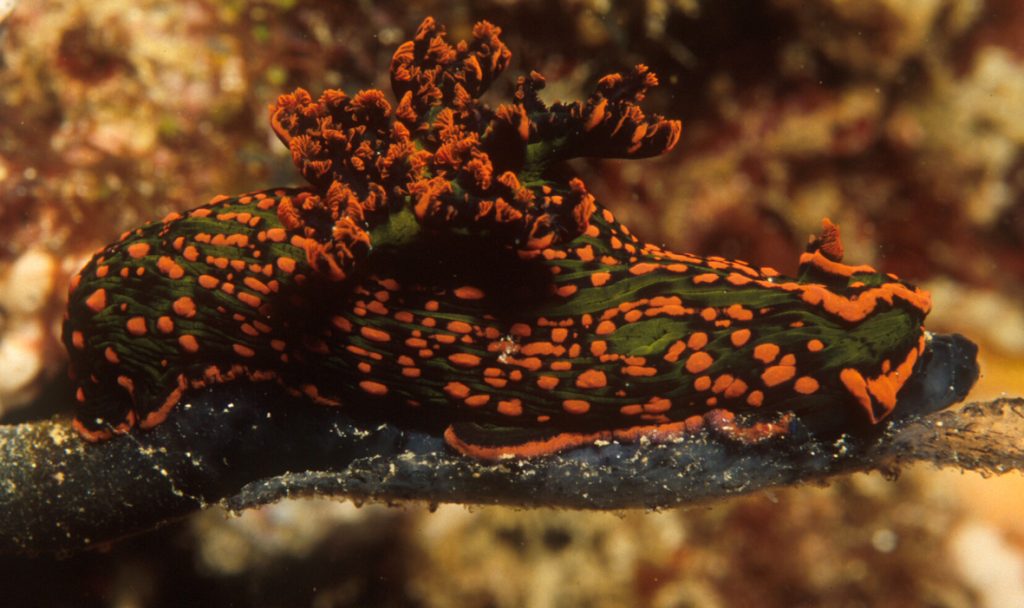
The site itself consists of coral ledges and bommies peppered with holes and crevices that are home to large groupers and sweetlips. An octopus and several species of nudibranch completed our list from this interesting site. And we knew that Mantas were not far away!
Manta Ray interaction tours are run all year round from Coral Bay and are extremely worthwhile. A spotter plane is deployed to pinpoint the location of the Mantas, guiding the skipper to within snorkelling distance of these huge marine behemoths. Occasionally, however, the services of the spotter plane aren’t necessary, as the crews will visit known cleaning stations that the Mantas are known to frequent.
When Mantas are located, the basic procedure is to get kitted up with masks, snorkel and fins on, camera in hand. If the boat is full, there will be two groups who will take it in turns to swim with the Mantas. One of the crew acts as a spotter and will enter the water first and locate the Mantas, indicating their position by a raised arm. The skipper then signals to the snorkellers to enter the water and swim towards the raised arm, ideally by sliding in rather than crashing, as excessive noise and splashing is disliked by the Mantas.
Of our two Manta interaction tours, the experiences were quite different. The first time was a literally breathtaking, full speed swim after a pair of fast swimming Mantas in murky visibility. Duck diving towards the Mantas isn’t allowed, although it’s the last thing on your mind when swimming at full speed.
I used a fisheye lens, which created a difficult challenge in conveying the size of the animals when photographed from several metres above. I chose shutter priority of 1/160th to freeze the movement of the Manta itself and that created by my frantic swimming.
For our second Manta interaction, we found a single specimen at a cleaning station. It was in deeper water than the first trip, and looked tiny through the fisheye lens. It was however a superb experience to see this incredible animal cruising beneath us, completely unconcerned by our presence.
Then, without warning, it suddenly took off. We swam after it but it soon circled back to the cleaning station and resumed its tranquil soaring. Back on the boat we learned of the reason for its fright – a large Tiger Shark had swum right beneath us. None of us in the water saw it!
In Coral, Bay, our first Whale Shark Adventure was cancelled thanks to high winds but luckily we got a chance a couple of days later. It takes a lot of effort and infrastructure to locate a Whale Shark in the vastness of the seas around Ningaloo. They are only found on the outside of the reef and not necessarily close to the reef, sometimes many miles out to sea. The spotter plane is thus an essential team member and stays in constant contact with the boat throughout the day.
Once a sighting is verified, a wave of excitement and expectation sweeps over the boat. The procedure is similar to the Manta interaction tours – once the snorkellers are ready, the skipper deposits the guide in the water and reverses the boat into the path of the shark. The snorkellers then follow the lead of the guide who pinpoints the shark’s location by a raised arm.
In this situation, akin to “an underwater stampede”, it isn’t easy to photograph the animal. With up to ten people in the water at any one time, it’s easy to crash into other enthusiastic snorkellers and get stray arms, fins or bodies into the images. There are also rules surrounding swimming with Whale Sharks, which aren’t conducive to the best photographic angles, particularly when using a fisheye lens, which also requires the photographer to get in close. A good tip is to ensure you’re in the best spot on the boat – if the shark is coming from the left, be on the left so that when the shark comes into view, no one is to your left, only the shark.
For our second week, we moved north to Exmouth. Unlike Coral Bay, Exmouth is a town rather than a “resort”. It has grown considerably since the influx of diving, eco tourism and fishing and boasts decent shopping facilities, a prawn fishery and a naval base, which has inadvertently created a fantastic dive site, more of which later.
The format of the diving in Exmouth is similar to Coral Bay except the bus rides are considerably further, which means an earlier start – usually 7.00-7.30 am. Once the trailer is loaded with the equipment and everyone’s onboard the bus, it’s a 45-minute journey to the Tantabiddi mooring, which is used for the Whale Shark adventures. To reach the boat, a small RIB makes several journeys ferrying divers, equipment and supplies to the dive boat. Divers visiting the Muiron Islands and the reefs around the north of the cape have a 20 minute bus ride from Exmouth to the Bundegi mooring where there is a small jetty from which to load the equipment.
In Exmouth we’d booked three Whale Sharks adventures. Each day turned out to be unsuccessful. The crew said that this was somewhat unprecedented for the time of year. There must have been a reason, as since we’d been in Exmouth, we’d heard that the sightings had also dried up in Coral Bay. It was probably a blip, but “Whale Shark disappointment” was widespread amongst the crew and the snorkellers.
Although relatively little is known about their behaviour, a basic understanding of Whale Shark habits (available in books, DVD’s and a specialty course at the dive centres) goes a long way towards turning a “disappointed” Whale Shark adventurer into one that is merely “philosophical” For some, it was their only chance to see a Whale Shark and it hadn’t happened. At least we’d seen one in Coral Bay.
Central Station is a dive site often visited before setting off to look for Whale Sharks. It’s one of those sites where anything can turn up. It’s probably wise to take a wide-angle set-up here, as schooling fish, large stingrays, turtles and white tip reef sharks are frequent here. A couple of days before our visit, a Manta and a Leopard Shark were sighted. A macro and fish photographer will also find plenty of subjects such as mantis shrimps, juvenile striped catfish and the unusually tolerant threadfin pearl perch.
The uninhabited Muiron Islands are located northeast of the Cape Range peninsula and offers excellent diving. We were told that the visibility is often low, but we were lucky, blessed with fairly good visibility. The two sites visited were The Spit and The Maze, both coral ledges punctuated with some superb swim-throughs, particularly at The Spit. Here, we enjoyed passing through incredible walls of baitfish.
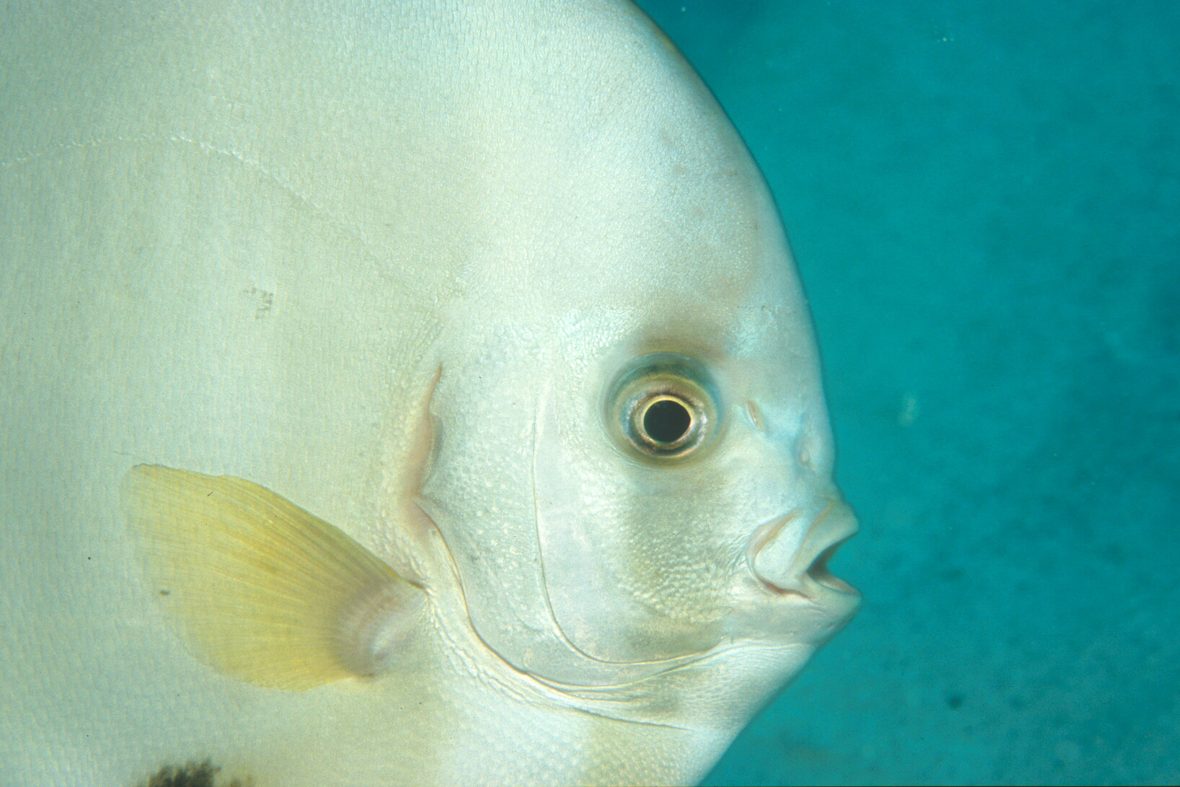
Blizzard Ridge, Labyrinth and Gulliver’s are excellent reef dive sites located around the tip of peninsula. Although lacking the visual grandeur of some of the Coral Bay sites such as Asho’s Gap, they more than make up for it in terms of what can be found there. Blizzard Ridge in particular is a special site yielding tasselled wobbegongs, white tip reef sharks, large batfish, schools of snappers, huge morays, stingrays, incredible swarms of baitfish and other surprises. At Gulliver’s, one group saw a hammerhead shark and a giant frogfish.
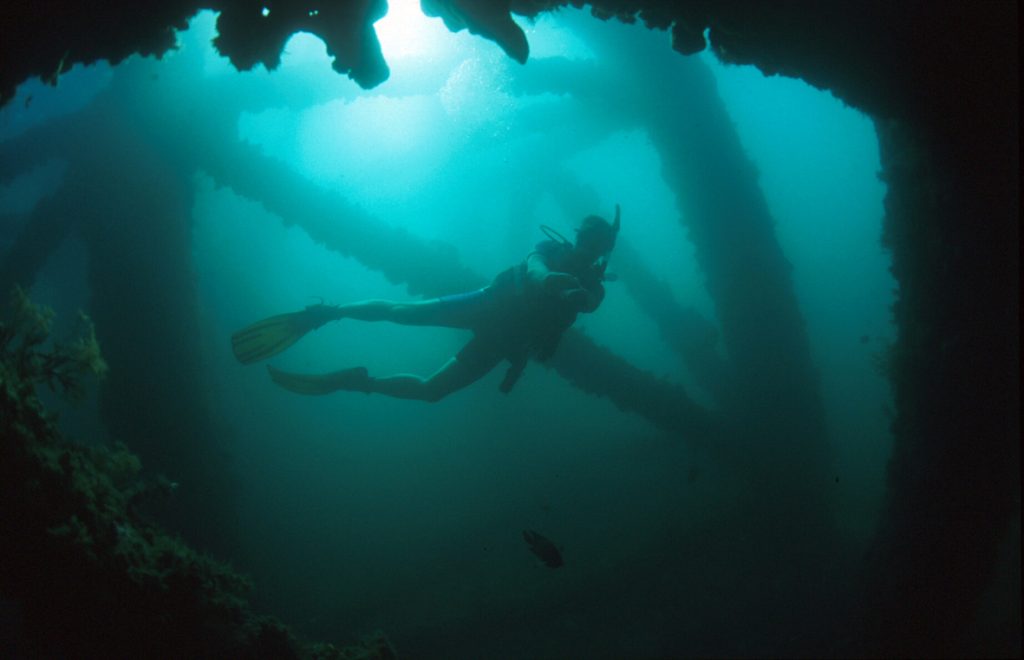
Navy Pier, or the Harold E. Holt Naval Pier to be precise has been voted as one of the top ten dives in Australia. It’s certainly very good and we only had time for a single dive there. To unlock the fantastic photographic potential, several visits would be necessary.
To dive there involves a bus ride into a restricted area guarded by naval checkpoints. Before the checkpoints, the bus must stop at the main naval base just north of Exmouth. Marcus, our guide and instructor for Navy Pier dive, removed his sandals and replaced them with his dive boots before entering the navy base to collect the keys to the pier gates. No open-toed shoes are allowed within the base! With the keys in our possession we drove past the Bundegi turnoff, through a checkpoint and into the pier complex itself. After the final obstacle of the gates, we drove to the end of the pier.
After kitting up, the divers must negotiate a series of steep steps to reach a lower platform from where it’s a 2 metre jump into the water. Cameras must be lowered using a conveniently stowed piece of rope.
Our dive was almost cancelled. The wind had been blowing hard for several hours resulting in choppy seas and a big surface current with the potential to sweep everyone away from the pier. The visibility had worsened as well. We were disappointed as it was our only chance to dive there, but we decided to wait. The wind began to subside and Marcus decided to go for it. The visibility remained poor, but what an excellent dive, full of photographic potential.
It’s a condition of diving at the pier, laid down by the Australian Navy, that the group must remain together and always be within sight of the dive guide. The Exmouth Diving staff strictly adhere to this rule. In a poor visibility dive, this rule has the effect of keeping the divers very close together, which can turn the dive into a series of collisions with other divers, especially if something interesting is found. It can also make for frustrating wide angle and fish eye photography as divers are constantly entering the “wrong” part of the frame and getting in the way.
Frustrations aside, there’s enough here to satisfy most world weary “been there, done that” type of diver – we saw white tip reef sharks, wobbegongs, schooling jacks and snappers, barracudas, moray eels, lionfish, stonefish, threadfin pearl perch, filefish, cornetfish and countless baitfish. For photographers, it doesn’t matter what type of lens you take, you’ll find plenty of subjects.
For those wanting to photograph Ningaloo’s population of marine mammals, it’s very difficult unless you are lucky enough to encounter them on a dive or snorkel. Rules of marine conservation, laid down by CALM (the Department of Conservation and Land Management) prevent dive operators from (knowingly) allowing divers and snorkellers into the water with whales, dolphins and dugongs. There are severe penalties for the dive operators if they do step onto the wrong side of the law such as the loss of their operator licences. Although it can be frustrating for photographers, it is, of course in the interest of the conservation of these (often rare) animals.
So, with all that underwater action, how do you concentrate on good underwater photography? Well, it’s not easy. I found myself at times falling back into a previously discarded habit of “a photo of this, a photo of that” without any real concentration on any particular subject. At Gulliver’s, I remember photographing a small gorgonian when suddenly I was tapped on the shoulder by another diver. There was a large white tip nearby so I went after it but couldn’t get close enough. After my unsuccessful pursuit, I’d forgotten about the gorgonian and headed off somewhere else!
I coined an expression “bamboozled by baitfish” for the incredible profusion encountered at sites around the Muiron Islands and the north cape such as Blizzard Ridge, where it’s easy to get carried away by the sheer number of the fish rather than aesthetic value of them. When a large potato cod came right up to me at the end of a dive, I’d run out of film!
During our time at Ningaloo, the visibility was often severely affected by suspended particles and plankton. This makes strobe placement critical in order to avoid the “perfect picture apart from the backscatter” frustrations that can plague low visibility underwater photography. On some wide-angle subjects, I found that I was over compensating my strobe positioning due to “backscatter paranoia”. Digital users, of course, have the instant feedback that film users like myself don’t have.
Preparing camera equipment the evening before diving is a general “good practice” for underwater photographers and it’s certainly essential here. You might want to change lenses and ports between dives and snorkels, so it’s a good idea to ask what you’ll be likely to be doing to avoid the disappointment of meeting Manta Rays with a 105mm macro! To maximise your photography, ask about the dive sites you’ll be visiting, pack your bag accordingly and expect to change films, lenses and ports on busy, crowded boats.
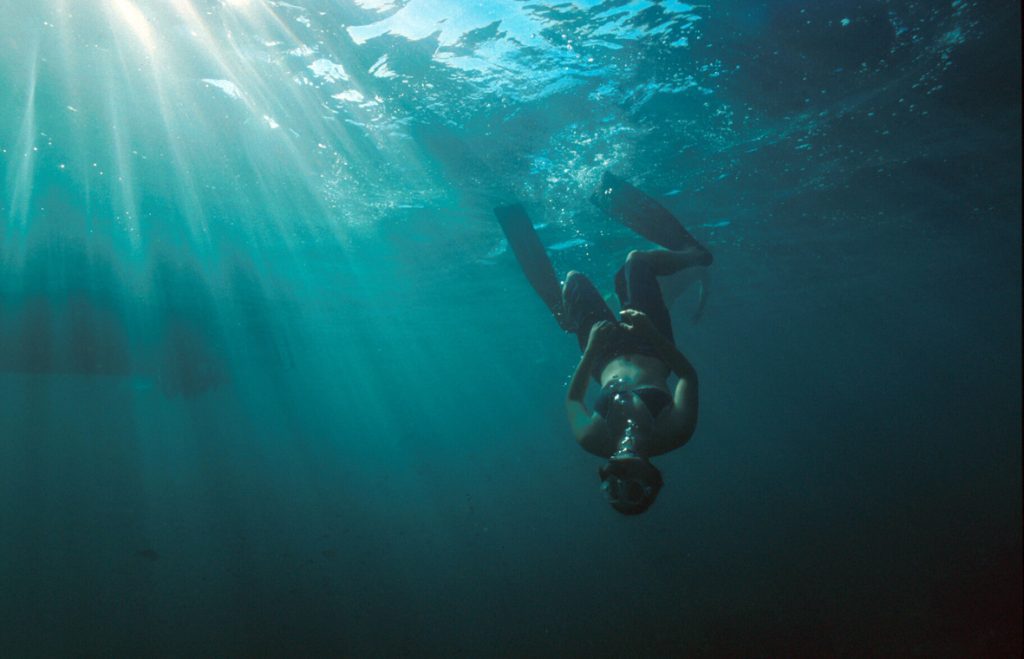
Also worth a mention is the photographic possibilities whilst snorkelling. Duck diving between dives can yield some interesting results, especially if the sun is projecting shafts of light around the boat. Around Coral Bay, expect impressive groups of inquisitive spangled emperors to gather under the dive boat. For those with enough time and a fisheye set-up, there’s some good half and half possibilities in Cape Range and Coral Bay. The lagoons of Cape Range are home to blue spotted rays, shovelnose rays and stingrays, whereas Coral Bay creates opportunities with combinations of paddling holidaymakers, fish and moored boats.
If there was a criticism of the diving, it’s the small number of known dive sites, particularly at Coral Bay. Divers visiting for any length of time might find themselves revisiting several dive sites, which may or may not be acceptable depending on the individual – for photographers it’s perhaps a good thing as it presents an opportunity for “re-shooting” a subject.
The weather is also a major factor in the choice of dive sites visited, which during our visit varied enormously both in terms of visibility and surface swells, so it’s not always possible to know the exact sites you’ll be diving until the skipper is able to assess the situation.
Wild, rugged, and largely unexplored, the thinly populated coastline of western Australia provides an enjoyable, varied and challenging destination for underwater photographers. For those wishing to dive and photograph new frontiers, there must be countless virgin dive sites awaiting discovery in what is a remote and vast area. I’m sure that the dive operators will gradually open up new sites over coming seasons.
We gave ourselves a fortnight to dive and photograph the mighty Ningaloo Reef. Was it enough? Of course it wasn’t!
Time of Visit: March/April 2005
Written in: May/June 2005