

Text by Jeremy Cuff/www.ja-universe.com
Photography by Jeremy & Amanda Cuff/www.ja-universe.com
Belize had been on our “to do” list for some time, almost making it to the top a couple of years back, but our recent trip came as a bit of a surprise, due to our planned Turks & Caicos Islands liveaboard being cancelled. Belize was offered to us an alternative, and a fine alternative it turned out to be…
On our descent through angry looking clouds towards Belize City, we could see large amounts of standing water in the rainforest clearings. There had been lots of rain in recent times. The squalls continued after our touchdown giving us the chance to watch a classic tropical downpour from the shelter of the airport bus stop.
Lots of rain is a double edged sword when it comes to diving. Rain causes run off from the rivers and streams into the sea, which in turn can badly affect the visibility. Nowhere was this more evident than when we travelled from the airport on the hotel minibus alongside the swollen Belize River. The weather was most certainly our “hot topic” as we mulled over whether or not it might affect our diving plans further out at Lighthouse and Turneffe Reefs, the areas of Belize’s best diving.
On the jetty just outside the Radisson Hotel, the Belize Aggressor (along with her sister vessel the Dancer) was saying farewell to guests, whilst busily re-stocking and cleaning up to be ready for our departure the following afternoon. Here, close to the mouth of the river, the visibility was horrific, so we asked about the conditions further out where we were headed. It would be fine we were assured, much to our relief.
There had actually been some nasty weather systems lurching around the Caribbean during the days leading up to our arrival, which we’d first picked up on a couple of days previously whilst on our outbound stopover in Miami. We were relieved to hear that the worst of a large tropical storm had largely missed Belize and was heading north, though the “side effects” were still unsettling the weather somewhat.
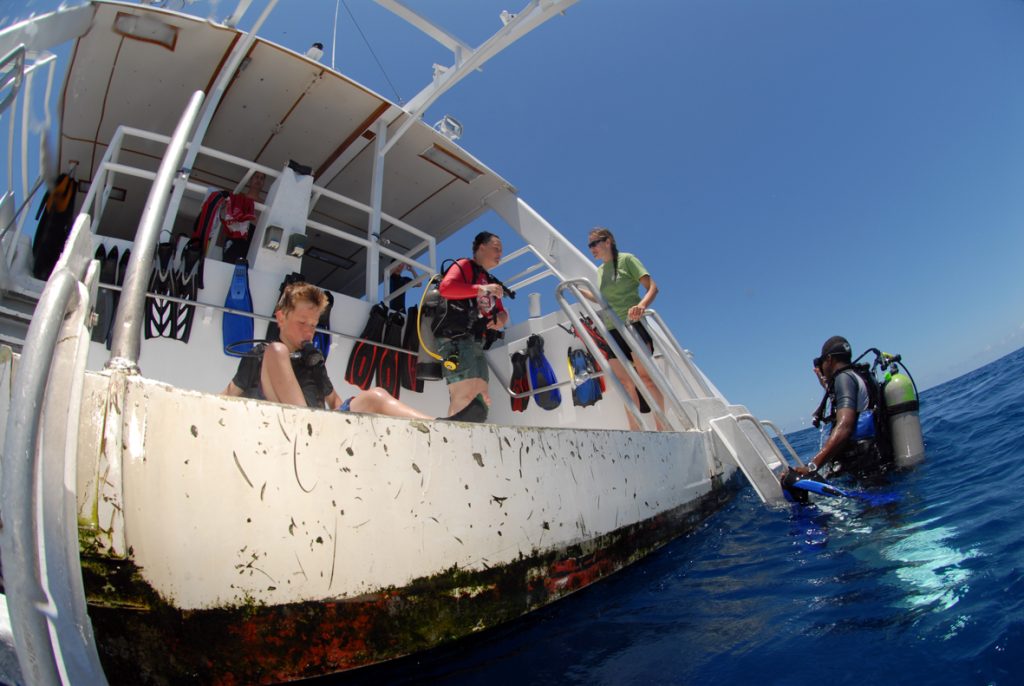
So, after a night onshore in Belize City at the conveniently located Radisson (don’t stay anywhere else if you’re liveaboard diving), we would board the Belize Aggressor to head out into slightly overcast and unsettled weather, though it would kindly improve as the week progressed. We considered ourselves fortunate – firstly, to be there at all after our Turks & Caicos cancellation, and secondly, that we’d avoided a potentially “trip cancelling” storm.
Though Belize is a small country, it actually boasts a lot of attractions for adventurous travellers such as pristine tracts of jungle and well preserved Mayan ruins. It also lays claim to a large barrier reef system, coming second only to Australia’s Great Barrier Reef in terms of size, a fact that many people find surprising.
Our first impressions of the diving, at the Long Caye Wall site was that it’s similar to the Cayman Islands, which made sense, as we weren’t actually that far from the Caymans as the crow flies. The visibility was “okay” but certainly not as fabulous as we’d experienced in the Caymans two years previously, where we’d lucked into near perfect conditions. Fortunately though, it seemed to improve along with the weather as the week progressed.
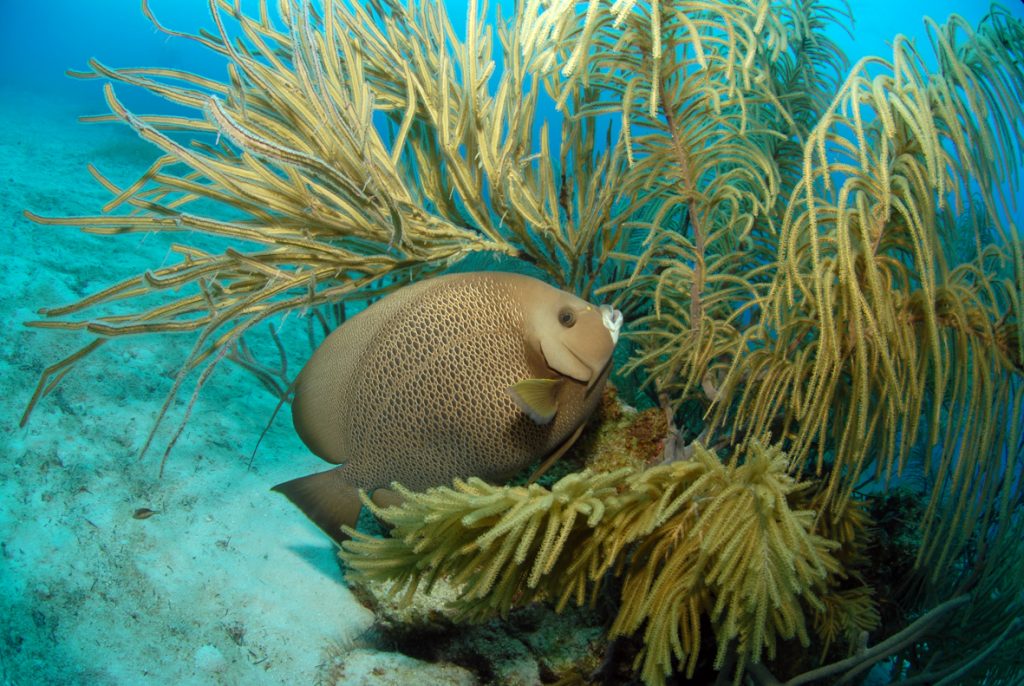
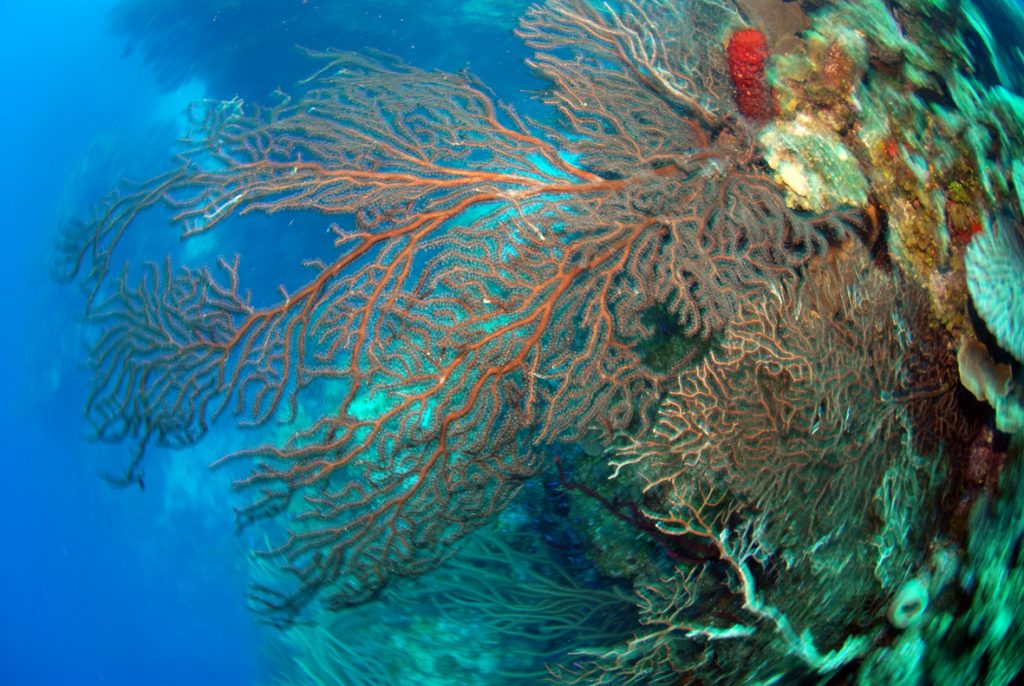
Most dive sites are combinations of spectacular walls, slopes and drop offs cut with swim throughs, fissures and overhangs that are adorned with sponges (including the gigantic barrel variety), plus a multitude of corals, gorgonians and other assorted reef growth. This would be our underwater backdrop for the week.
On the reef tops at some sites, such as Half Moon Caye Wall and Lighthouse Wall there’s a maze of overhangs, gulleys and ledges to explore, plus some interesting sandy expanses and sea grass beds which are home to garden eels, stingrays grubbing for molluscs, the occasional eagle ray, jawfish, pipefish and possibly seahorses, though they’re incredibly hard to spot, try as we might.
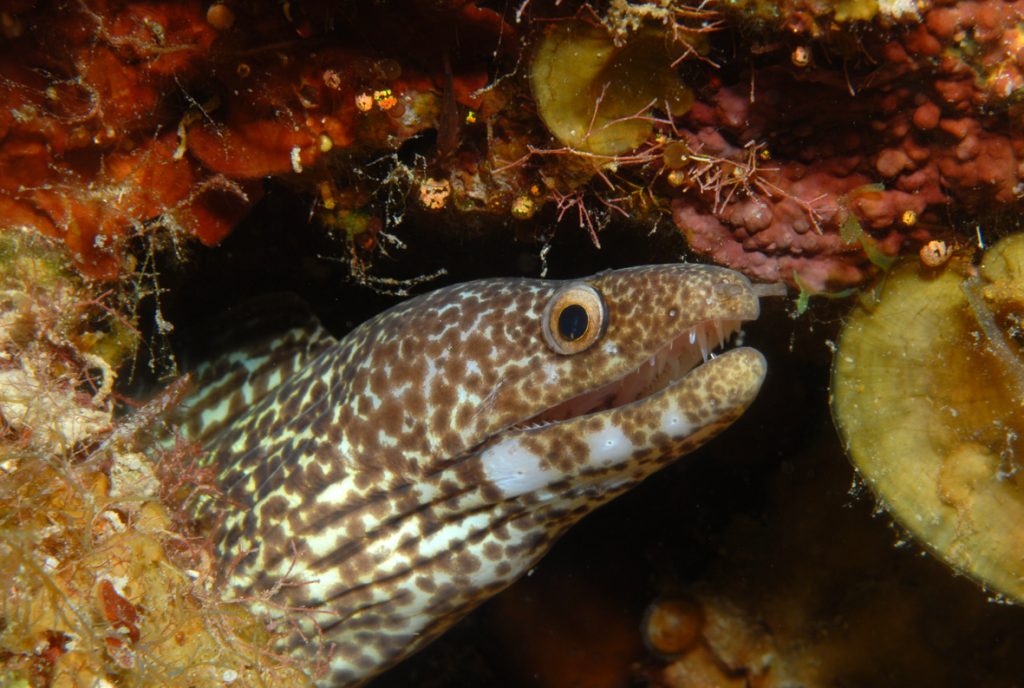
In the open water, especially along the reef edges, you can spot wary eagle rays along with reef sharks that were sometimes quite inquisitive, and there’s always a chance of turtles. Barracuda, tarpon, grouper and jacks can also be encountered with regularity, sometimes allowing a close approach from a patient diver. Fans of smaller things may also be rewarded with reef squid, octopus, flamingo tongues, moray eels (though some aren’t small!) and cleaner shrimp, sometimes in the act of cleaning an eel or a grouper.
I found Silver Caves to be a particularly interesting site, named after the silversides that frequent a cave in the reef, often numbering in their thousands. On the first of the two dives, I made a beeline to the cave, which positively brimmed silversides. There was a lot of activity going on, with tarpon and groupers everywhere, feeding on the bonanza. I immediately saw that it had great photographic potential.
On the first dive, things proved frustrating for the first twenty or thirty minutes as most of the other divers from the boat also went to check out the action, often kicking up sand in the cave entrance. Photographically, it was very difficult, so I decided to move away and wait until everyone had tired of the spectacle.
Once they’d all moved off along the wall, I spent some time having a look, checking out the cave and trying a few things, including working with my wife Amanda who models for me when required.
During the surface interval, I had a look at what I’d captured and decided to go back and spend the whole of the second dive around the cave. Though I had a couple of nice images from the first dive, what I really wanted to capture was the feeding tarpon surrounded by silversides in the cave.
There were always several tarpon in the area, all going in and out of the cave to seize a snack before coming back out into the open. However, I soon worked out that if I waited inside the cave, among the mass of silversides, the tarpon wouldn’t enter, so I needed a different approach.
With a change in tactics, I would wait outside the cave until a tarpon was “committed” to going inside, whereby I would follow it in. On each attempt, I couldn’t see the tarpon through the wall of fish, so I had to be ready for it to suddenly appear as the silversides parted. I also worked out that I needed to switch on my strobe’s pilot light so that I could see what was going on, and to prevent my auto focus “searching” in the gloom, and being unable to lock on to the subject.
With each tarpon encounter in the cave, I would probably get a chance for only one image in most instances, so it was a difficult and time consuming shot to capture. On some attempts, the tarpon would escape from the cave without me seeing it at all.
That said, it was worth the effort, as I did get a couple of images along the lines of what I was hoping for.
The Blue Hole is Belize’s signature dive, known the world over from the spectacular aerial shots that often adorn tourism and dive travel brochures. It was formed by the collapsed ceiling of a large underground cavern, resulting in the circular skylight that we see today.
Around the world, there’s several “blue holes” that can be dived, such as the ones in Dahab (Egypt) and Palau, but Belize’s version is reputedly the largest. It was visited by the intrepid Jacques Cousteau in the 1970’s, who brought this fascinating place to the public’s awareness and ensured its subsequent dive icon status.
Though liveaboards like the Belize Aggressor endeavour to include the site in each of their charters, it isn’t always possible to do the dive if the weather doesn’t allow, as it’s a tricky location for the boats to reach. We felt fortunate to have the opportunity after the unsettled weather at the start to the trip.
The dive itself involves an exciting freefall down the sheer wall into the black, to a depth of around 40-45 metres, so it’s most certainly a dive to be taken seriously, and where the briefing must be strictly adhered to. At around 35-40 metres, the first shelf of the original cavern begins, where large stalactites descend from the ceiling. Divers have just a few short minutes to explore this unique topography before heading back up the wall.
A single dive there doesn’t cut a photographer much slack, as you get to spend very little time at the most interesting depth. As well as carefully watching depths and times, you must very quickly decide what settings you’ll need in order to best capture the vistas, and also try to make visual sense of the scrum of divers in what is a tightly packed dive group, unlike the reef dives where buddy pairs can do their own thing. It wasn’t easy to get it right.
To be honest, I wondered if the Blue Hole might be a bit of an anti-climax after all the hype that surrounds it, but no, this was an enjoyable and unique dive. We would thoroughly recommend it to anyone looking for something different.
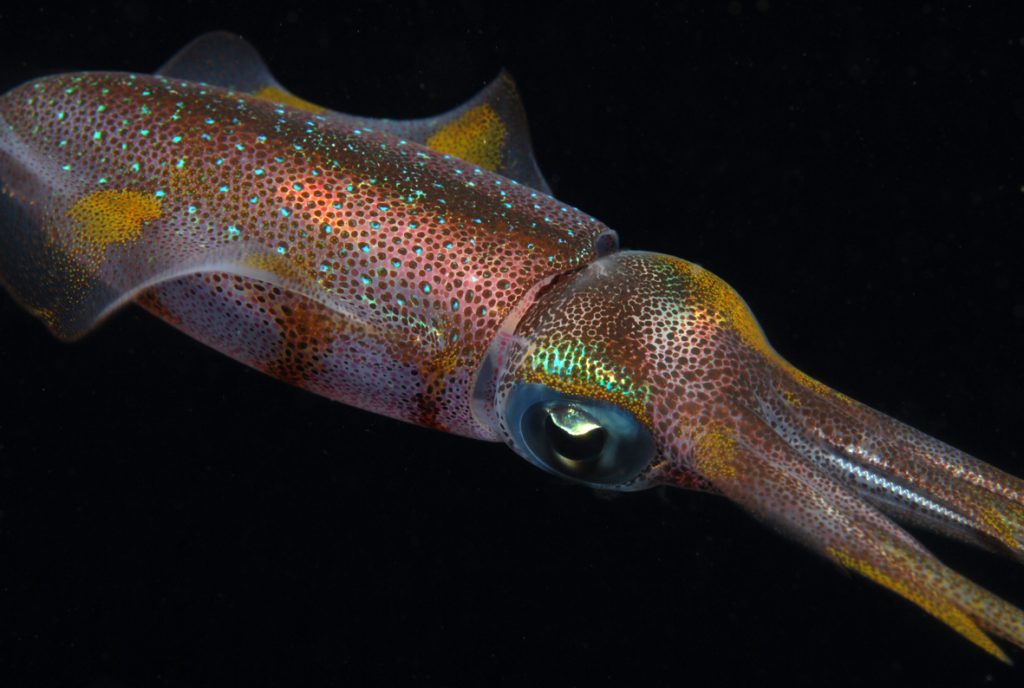
Night dives on Belize’s Reefs also turned out to be very productive. My friend Simon, who joined us with his wife Tonya and son Thomas, really (and I mean really) wanted to see an octopus, so we set off most evenings in search of his holy grail.
On our first night dive we found plenty including groups of squid, crabs and even a rare toadfish while increasingly bold tarpon, eyes orange in the strobe lights, cruised somewhat menacingly around us on the hunt for any unwary (or unlucky) fish revealed by our lights. But we hadn’t seen an octopus, even though other divers had.
Another night dive later in the week proved to be “the one”, as we eventually found an octopus. To Simon’s delight, this specimen wasn’t in a hurry to disappear into a hole, and instead treated us to an incredible display of colour change, contortion, that strange “slinky” movement unique to octopuses, and the bizarre “tenting” behaviour whilst we looked on.
At this stage, late into the dive, my strobe had started to “die” after I’d spent a lot of time photographing some squid earlier, exhausting its power supply. As a result, I wasn’t able to get any images of the “best bits” of the octopus display. Luckily, Megan (one of the crew) came to the rescue and filmed the performance as my strobe flashed on and off in the background. She later put some music to the footage and posted it on her website and You Tube!
Like our aforementioned Cayman trip, this charter was also one of the Aggressor Fleet’s “family weeks”, unique in that children of six years or older are welcomed onboard. The family week itinerary is based on the normal “grown ups” trip, but with a few subtle tweaks to make it more “child friendly” both onboard and in the water.
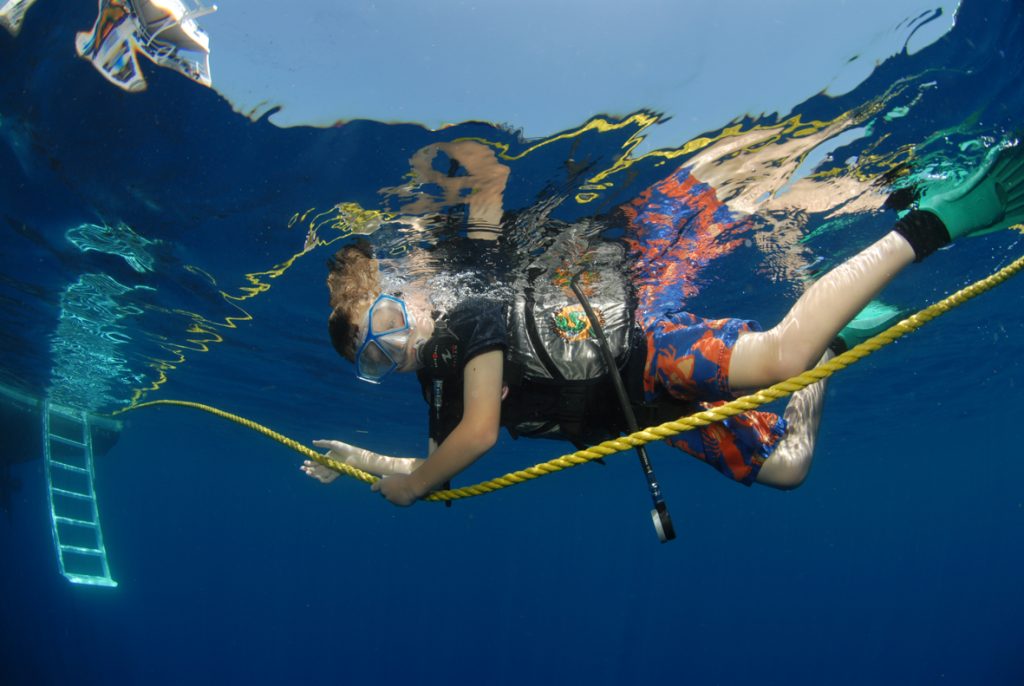
For kids, it’s a great step towards becoming a diver. We watched Zac practice his giant stride entry and dive with a SASY (Supplied Air Snorkelling for Youth) setup which is a self contained regulator and tank, but for surface swimming only. With this equipment, a child can thus breathe through a regulator like a diver, check air and view the reefs from above, but without the snorkel filling with water.
In Belize, he was in the company of three other children of the same age, and we can honestly say that we’ve rarely seen children so happy and “in their element” – free of toy shops, shopping malls and TV – just kids being kids, having fun together, always happy and always smiling – it was a joy to behold.
A few words should also be said about Half Moon Caye, which the Belize Aggressor passengers get a chance visit for a barbecue and nature walk about half way through the week. It’s a fascinating island, and forms part of the wider World Heritage Area that includes Belize’s barrier reef system. The island is home to lizards, iguanas, hermit crabs and colonies of nesting booby birds and frigate birds, which can be observed from a canopy level viewing platform.
Overall, we thoroughly enjoyed the best of Belize’s diving. Our special thanks must go the Aggressor Fleet team, who at short notice were able to offer us a great alternative to our original plans. It all turned out well in the end, and we came away with some very fond memories.