
Text by Jeremy Cuff/www.ja-universe.com
Photography by Jeremy & Amanda Cuff/www.ja-universe.com
Two dives on one of Corsica’s best known dive attractions, the American B17 Bomber that crash landed at Calvi in 1944…
In WW II, the Mediterranean was a far cry from the idyllic holiday destination that much of it has become today. Back then, it was one of the front lines in the war as both sides fought for supremacy of the entire region – strategically important for its access to ports, islands, mainland Europe, North Africa and the Atlantic.
As with much of Europe and North Africa, Corsica suffered its fair share of war’s grim realities. As the first part of France to be freed from German tyranny, the island became a useful staging post for the allied effort in liberating the remainder of occupied Europe.
The final flight of Calvi’s B17 (Serial Number 4231044) began on Valentines Day 1944 from the US Air Base at Foggia in Italy. The crew, members of the 340th Bomb Squadron, were assigned to the aircraft for a mission to Verona in Italy, to bomb the railway marshalling yards used by the Germans. The mission consisted of ten planes flying in formation although three returned to base prior to Verona being reached.
Close to Verona, with B17 4231044 having commenced its bombing run, the crew were ready for the target to come within range when a pair of German Me 109 fighters intercepted. An exchange of fire ensued with the consequence of the tail guns becoming inoperable.
The remaining bombers in the 340th Squadron decided to abort the bombing run resulting in B17 4231044 running out of formation and lacking the important firepower cover of the other planes. The B17 began being hit from behind, with the tail gunner being fatally wounded.
The danger of situation forced the crew’s decision to jettison the bombs whilst fire was exchanged with the Me 109 assailants, one exploding. Shortly after, a pair of friendly P47 Thunderbolts arrived at the scene to intercept the German fighters resulting in the remaining Me 109 retreating to safety and vanishing into the sky. The encounter was over but the damage had been done.
It had been a fatal encounter. The tail gunner was dying, the radio operator and left waist gunner had been killed, the right waist gunner had been injured and the B17 was badly damaged with two engines gone and a third one not at full power. The crew reckoned on enough altitude to go for Calvi and whilst mayday messages were sent out, they nursed the stricken bomber towards the island of Corsica.
The surviving crew were fortunate in that the B17 enjoyed good gliding characteristics but it wasn’t enough to allow a landing at Calvi’s airfield. The close proximity of the mountains and the shortness of the runway put paid to that idea.
There was only one option – to ditch the plane in the sea. Seven crewmembers survived the ordeal.
Though the whereabouts of the B17 had been known since the 1960’s thanks to the activity of divers, the 50th anniversary of the war brought the story of the B17 back into the public consciousness. On the 3rd October 1995, American B17 crewmember Armand Sedgeley returned to Calvi for a ceremony honouring the entire crew. It was attended by the Mayor of Calvi, Ange Santini and the Prefect of Calvi, Paul Laville. Interestingly, scuba divers also played a part in the ceremony by taking a plaque to the sunken bomber.
To add even greater significance, then US President Bill Clinton sent a message of goodwill to the participants on 18th September 1995. His letter said…
Greetings to all those gathered on Corsica to dedicate a memorial honouring the crew of the Flying Fortress that crashed in the sea near Calvi in 1944.
As the world observes the fiftieth anniversary of the end of World War II, we pay tribute to the thousands of men and women who rose to defend the cause of freedom. We owe our liberties to the courage and determination of people who, like you, were willing to risk their lives for future generations, and this occasion is a solemn reminder of all those who paid the ultimate price.
I extend warm thanks to our friends in France for setting aside a special time and place to honour the bomber’s crew. By dedicating this memorial, you ensure that future generations will know the history of their service and sacrifice.
Best Wishes to all for a memorable ceremony
Bill Clinton
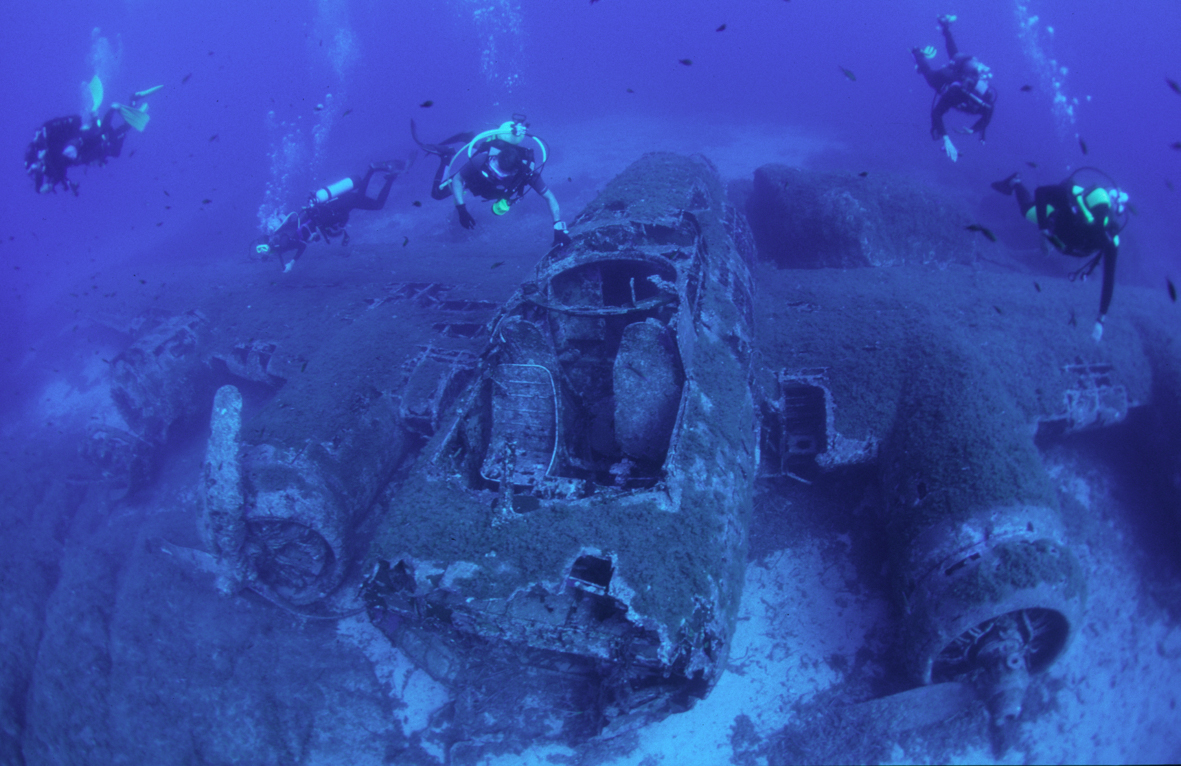
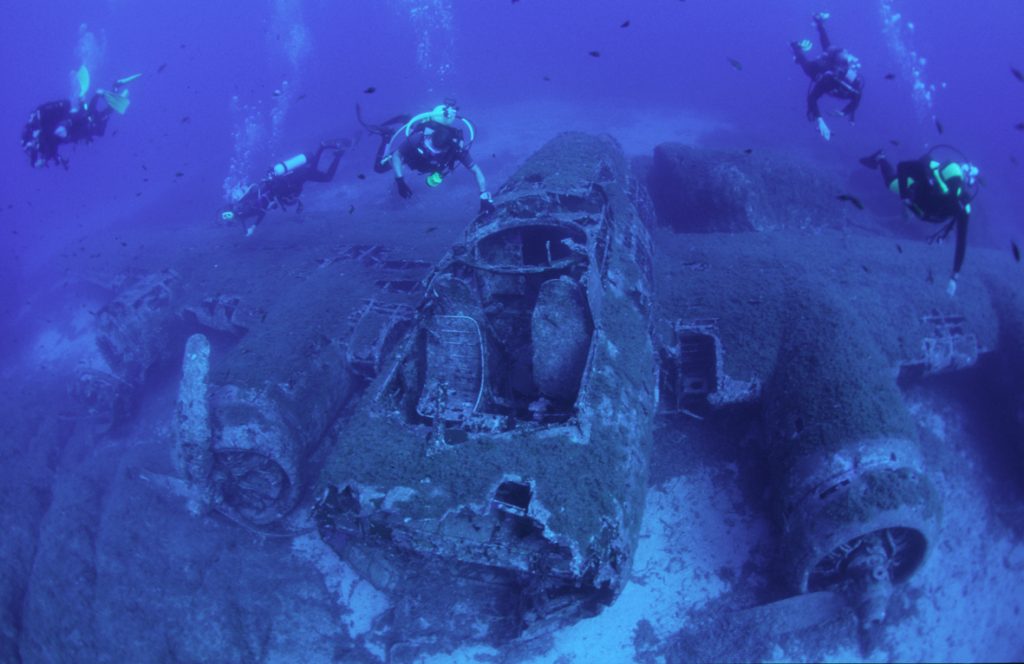
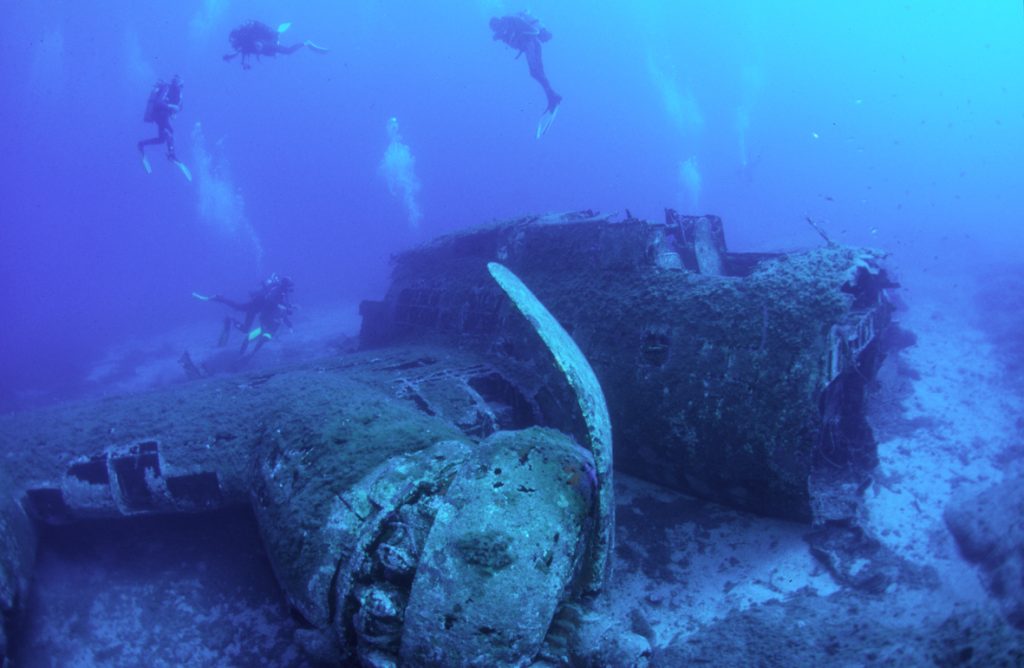
The B17’s final resting place is in around 30 metres of water, a short distance from the Citadel and less than 5 minutes boat ride from the harbour. It lies upright and mainly intact (with the exception of the nose and tail sections) on sand and rubble at the base of a rocky slope.
The Bay of Calvi is generally sheltered from the worst of the weather and the dive itself is relatively easy – strong current is rare in this area although some swell may be encountered at the surface, depending on the wind direction.
The descent to the bomber begins in the shallower areas of the rocky slope where divers gather before moving down towards the B17. The slopes here are relatively barren compared to other dive sites around Calvi though fish and invertebrate life can be found on and around the B17. On our dives, we spotted a few tuna, wrasse, corals and nudibranchs.
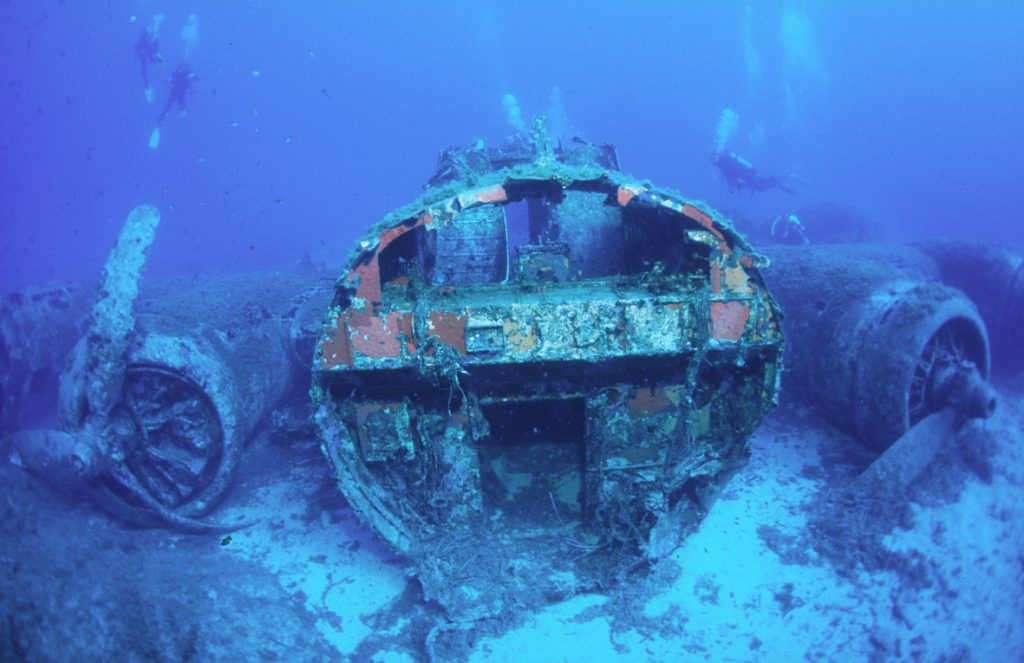
The entire aeroplane can be explored in one dive, although a second dive is a good idea if there is enough time. The intact cockpit is well worth investigation and acts as the focal point for divers. The pilot’s seat and the controls of the B17 can still be seen here. The missing nose section of the plane allows divers the opportunity to study the internal structure of the B17 immediately below the cockpit. The missing tail section allows similar views from behind the cockpit.
The four engines are also quite well preserved with the impressive propellers still in situ, providing an insight into the power required to make the bomber and its deadly cargo airborne.
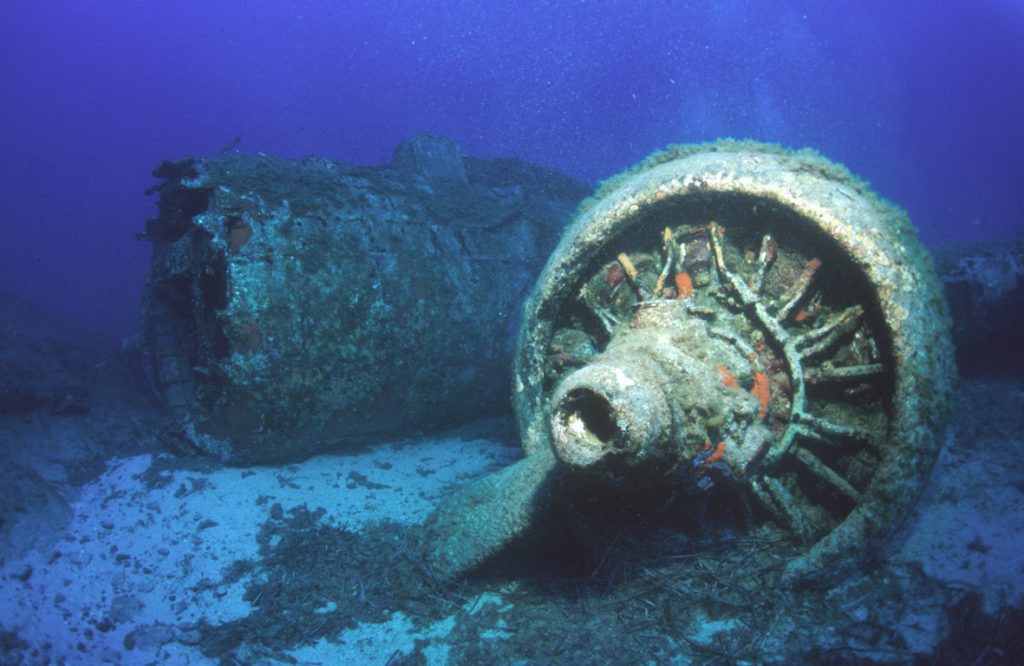
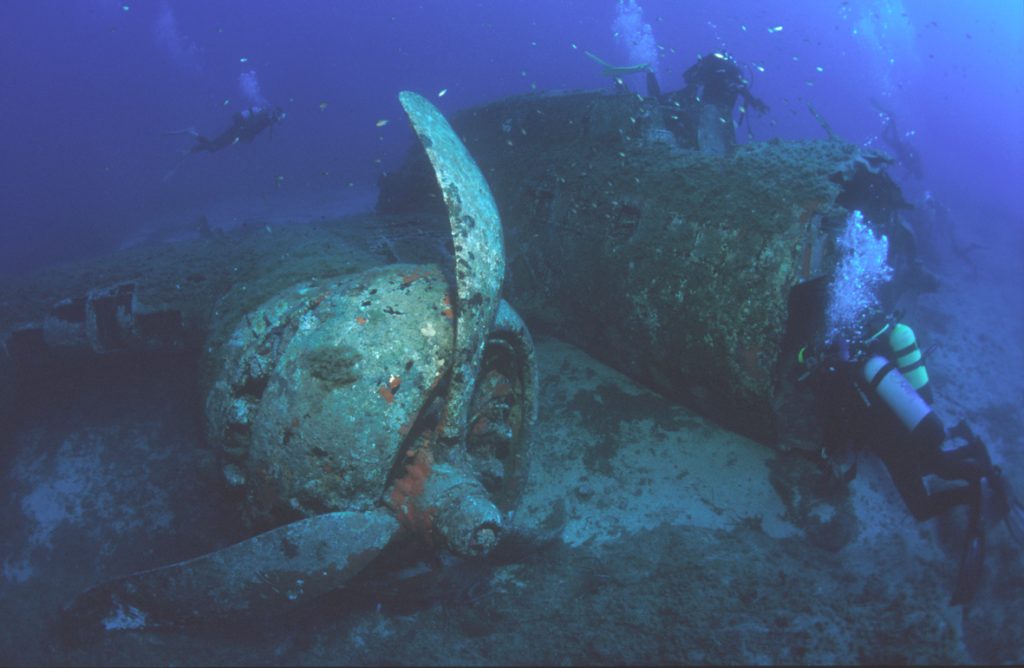
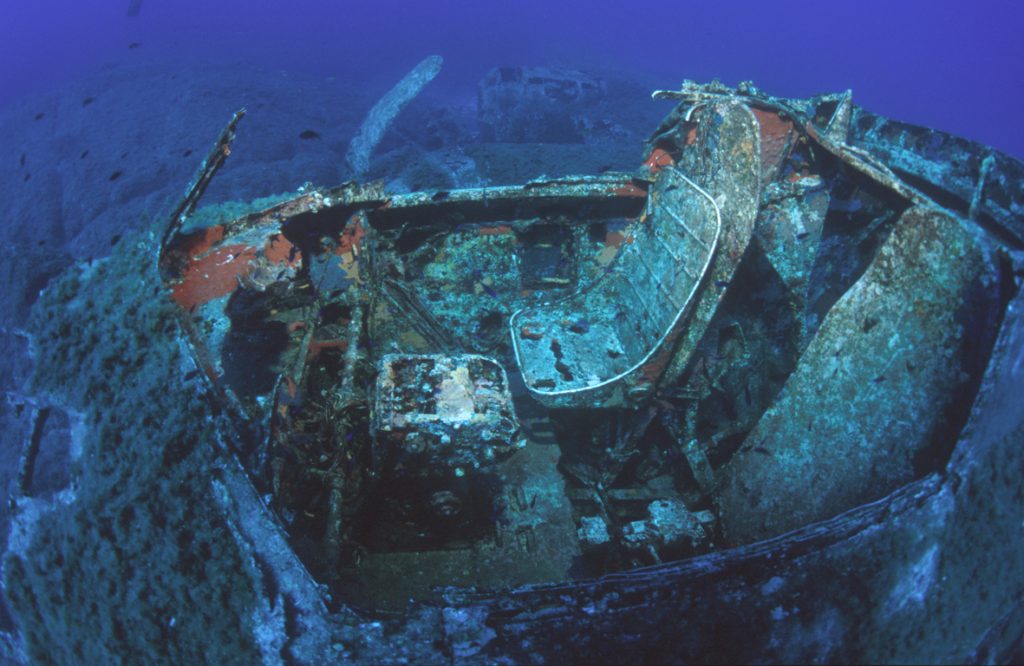
The visibility around Calvi is generally quite good, affording divers good overall views of the bomber, which makes for a very photogenic and a dynamic subject for underwater photographers. Even novice divers are sometimes taken to view the wreck from the 18-metre mark from where it can be easily discerned.
Diving is popular in Corsica and at Calvi there are several dive centres to choose from, all of whom visit the B17. We chose the Club de Plongee Castille which is located on a boat, the Recteur Dubuisson, in Calvi’s picturesque harbour. The dives themselves are not conducted from the dive centre boat, but from a pair of smaller launches that are moored alongside. The centre operates regular visits to the bomber and employ multi-lingual staff and instructors – ideal for the regular influx of international dive visitors.
Diving around Calvi is not confined to visiting the B17 – sites such as La Revellata and La Bibliotheque offer some of the best diving available in the Mediterranean with a combination of interesting underwater topography and prolific sea life – morays, groupers, scorpionfish, gorgonians and anemones can often be found, sometimes in great abundance.
Those wishing to dive Corsica in a wider sense will find much to wet the appetite. Most of the larger coastal towns have at least one dive centre and the possibilities for extended dive trips are extensive, although the dive centres tend to wind down their operations to a skeleton staff over the winter months. Of the many great diving experiences on offer in Corsica, the B17 of Calvi offers an exciting and historically poignant introduction.