
Text by Jeremy Cuff/www.ja-universe.com
Photography by Jeremy & Amanda Cuff/www.ja-universe.com
Imagine a place where the entire hub of government, administrative functions, infrastructure, and ports of entry and exit have been destroyed. I suppose, it’s somewhat akin to a war zone. Whether you can or can’t imagine it, that’s what happened to the island of Montserrat thanks to the Soufriere Hills volcano. Today, Montserrat is recovering from its’ ordeal, and makes for a very interesting and offbeat place to visit. The are many great experiences possible there, including diving…
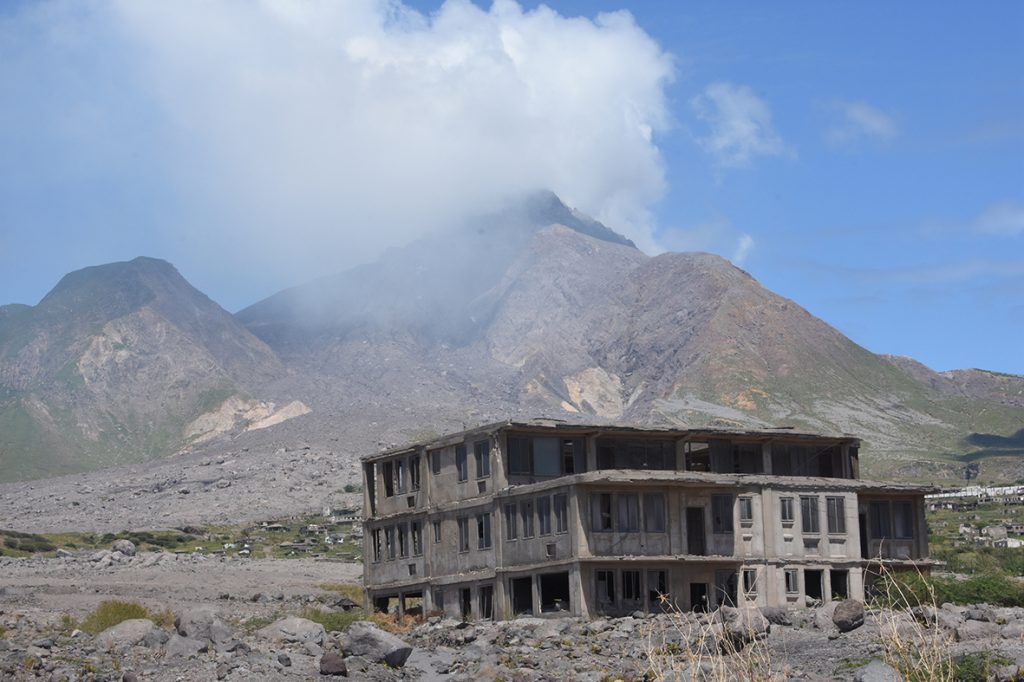
The island of Montserrat is located in the Caribbean and is part of the group known as the Leeward Islands (part of the Lesser Antilles to add further complexity). Beginning in 1995, the devasting eruption of the Soufriere Hills volcano changed things forever, destroying the capital city of Plymouth, the airport, the port, homes and livelihoods. It forced thousands to evacuate the island, not to return.
The volcano isn’t erupting currently, but it still sits within an exclusion zone and is closely monitored by the Montserrat Volcano Observatory. As a result, Montserrat is a very interesting “off the grid” kind of place to visit, most easily reached by travelling via the nearby “hub island” of Antigua.
I talk about my “to do list” quite a bit in my features, and Montserrat was no different. It had been on there for some time, but as with all these things you want to do, it has to bubble up to the top of the list in order to become a reality. The time had come.
It took a bit of research to work out how best to do it, but with the wonders of the worldwide web, we soon built a picture of the options. There are regular flights from the UK to Antigua, so that was straightforward. For accommodation, we chose a self-catering house called Gingerbread Hill; I decided we had to stay there from the minute I finished looking at their website, so we got in touch and booked off our dates.
I’d also been corresponding with Andrew from Scuba Montserrat who gave us some useful information about the diving. The biggest palaver was booking the flight across to Montserrat from Antigua as options are limited. We were also concerned about the weight and amount of our luggage (including, of course, our dive kit and camera gear) but in the end nobody challenged it, it was crammed in, the flight ran and it all worked out. There is an alternative of a foot passenger ferry that regularly shuttles between Antigua and Montserrat; it’s known as the “vomit comet”.
We chose the Easter holiday period in which go there, which was considered by Andrew to be as good a time as any, and outside of the hurricane season (July to November/December). It would also mean “topping and tailing” the trip with stays on Antigua which was fine by us; a night on the way out and two on the way back. We chose the small, independently owned Anchorage Inn, very “old style Caribbean” in its’ vibe which we quite enjoyed and worlds apart from the international resort hotels that have proliferated there.
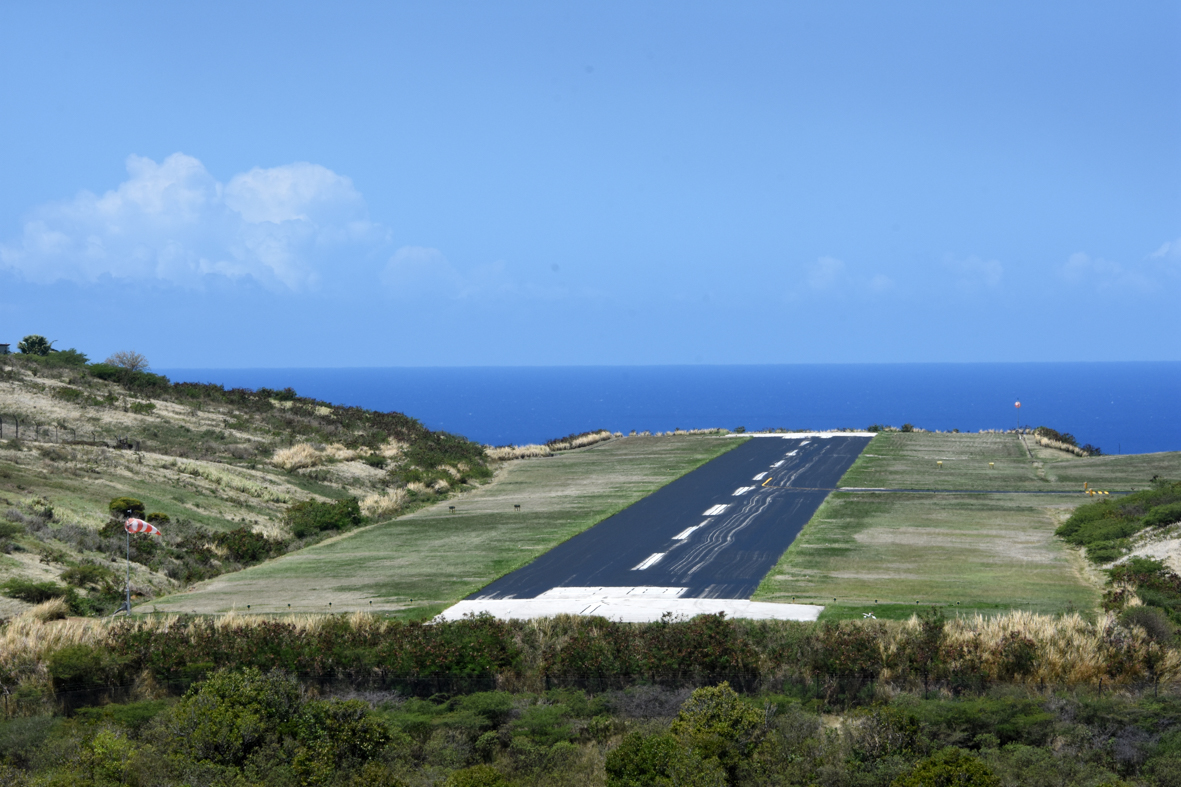
You know you’re going “off the grid” when the plane that takes you there has capacity for 6 passengers (5 were on it including ourselves). As we lifted off out of Antigua over the water, turning towards Montserrat, we could clearly see some rays cruising the shallows beneath us. It was a fabulously clear day as we headed away from Antigua on the 20-minute flight to Montserrat, to a very different world. As we approached, the still smouldering Soufriere Hills dominated our attention to the south of the island.
At the tiny airport, David was waiting to collect us, who with his wife Clover own and run Gingerbread Hill and the popular Hilltop Coffee House where memorabilia from the now abandoned Air Studios has been curated. David was also significantly involved in documenting the Soufriere Hills eruption. It was a great place to stay, and hard to leave when our departure day came around. Our accommodation was on the hillside at “canopy level” which allowed us to watch the local birdlife at close quarters such as hummingbirds, bananaquits and tremblers, and below we could spot iguanas and an introduced species of mammal, the aguti. Our balcony also afforded magical views over the Caribbean towards the remnant volcanic islet of Redonda, with Nevis in the distance beyond.
We found that most mornings we got up very early, mostly owing to early nights (10 ‘o’ clock was a rarity on this trip), though we were assisted by the dawn bleatings of some goats that roamed the grounds; we called it “goat ‘o’ clock”. And if you still weren’t relaxed enough, there was also a hammock that David and Clover had installed nearby. I would sometimes retreat to it with my headphones.
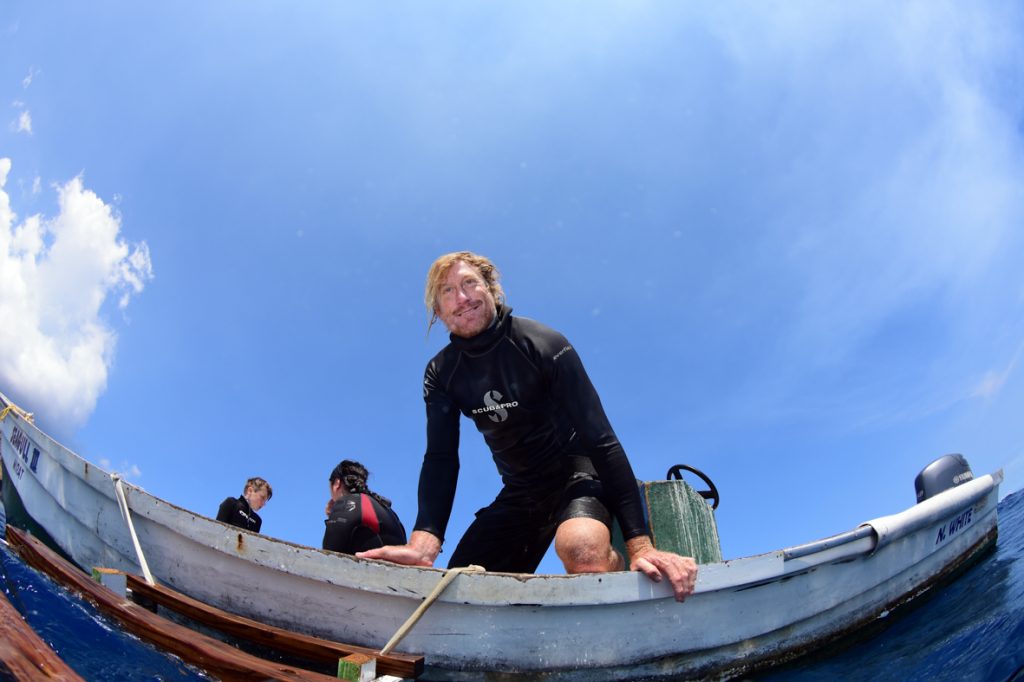
We found it very useful to hire a car to get around (a very old Toyota RAV4) which Clover arranged on our behalf, and although Andrew from Scuba Montserrat lived and had his tiny dive centre close by (underneath the JavaLava Art Café coffee shop), it was very handy for transporting our dive gear to and from the “new” port at Little Bay (some distance away from Gingerbread Hill) from where he would take us diving. It also gave us our independence to explore when we weren’t diving.
Like most places, the diving conditions and visibility in Montserrat can vary considerably depending on the wind direction and prevailing conditions. We discussed this with Andrew early on, who kept a close eye on the weather forecast. Later in our stay, the wind direction was forecast to change making some dives more difficult (or impossible) to do. We would make the most of this “optimum weather window”.
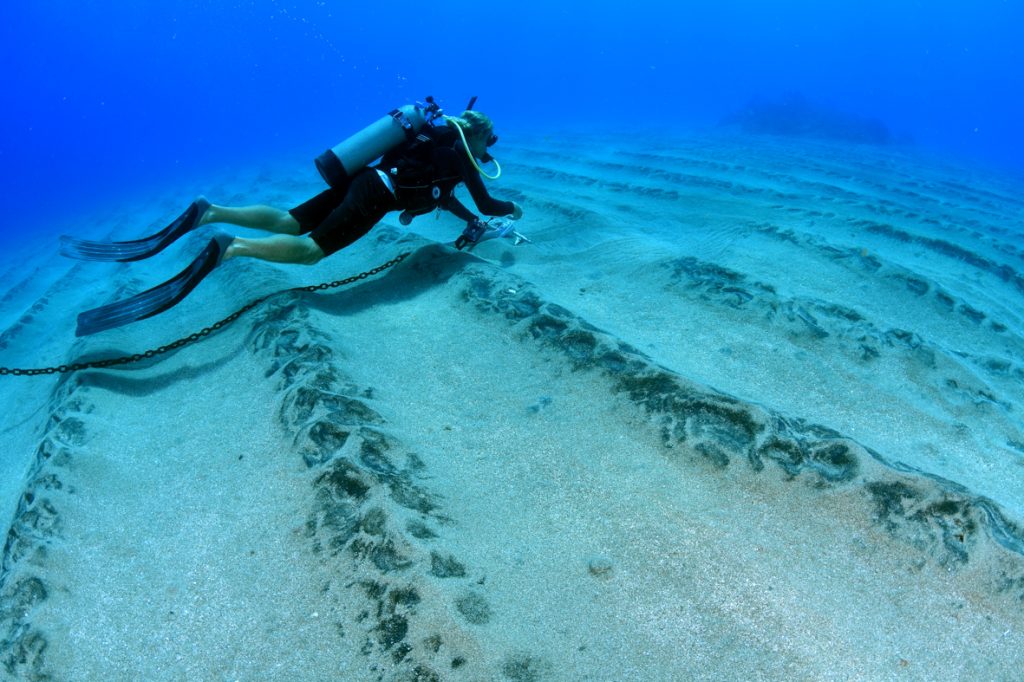
Scuba Montserrat is run by Andrew and Emmy, a “couple team” who have lived on Montserrat for a number of years, making them almost certainly the most knowledgeable divers on the island. Emmy was away visiting family during our visit, so we dived exclusively with Andrew. We enjoyed his enthusiasm, laid back style and dry sense of humour. On a more serious side, they also developed a locally based marine conservation group which built and designed an artificial reef and works to protect marine habitat called the Montserrat Reef Project. Also, they are both listed as Reef Ball Foundation Coral Experts.
Though a heavy cold frustratingly curtailed my diving activities from what I had hoped to do (including a night dive), it was still enough to get a good impression of Montserrat’s underwater realm.
We explored sandy expanses, sea grass beds, rubble and flat reef expanses at sites such as Sea Studios where jawfish (some with eggs) peered from the safety of their holes, and out on the sand, we were able to get close to a surprisingly approachable species of stingray on numerous occasions.
Other sites such as Little Redonda and the bizarrely named Donkey Paradise on the north of the island are only possible when the conditions are calm, so we took advantage. I wondered about the Donkey Paradise name; was it named after a proliferation of the delightfully named Donkey Dung Sea Cucumber perhaps? Well no, according to Andrew it was supposedly named after a braying donkey on the clifftop (or something like that!). Who knows? It’s funny and infinitely better than unoriginally named dive sites such as “Coral Gardens” or “Aquarium”.
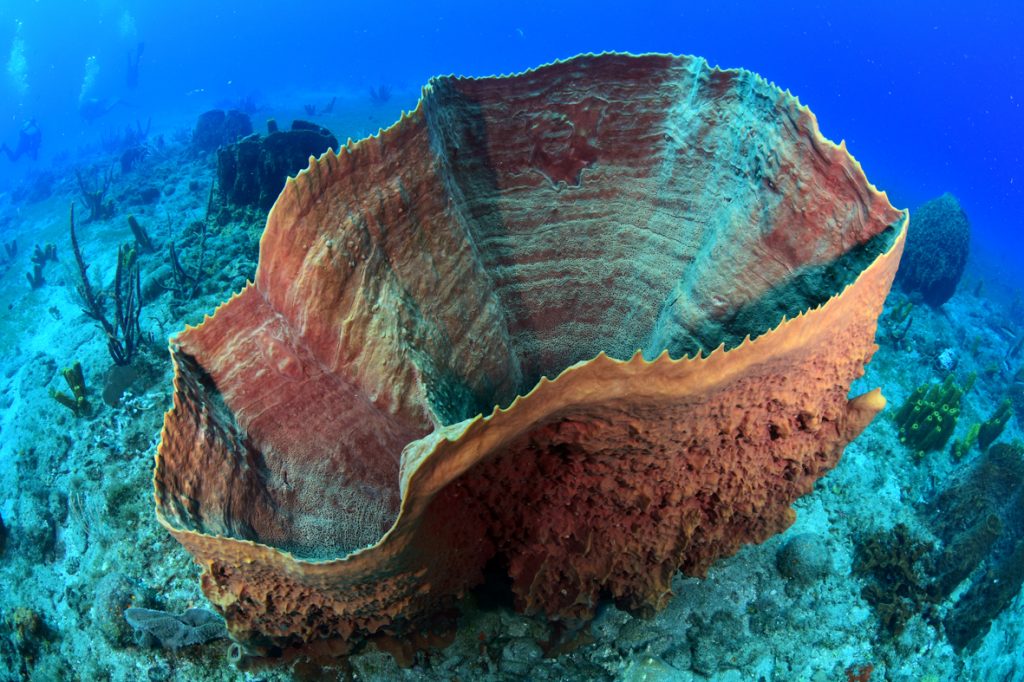
On these sites around the northern tip, we found the most interesting topography with overhangs, ledges and cuts in the reef adorned with assorted reef growth including wire corals and large barrel sponges. Underneath some of the ledges, it’s possible to find lobsters and nurse sharks, both of which we spotted but were unable to photograph due to their inaccessibility.
Other sites such as Rainbow’s End and Sunshine Boulders revealed a variety of inhabitants such as flamingo tongues, pufferfish, secretary blennies, arrow crabs, hermit crabs, morays, garden eels and lionfish. No matter how far off the grid Montserrat might be in human terms, it’s certainly no barrier to the lionfish as they complete their relentless invasion of the Caribbean. Though we didn’t see any, seahorses and snake eels are also present and for the bigger stuff you could expect jacks and turtles and perhaps the odd surprise. Andrew had reported a humpback whale in the area recently, though it wasn’t seen on a dive.
We found little or no current on our dives, which made them all easy and enjoyable, and there’s at least 50 sites that are theoretically possible to visit depending on the conditions and the experience levels of the divers. The deepest dive we recorded was 21 metres.
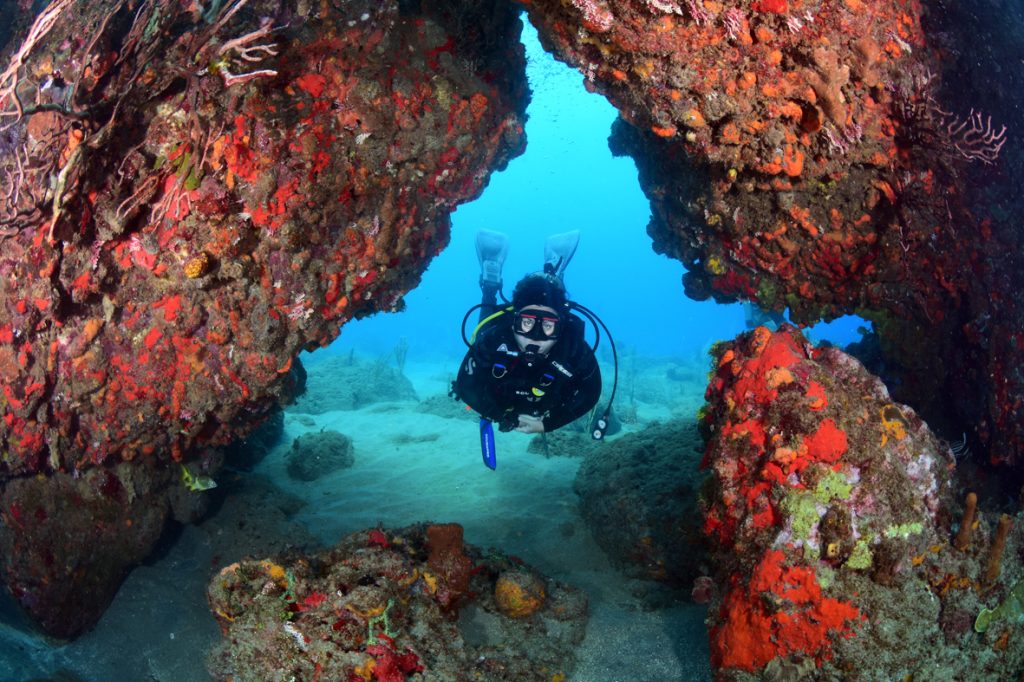
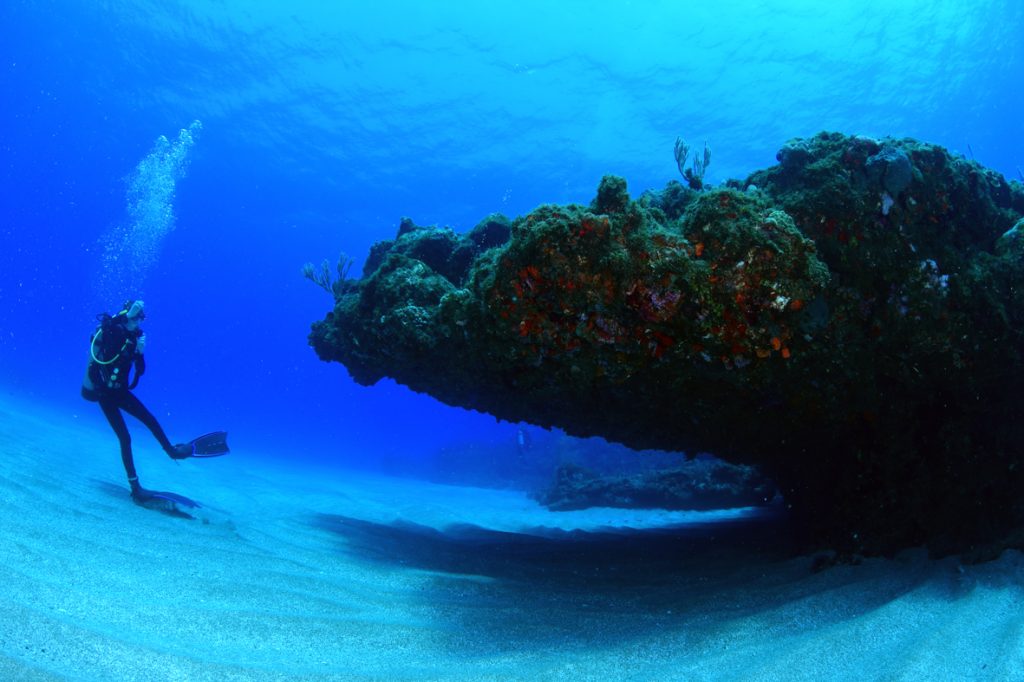
One site that is very dependent on calm water is the Bat Cave, offering divers a “most unique” experience. It’s located on the north west side of the island fairly close to Little Bay. The dive involves a pleasant reef dive fairly close to the cliff, a roving safety stop at 5 metres followed by swim up a channel at shallow depth and into a cave. Once inside, you can pop up to the surface and see a large roost of bats hanging from the “ceiling” with some flying around. As you’re directly beneath them, unpleasant things can rain down on you (so to speak!). Our son Zac had a quick look, but didn’t hang around which I ribbed him about later. I remembered the Steve Irwin quote “I love bats, but not when you’re underneath them”. There can’t be many dive sites that promise sightings of bats!
We allowed ten days on Montserrat itself (not including our Antigua stopovers), which was a adequate amount of time, although more would always be good. As well as diving, there’s plenty of other things to keep interested travellers busy that are worthy of mention.
It’s possible to trek rainforest trails, perhaps with island legend and nature guide to royalty James “Scriber” Daley who was once scalded by his parents because they didn’t understand his love of the forest and outdoors. With “Scriber” you’re virtually guaranteed to see the endemic Montserrat Oriole which is the islands’ national bird.
You can also enjoy largely deserted beaches, and hangout in great places like Hank’s Beach Bar where you can while away an afternoon watching pelicans hunting while the sun goes down. Then there’s the abandoned Air Studios (strictly speaking off limits, but we had a sneaky visit), once used by bands and artists such as the Police, UFO, Jimmy Buffet, Black Sabbath, Stevie Wonder, the Rolling Stones and Rush.
But no visit to Montserrat can fail to include aspects of the Soufriere Hills eruption. It’s possible to visit the Montserrat Volcano Observatory where volcanologists study and carefully monitor the brooding menace of the volcano. Best of all, perhaps, is that it’s possible to take a tour into the ruined city of Plymouth, a modern-day Pompeii if ever there was one.
On Montserrat, you could say that the current period of time is the “calm after the storm” or perhaps more accurately “an interval of calm” before the next storm, as “the Soufriere” will certainly erupt again.
We found Montserrat very rewarding and were glad that we made it happen. If you like “off the grid”, it’s most certainly worth a visit.