
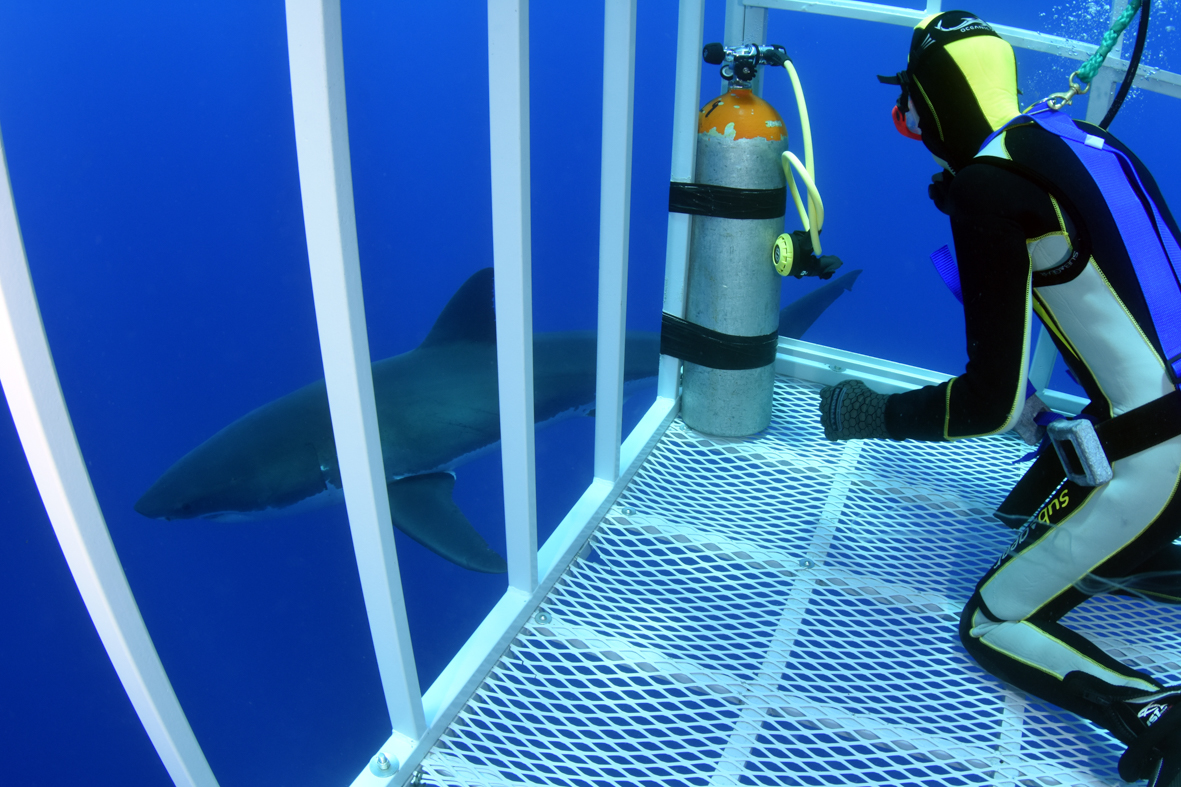
Location: Guadalupe Island, Mexico’s Pacific Side
Purpose of Visit: Close Encounters with Great White Sharks
Text by Jeremy Cuff/www.ja-universe.com
Photography by Jeremy & Amanda Cuff/www.ja-universe.com
It’s been one of my life’s ambitions to see a Great White Shark (in the right circumstances, of course). Previously, I had to abort a long-awaited trip to Mexico’s Guadalupe Island back in 2008 thanks to an unplanned hospital visit messing with my plans. It took a good few years for it to return to the top of my “to do” list, but it was certainly worth the wait when it did…
A Great White Shark can conjure up many things in a person’s mind, depending on their disposition; fear, awe, terror, loathing. reverence, mystery, respect, perfection, power, savagery, intelligence, resourcefulness, cunning, and even beauty. Rarely will anyone be indifferent to them.
Contrary to some opinion that (sadly) still persists, stoked by tabloid sensationalism linked back to a certain film from the 1970’s, the Great White Shark is definitely not an indiscriminate, hellbent, mindless killer. In fact, it couldn’t be further from the reality. Words and portrayals such as intelligence, wariness, shyness, and an ability to think and consider much more accurately describe them, and there’s still a huge amount that we don’t know about their lives. A trip to Guadalupe will begin to show you that.
Though Great Whites are global in their distribution, only a small number of destinations offer reliable sightings and the necessary infrastructure to observe them. In addition to Guadalupe, only South Africa and South Australia can offer comparable experiences, which like Guadalupe is usually conducted via dedicated trips. Other Great White sightings and encounters tend to be more random. Recently for example, a Great White was positively identified from a location off Majorca in the Mediterranean, but you’d never go there for a “guaranteed encounter”.
Guadalupe itself is a remote and isolated island of volcanic origin located off Mexico’s west coast, some 165 miles west of Ensenada, the usual departure point. It was designated as a Biosphere Reserve in 2005 due to the uniqueness of the habitats both above and below the waves. It is known for the seasonal gatherings of elephant seals and sealions, which are believed to be the reason for the annual Great White Shark visitations. The “shark season” is between August and October.
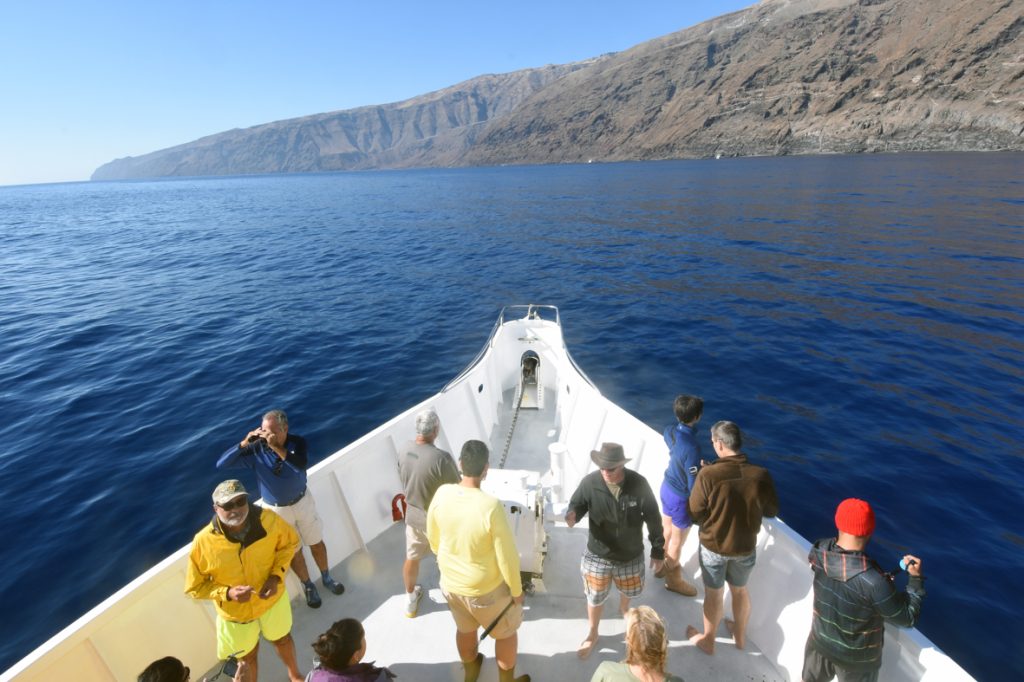
The reliability of the encounters and the number of sharks present also attracts teams of scientists to the island, as efforts are made to understand the lives of these sharks with a view to conserving them. Photographers and videographers can also assist the scientific studies by contributing images and footage to aid the ID of individual sharks, many of which are known to have visited the island previously. Recently, tagged sharks from Guadalupe have been discovered to move great distances into areas of the Pacific Ocean not previously thought to be very productive, now known as the “White Shark Café”. You could therefore find yourself sharing the area with a research vessel, perhaps with a TV film crew in tow.
Guadalupe is one of the best places on the planet to observe these incredible apex predators up close in gin clear water, often under sunny skies, making for a fabulous blue water backdrop. You could even say that it’s the place for the “guaranteed encounter” if such a thing exists in diving. Due to the remote geography, the only way of visiting the area is by a liveaboard, such as the Solmar V, a boat I’d travelled on previously in 2009 for an excellent Socorro Islands trip. I remembered the phrase “the ocean is the ocean” being popular on the Solmar. Roughly translated, it means “you never know what might show up, or decide not to show up. The ocean isn’t entirely predictable.”
For us, this was a “boy’s trip”, in that I did it with our son Zac (aged 13 at the time). After confirming that they’ll take children onboard, we discussed the trip with him, showed him the website, looked at some video clips, and talked it through. He felt unsure about the idea of the “deep cage”, but was up for it. We made the booking.
Unless you’re coming from within Mexico independently, the usual and preferred way to get to the departure point of Ensenada is to travel to San Diego in southern California, from where the Solmar V arranges a transfer coach across the USA/Mexico border at Tijuana and down to Ensenada. It’s an interesting journey, with some great coastal vistas en route. Out there in the ocean are the Great Whites I mused, as we stopped at a scenic look out.
Nestled at a dock amongst Ensenada’s port area was the Solmar V. Zac was thrilled at the sight of the shark cages stacked on the boat, ready for the voyage and the action to follow. For me, it was exciting too, and nice to see some familiar faces from my Socorro trip; Michael (dive instructor), the captain and some of the kitchen staff.
It’s a long and sometimes “seasicky” journey of 18 – 20 hours out to Guadalupe. You’ve got everything to gain and nothing to lose by taking seasickness tablets, even if you don’t normally suffer, as you’ll be in better shape and ready for action as soon as you arrive.
The trip is a 4-night/5-day affair with day one spent travelling from San Diego to Ensenada followed by the overnight voyage out to Guadalupe. On days two and three it’s non-stop cage diving. On day four it’s another full day of cage diving followed by the overnight voyage back to Ensenada. On day five, the boat returns to port from where the coach will return you back to San Diego arriving late afternoon/early evening. You get three full days of cage diving.
Upon arrival (usually early in the morning), the captain secures the vessel and the crew get straight to work, setting up the cages, providing briefings, and baiting the water to attract the sharks. They do this continuously for the duration of the trip (except at night). As a result, the dive deck can resemble scenes from the Texas Chainsaw Massacre as the crew prepare (or dismember) tuna and other shark delicacies. It can be a real gorefest!
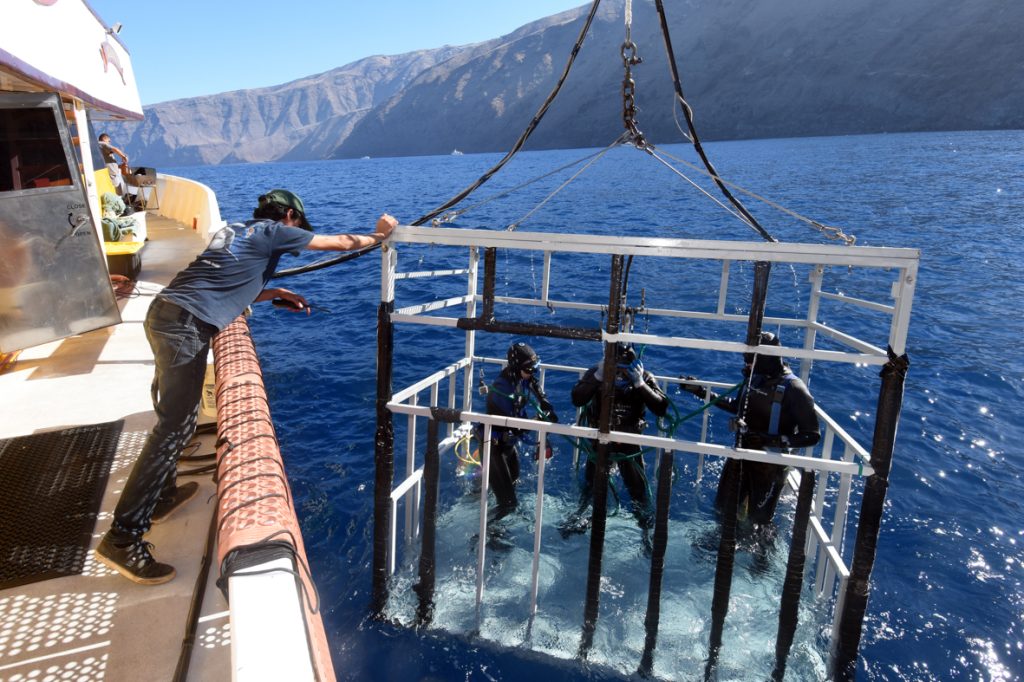
The Solmar V has two types of cages, with very different vibes; two 4-man surface cages attached to the dive deck at the stern and one 2-man deep cage accessed from the side of the vessel. All of the cages are fed by air from the surface. In terms of other equipment, the crew fit each participant with a “weight jacket” as opposed to a belt. This ensures that the cage diver is overweighted and remains firmly planted on the floor of the cage. To stay warm, you’ll need a 5mm wetsuit (minimum) or a dry suit, a hood, and also gloves.
In order to keep things fair and equitable for everyone using the surface cages, the crew have created a rota system of drawing names out of a hat, but allowing pairs or groups to be in the cages at the same time. This is especially helpful on the first day, as everyone wants to get in, but as time passes over days two and three, it’s easier to hop in whenever you want, as some tend to tire out and retreat to the sundeck (good in itself for seeing the sharks). It’s not unusual to have a surface cage to yourself later in the trip.
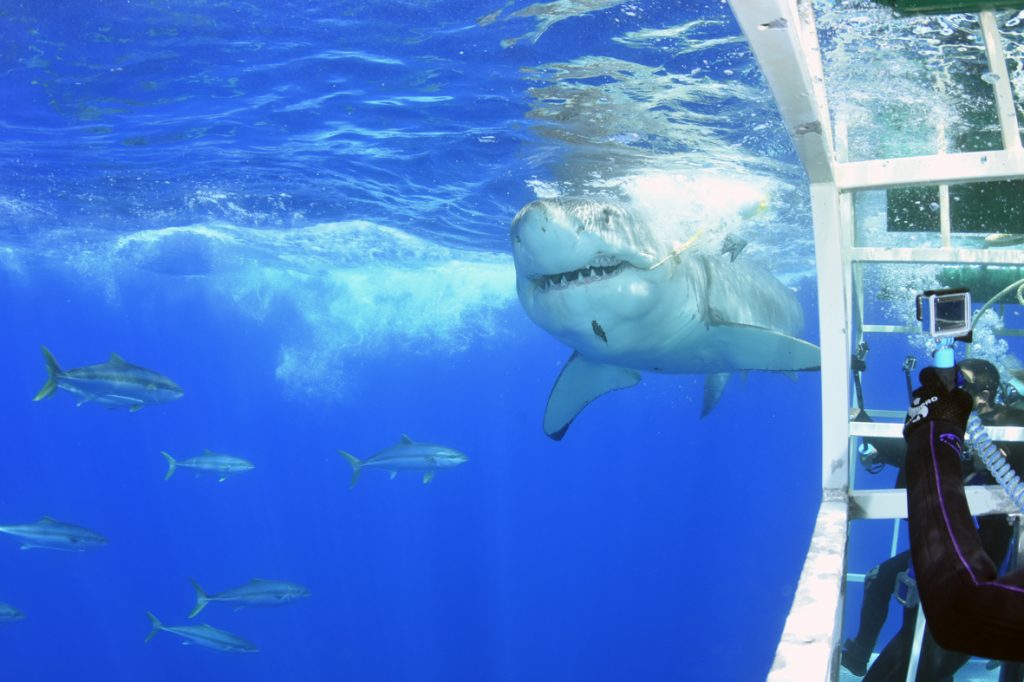
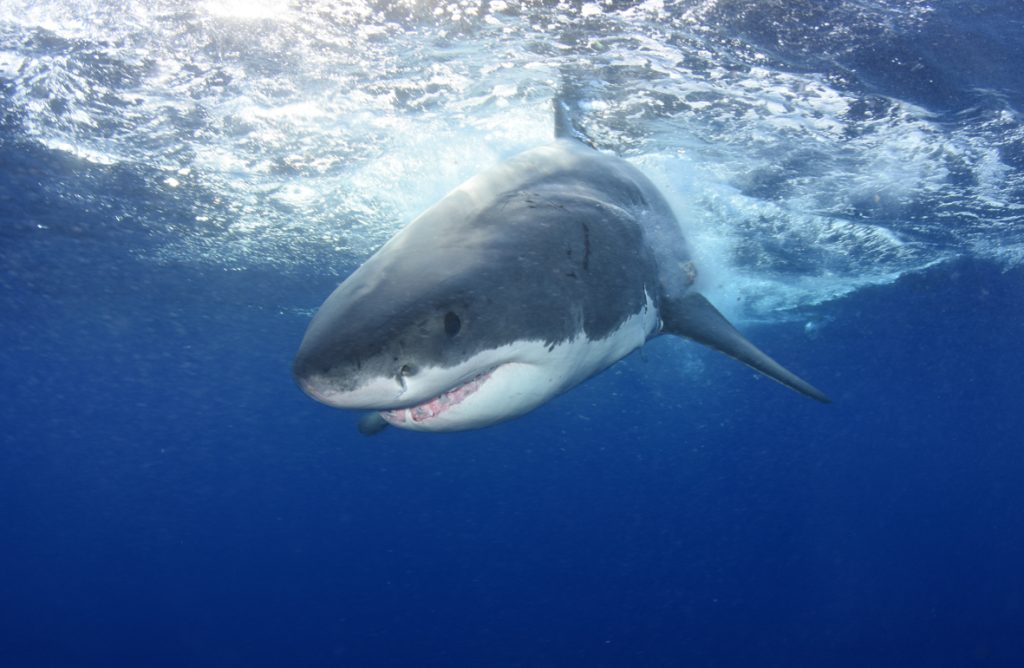
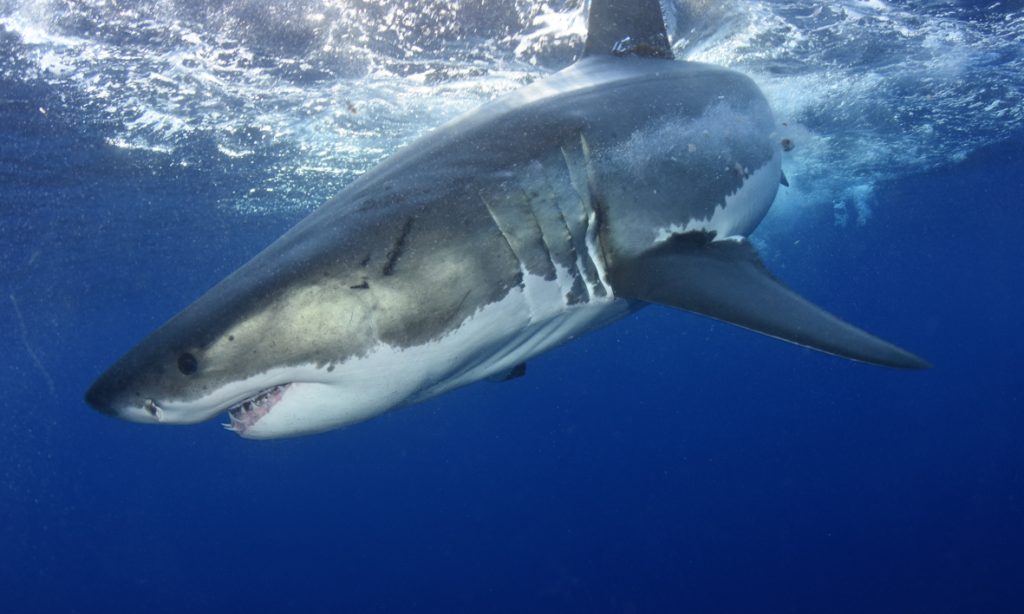
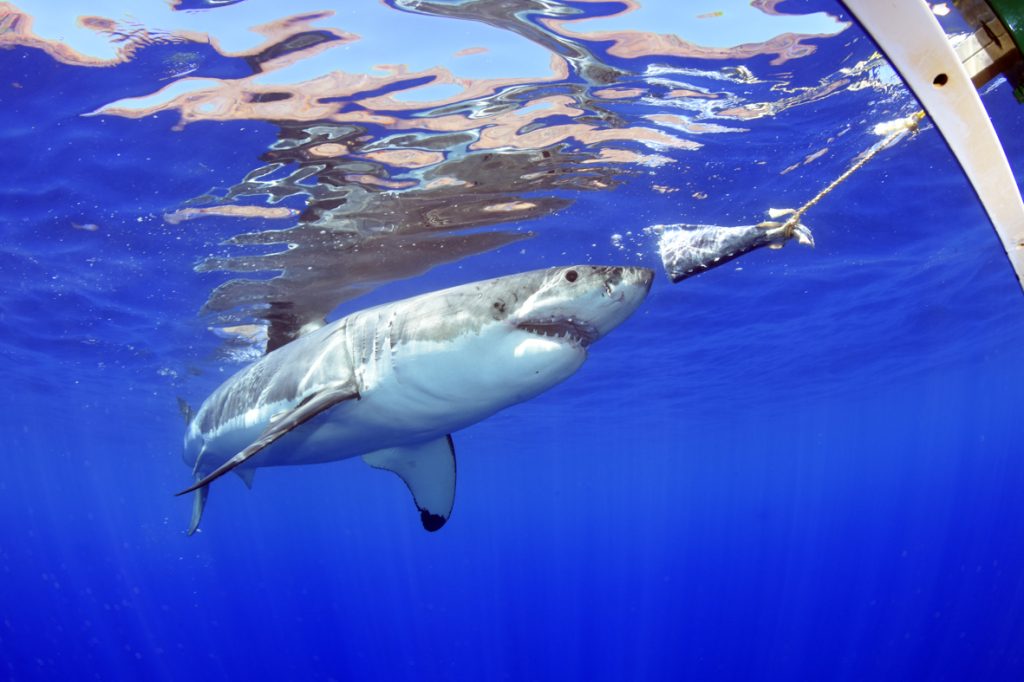
The surface cages feature a viewing slat for uninterrupted views. The crew continuously bait and chum the area around these cages except when participants are entering or leaving the cages. The chum is used to attract the sharks to the general area of the surface cage from where “controlled” bait is used to draw the sharks as close to the cage as possible. To do this, there’s a crew member stationed on each side of the dive deck with a baited rope. If a shark checks out this bait, the crew member draws the bait towards the cage, hopefully with the shark following. Sometimes the shark will take the bait just in front to the thrilled cage dwellers.
The deep cage is only available to qualified scuba divers and is lowered to a depth of about 10 metres by a crane. It takes two divers plus a crew member whose job is to spot sharks, keep everyone safe and film any action which is streamed live onto the boat for others to watch. It’s much more serene than the surface cage and affords some very different views. There’s no bait deployed around the deep cage, but you’ll often get sharks swimming close by. Zac ended up really liking the deep cage, and one of my best memories was of him giving me a “mind blown” signal as a shark gave us a close encounter. The deep cage is in operation all day, but it’s important to book your time with the crew – each “immersion” is 30 minutes.
And so, we enjoyed three great days of cage diving in near perfect conditions. You learn that the Great White Shark is very much a “think and consider” kind of animal, clearly very intelligent and not in a hurry. They disappear out of sight only to reappear in a different place, often where you don’t expect. They also give each other space, their behaviour governed by a hierarchal etiquette.
On the first cage diving day, it can sometimes take a bit of time to attract the sharks and for them to be comfortable around the boat (therefore it doesn’t matter if you’re not first into cages), but once they feel confident you could see several individual sharks. At one time we had seven Great White Sharks in the general area of the Solmar V.
You may possibly see other pelagics whilst in the cages, especially jacks that also get attracted to the bait and chum. On a couple of occasions, we saw a turtle and a sealion pass by, which caused the heart to race a little; would we see a shark rocket from the depths to claim its prize? But no, it wasn’t to be. There’s no doubt however that the sealions, seals and turtles continually run the gauntlet here.
For photographers and videographers, the opportunities and potential are immense, but you can’t of course, tell the sharks what to do. Though you’re virtually guaranteed to “see” a Great White and probably several, the quality, quantity and duration of the encounters will vary from trip to trip. More cage time is more likely to generate good results.
In terms of the liveaboard itself, you can expect an enjoyable time on the Solmar V, which is a nice, well-appointed vessel (and recently refurbished, I understand). The crew themselves are experienced and knowledgeable and we found them to be helpful and friendly throughout. The quality of the food is good and the onboard “barbie” was a nice touch against the spectacular backdrop of the island at sundown.
You could imagine the remote and austere Guadalupe being the kind of island that might have once been used to banish undesirables. Though we went there to experience life behind bars, it certainly wasn’t a punishment or a penance. To see Great White Sharks up close and personal was a pleasure and a privilege. A great life experience.