
Text by Jeremy Cuff/www.ja-universe.com
Photography by Jeremy & Amanda Cuff/www.ja-universe.com
The dive spots and destinations that I choose to visit usually start by appearing on what I describe as my “dive radar” and then onto my “must do” list. In that respect, Kimmeridge Bay was no different, attractive to me in that it’s within the Purbeck Marine Wildlife Reserve and benefitting from a sheltered location; it seemed interesting. Back along, I’d had a couple of planned visits thwarted by poor weather, so I hoped this time it would work out. As the weekend approached, the weather looked perfect…
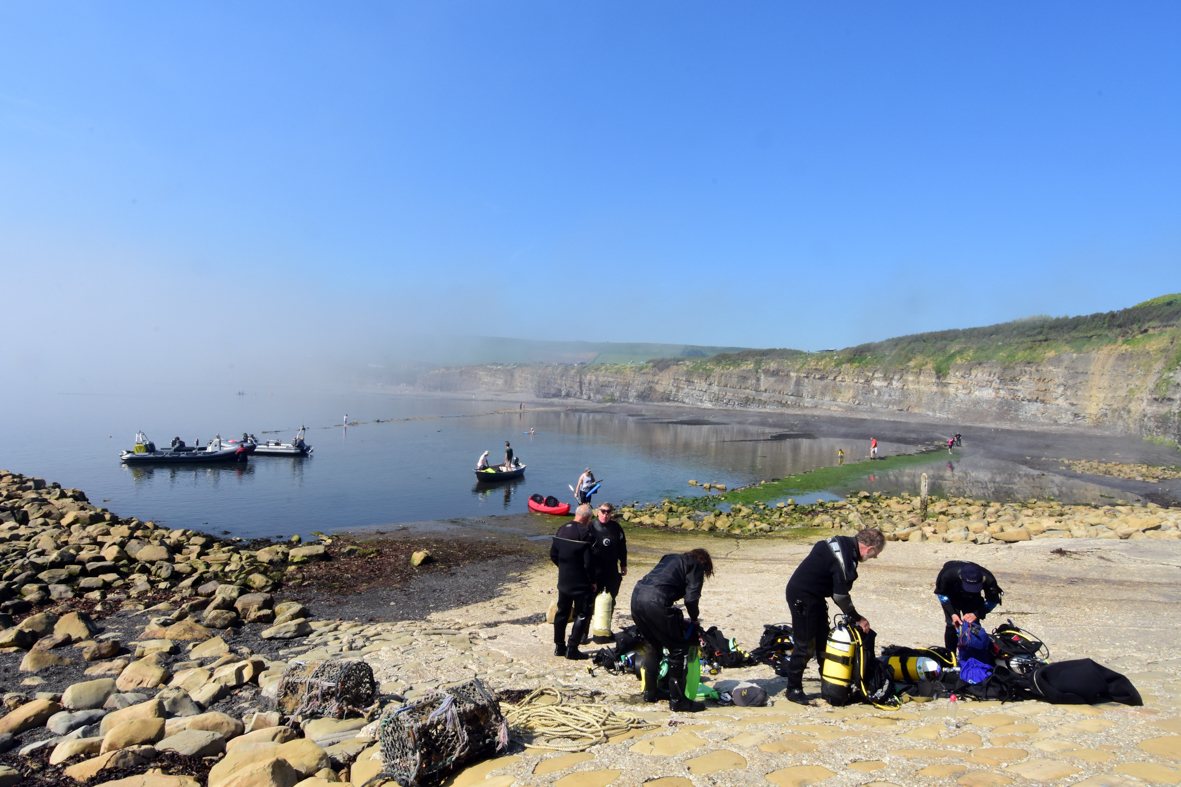
Kimmeridge is located in a beautiful and scenic area of the Jurassic Coast between Swanage and Lulworth, in the general area known as Purbeck. It’s a really nice place to visit, and somewhat off the beaten track, accessed by a narrow “dead end” lane several miles from the main Swanage to Wareham road.
The bay itself is located a short distance south west of the village of Kimmeridge and can be accessed by vehicle via a toll road. The area features some important and interesting geology which includes limestone ledges that extend out into the bay, which can be seen both above below the waterline.
It has many attractions, with excellent coastal path hiking, kayaking, fossil hunting and rockpooling opportunities, as well as offering divers something a bit different to have a crack at, making it an ideal destination for a “back to nature” diving weekend. To do the dives, I chose a weekend in May where I lucked into fabulous weather, although we did get some sea mist roll in, obscuring the sun for part of the day.
ARRIVAL AT THE SITE
In terms of the practicalities, this is a dive trip that needs planning and preparation in order to make it a success. Basically, you need to take everything you’re going to need in terms of dive equipment and fills as there’s no dive centre, and also supplies of food and drink, as there’s no shops or permanent cafes. On pleasant weekends you’ll sometimes find a snack wagon in the car park, but it’s not wise to rely on it being there.
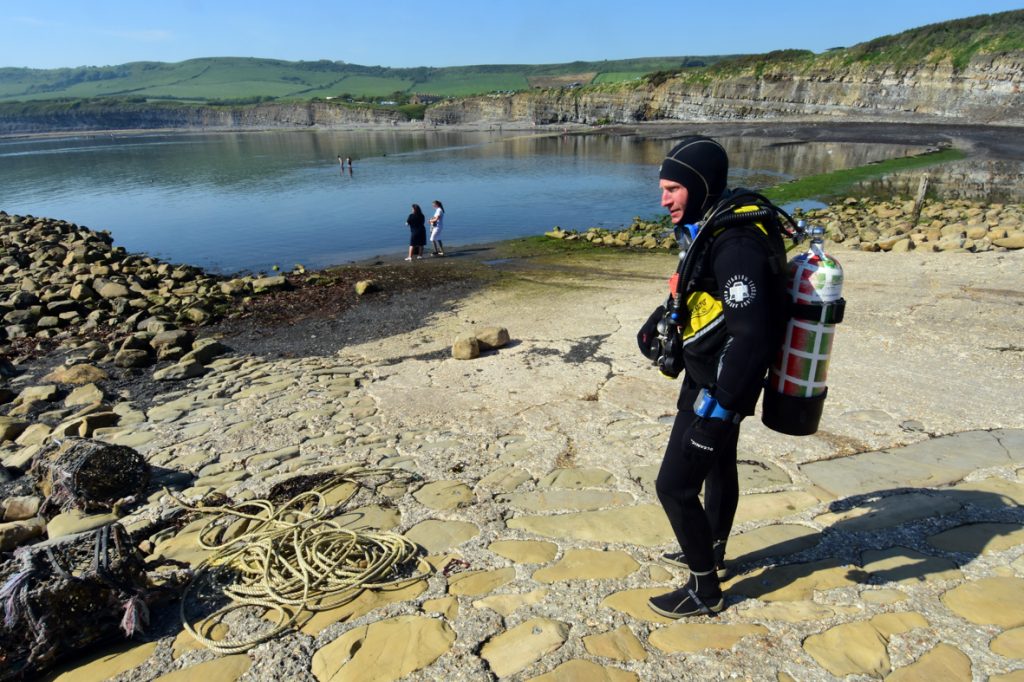
The biggest issue to solve for this kind of dive trip is how to get the gear to where you need it. At Kimmeridge, there’s a couple of boat slips, but you can’t park there, though you can drive down to that general area to unload (by the Wild Seas Visitor Centre) after which you must move your vehicle to the main car park further uphill.
Some kind of hand pulled trolley/trailer to transport the gear and supplies, such as a garden trolley with soft wheels can be a useful here. I purchased one last year for this kind of dive trip and it proved to be invaluable again.
DIVE BRIEFING
Once you’ve dealt with the logistics of getting set up in your chosen area, which will most likely be next to the main boat slip by the visitor centre, it’s really just a case of going diving in whatever section of the bay you’ve decided upon.
When entering the water, great care should be taken with any slippery seaweed that could cause a nasty fall. It can be tricky keeping your footing whilst navigating slimy, uneven pebbles as you wade into deeper water.
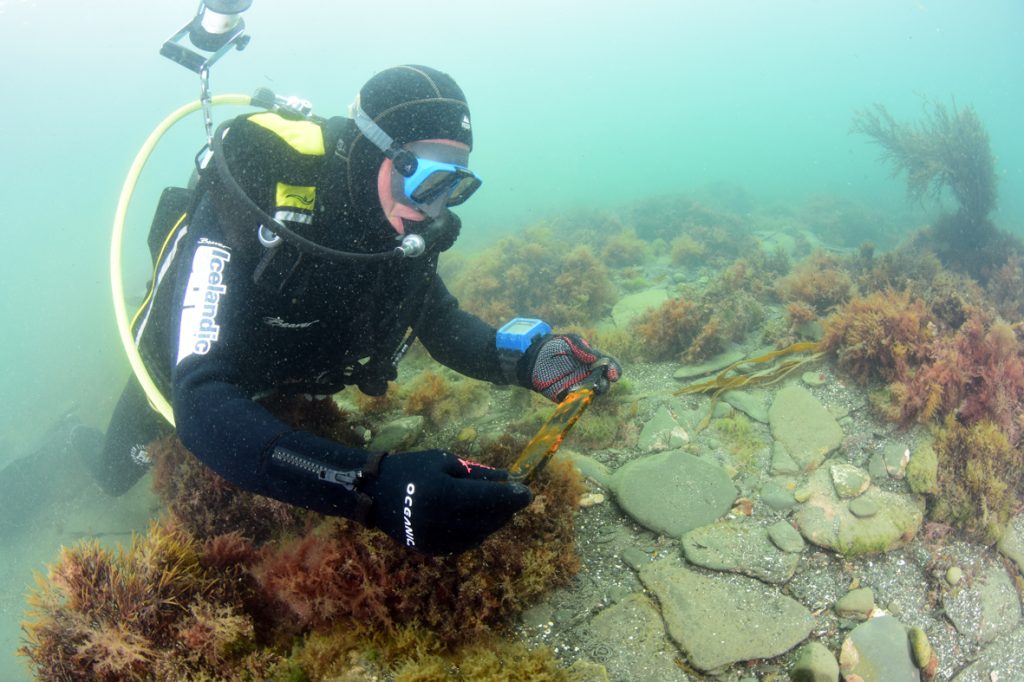
Diver safety is a serious point at this site, due to the shallow depths combined with the presence of boats. As you can expect to get no deeper than a few metres on a dive, divers are constantly within the “danger zone” of boat traffic. It’s thus essential to ensure that buddy pairs stick closely together and use an SMB at all times to indicate their presence. To not do this would be foolhardy. Visibility, can also vary tremendously, so buddy pairs must keep close to one another to avoid getting separated.
Due to the shallow depths, “overweighting” yourself is probably the way to go here, to ensure you’re able to stay down rather than accidently bobbing up, or spending the whole dive kicking to stay down which isn’t much fun.
In terms of tides, the range isn’t huge in this area, so it’s possible to dive at any time, though it is much easier when the tide in higher. During my visit, there was no appreciable current, though you may experience surge if any waves are blowing in. The unhelpful weather to watch out for is an easterly wind and perhaps a southerly wind, which can send waves into the bay and destroy the visibility and make entry/exit from the water difficult and dangerous. It’s worth keeping an eye on the weather forecast before setting out.
THE DIVES
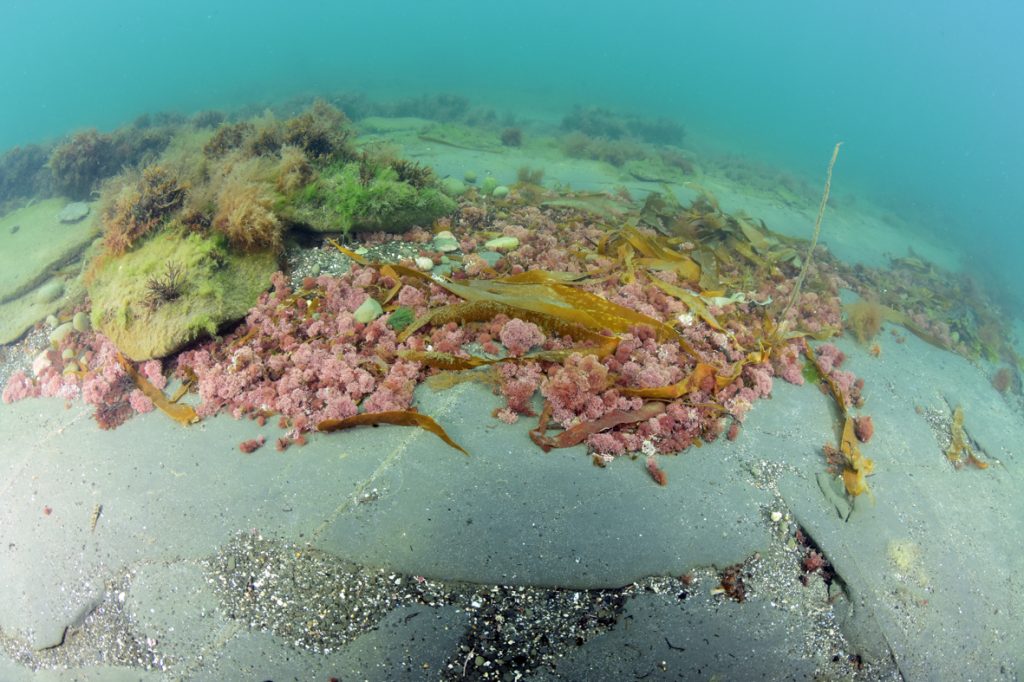
The diving in Kimmeridge Bay is over mainly flattish expanses, but there are interesting ledges and rock “pavements” that make it more unique. Other than the ledges and pavements, there’s little in the way of “underwater landmarks” with which to navigate, so the dives themselves are really random explorations of the bay. This can be disorientating, so it’s important to maintain awareness of where you are in relation to the shore and your chosen exit point. We found ourselves benefitting from the shallow depth in order to pop up and check our location, whilst listening and looking for any nearby boat movements.
Essentially, the dives in Kimmeridge Bay are “naturalist” dives. During my visit in May, it very much seemed liked a “nursery area” with many fish fry being present. Divers in a hurry probably won’t see much, so it’s important to slow it down and look carefully. This adopting this approach, you have the greatest opportunity to be rewarded with some interesting sightings, often on a “macro” level.
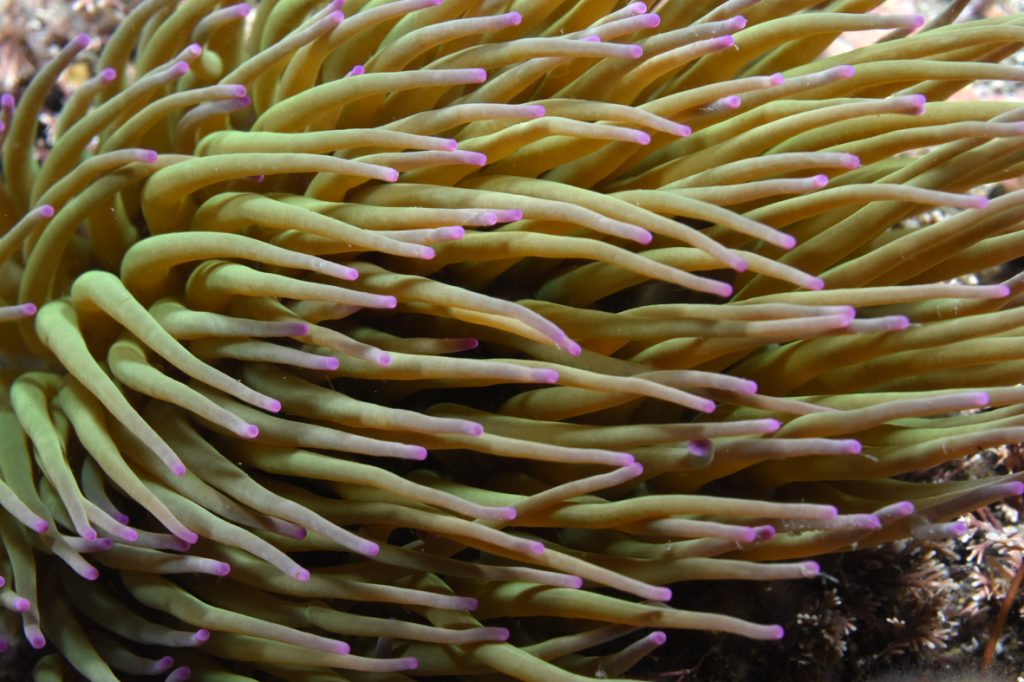
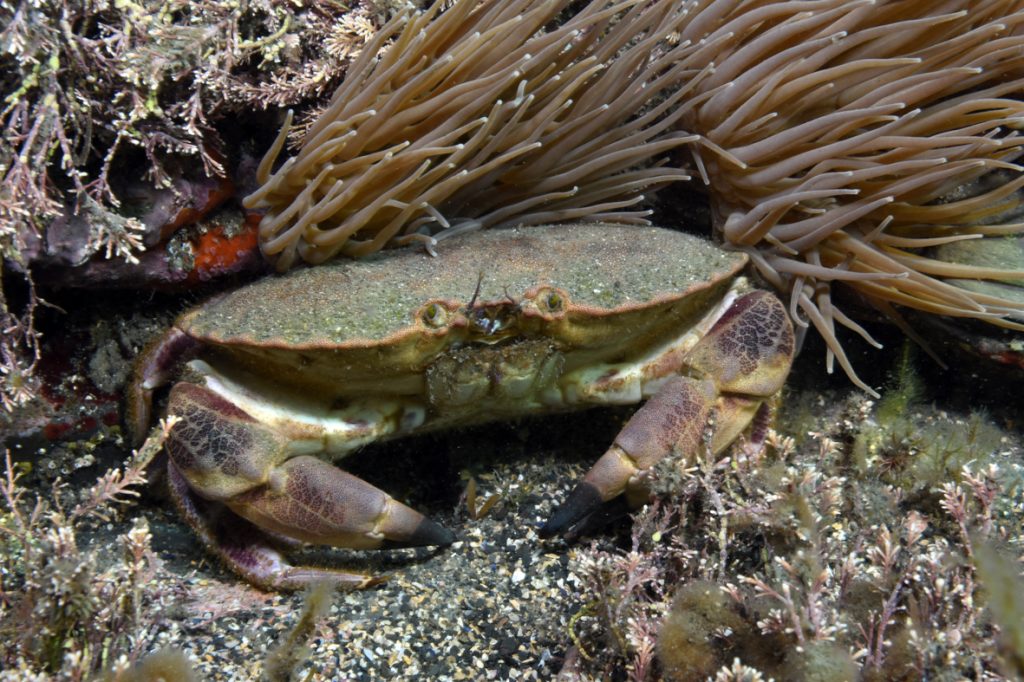
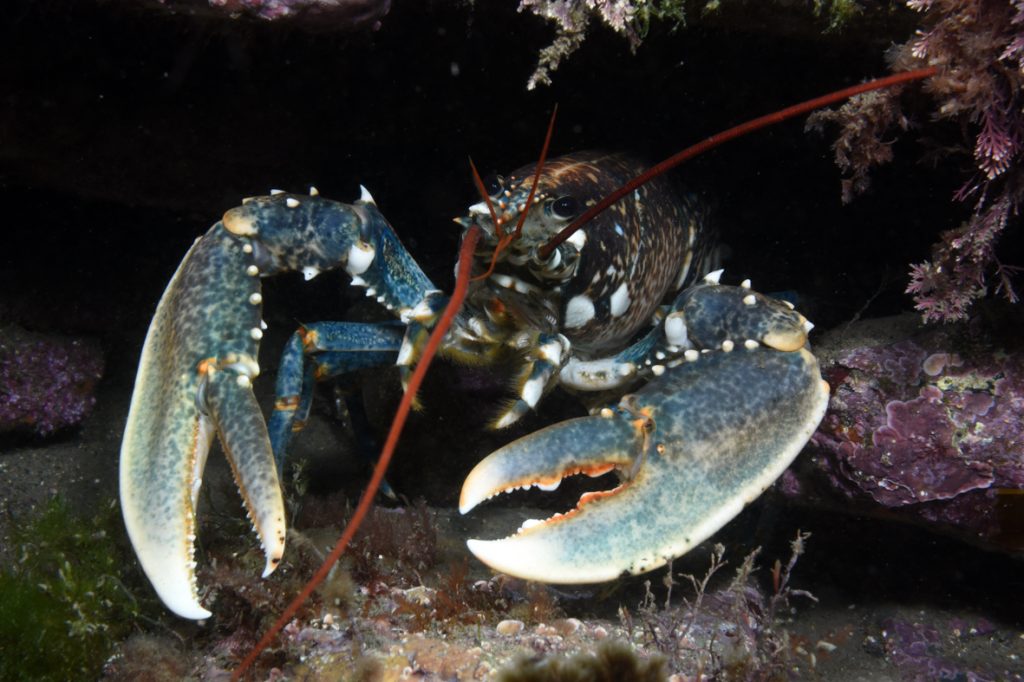
During two dives in the bay, we found extensive weed beds (often colourful in the sunlight), anemones, whelks, tiny groups of shrimp, fish fry, a startled flounder that I nearly put my hand on, delicate jellyfish in the mid-water, pipefish, wrasse, several impressive lobsters, spider crabs, velvet swimming crabs and edible crabs. Much more must surely be possible if you spent more time there.
In summary, Kimmeridge Bay is an interesting dive spot that’s ideal for divers of all abilities, especially for those with particular interests in marine life and photography. It’s also safe for snorkelling in the summer months, so non-diving kids and adults can get in on the action too by following the snorkelling trail. Also, there’s a newly refurbished Wild Seas visitor’s centre (run by the Dorset Wildlife Trust) next to the boat slip that provides information about local sea life and conservation efforts. It’s a very nice part of the world, it’s off the beaten track and likely to be highly rewarding for those who make the effort.
Dive Centres
To dive at Kimmeridge Bay, you need to be self-sufficient and bring everything you need.
If you need to organise fills or obtain dive related supplies whilst in the area, the nearest dive centre (Divers Down) is located in Swanage about 10 miles away (a good 30 minute drive each way).
If you need to contact them for any reason, visit www.diversdownswanage.co.uk or call 01929 423565.
Type of Dive
Very shallow shore dive (easier at high tide).
Depth
Exact depth will vary depending on tides and where you choose to go, with the maximum being 5-8 metres. Due to this, you need to ensure you have sufficient weight to stay down.
Marine Life/What To Look Out For
Kimmeridge is good for sightings; depending on the time of year, expect spider crabs, edible crabs, velvet swimming crabs, tompot blennies, pipefish, wrasse, bass, flounder, prawns, anemones, jellyfish and blennies. You might also be lucky to see lobsters, cuttlefish, scorpionfish and perhaps even John Dory. Who knows, there could perhaps be seahorses somewhere in the area, as they’re known from nearby Studland Bay a few miles along the coast.
Visibility
Variable depending on wind direction, run off and other factors, but can be 6 to 8 metres if you’re lucky. On less ideal days, it can be very much reduced. An average is probably 3 or 4 metres.
Seabed
Flat expanses, ledges with overhangs, extensive weed beds, limestone “pavements”, rocks, boulders and rubble patches.
Hazards
Boat traffic, low visibility, disorientation (surprising easy in poor visibility), slippery seaweed/rocks/boulders (when entering/exiting the water).
Accommodation
Accommodation is limited to a few places in Kimmeridge itself (book these early if planning to stay close to the bay), but there are plenty of options to suit all budgets in the wider area, such Corfe, Wareham, Worth Matravers and Swanage.
For those wishing to camp, there are several options in the area.