
Text by Jeremy Cuff/www.ja-universe.com
Photography by Jeremy & Amanda Cuff/www.ja-universe.com
When Mark (Scuba Diver’s Editor in Chief) asked me if I could contribute a feature on Swanage Pier, I probably had enough material already “in the bag” as I’d dived there several times in the past. However, his request gave me the impetus to have another stab at what is a very popular (and perhaps even iconic) dive site on the South Coast, drawing divers from far and wide…
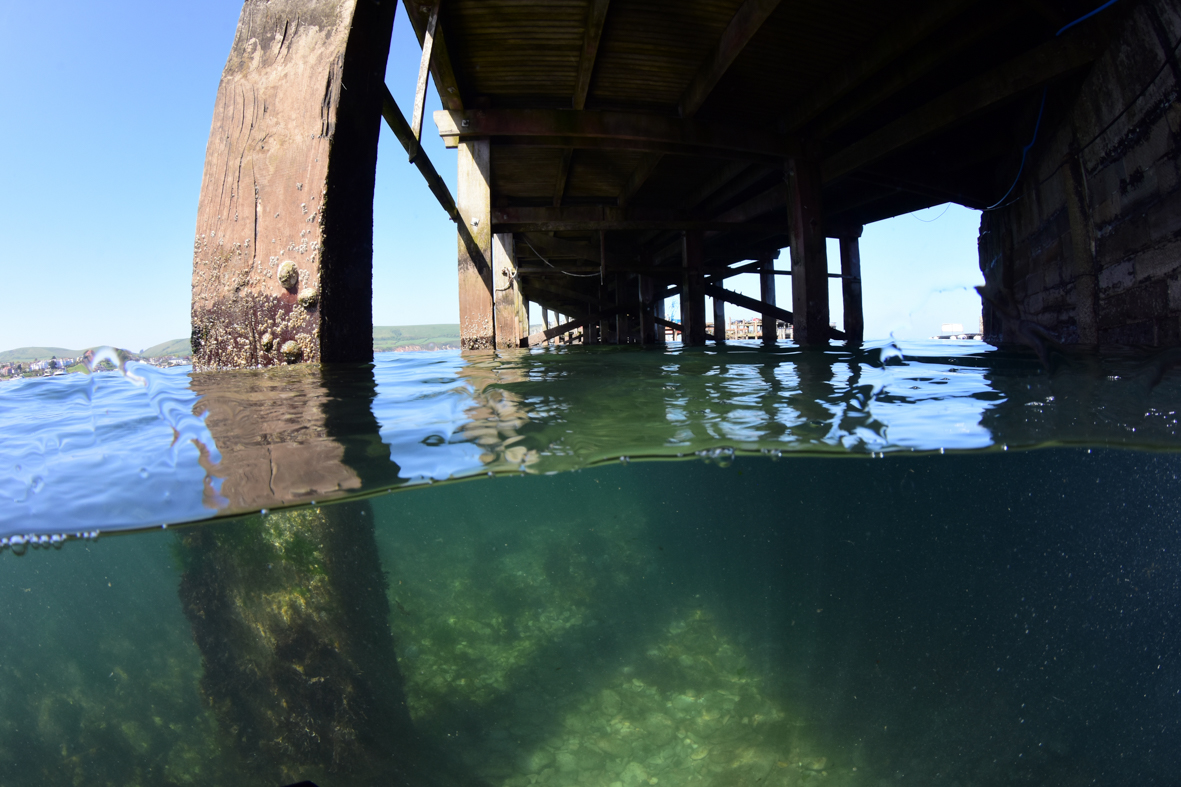
The pier itself is located in the pleasant seaside town of Swanage in Dorset, in an area known as Purbeck. It’s a nice place to visit on all sorts of levels. It has a close proximity to the town centre and a sheltered beach that’s popular with families and sunseekers. When combined with other local attractions, it’s an excellent destination for a weekend “diving break” as well as providing plenty of things to do for any non-divers tagging along.
Swanage Pier has featured regularly in my own diving journey over the years, initially when completing my PADI Advanced Open Water where we used the flat expanses next to the pier for the navigation dive. At other times, we dived it a couple of times with mates, used it to check out our new DSLR underwater camera rig, took a very nervous diving friend on an “easy” dive, introduced our son Zac to UK diving, and most recently on this year’s early May Bank Holiday weekend to cover this feature (where I lucked into fabulous weather).
The original Swanage Pier was completed in 1860 by James Walton for the Swanage Pier and Tramway Company. The Pier was built primarily for shipping stone. Horses were used to pull carts along the narrow-gauge tramway which ran along the pier and seafront.
When a steamer service started between Swanage, Poole and Bournemouth in 1874, the pier was used for both day-trippers as well as the stone cargo. It soon became clear that it was unable to cope with this “dual use” and it was subsequently decided that a new and longer pier was needed.
The first pile of the new pier was driven on November 30th 1895 and it opened to traffic on March 29th 1897. The first steamer landed people in May 1896, with last being in August 1966. In 1940 the landward end of the pier was blown up as an anti-invasion precaution. Following World War II, steamer traffic was reinstated in 1948 but after 1966 the pier deteriorated for almost 30 years.
In 1994, the Swanage Pier Trust acquired control of the Pier Company, with the aim of keeping it open to residents and visitors and providing for its eventual total restoration. Much money has been spent on restoring the timber structure, with renovations being financed by sources such as the Lottery & English Heritage.
At the time of writing in early May 2018, the pier is undergoing further restoration work which is designed to secure its’ ongoing future. The work is scheduled to be completed by August 2018, though like many construction (or reconstruction) projects, they have a habit of over-running. By the time you read this, the works should be finished or nearly finished.
ARRIVAL AT THE SITE
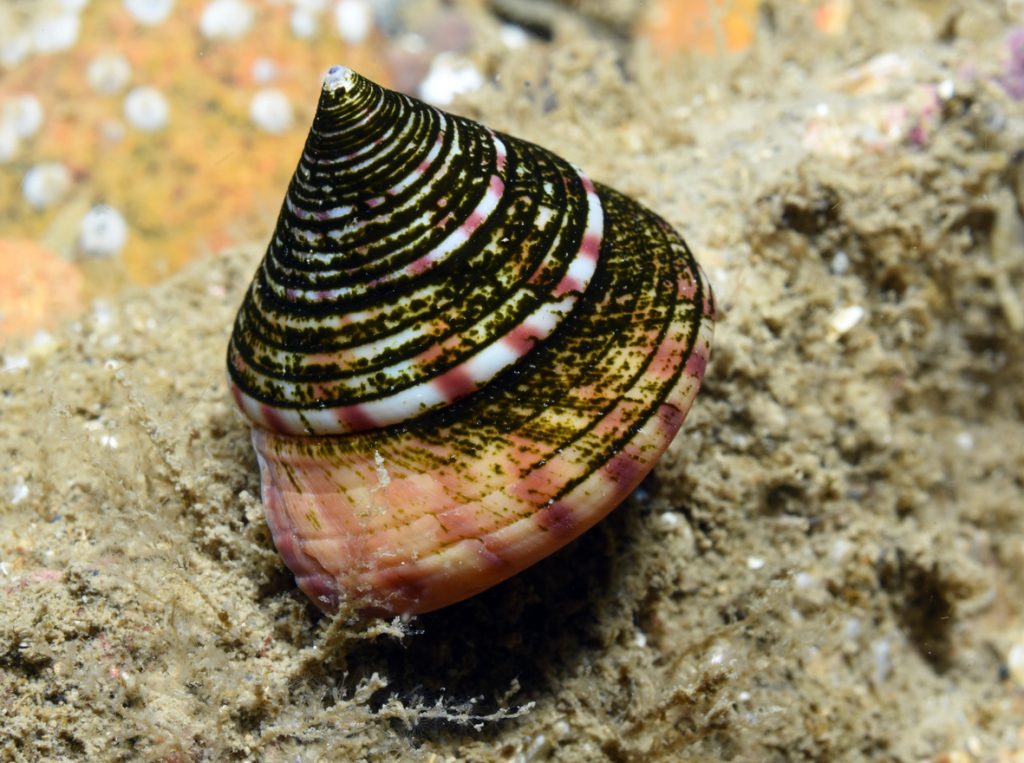
The pier can be accessed by diver’s vehicles via an entrance gate where there’s limited parking on a “first come first served” basis (£9 for a full day). This means an early start, which may or may not be to everyone’s taste. Even if you arrive at 06.30 am, expect to see a queue starting to form, especially on good weather weekends such as my recent visit.
If staying overnight, it can be a bit of a faff getting your gear from your accommodation into the vehicle in time to get onto the pier by 06.30/7.00 am. I drove my pickup down to the pier at 06.30am, to ensure that I got a space and then had breakfast after I’d parked.
If the pier parking is full, it’ll turn your pleasant day of diving into a less enjoyable experience as you’ll have to transport dive kit from another car park uphill from the pier (helpfully, the pier management provides trolleys for transporting dive kit). It must be said that nabbing a pier parking space is definitely the key to the day.
DIVE BRIEFING
Even when conditions don’t allow elsewhere, Swanage Pier is always a contender as a reliable place to dive (as much as that’s possible with coastal sites). It’s therefore a good “fall back” site, though that is not to say it’s in anyway inferior to local boat dives. The unhelpful weather to watch out for is an easterly wind, which can send waves into the bay and destroy the visibility, so it’s worth keeping an eye on the weather forecast.
In terms of tides, the range isn’t huge in this area, so it’s possible to dive at any time, though it is much easier when the tide in higher. In my visits, there’s never been any appreciable current, though you may experience surge if any waves are blowing in.
The dive itself is very shallow, with the deepest depth I can remember attaining being about 5 metres at the very end of the pier at high tide. “Overweighting” yourself is probably the way to go here, to ensure you’re able to stay down rather than accidently bobbing up (perhaps risking clunking your head on a beam in the process) or spending the whole dive kicking to stay down which isn’t much fun.
To enter the water, you’ve normally got three choices (except at the time of writing when refurbishment work was ongoing). The most popular choice is the steps on the sea wall next to the gent’s toilet (try not to think about that!), or alternatively there’s a lower platform on the pier itself with a ladder; some dive boats arrive and depart from this section so care must be exercised. Similarly, the “on pier” dive centre (Divers Down) have a pontoon that divers can use as an entry point, though boats are also coming and going from here, so you must be vigilant and sensible (they probably don’t encourage using this).
If using the “sea wall steps”, great care should be taken with any slippery seaweed that could cause a nasty fall. When entering the water here, it can be tricky keeping your footing whilst navigating slimy, uneven pebbles as you wade into deeper water. Visibility, can also vary tremendously, so buddy pairs must keep close to one another to avoid getting separated.
THE DIVES
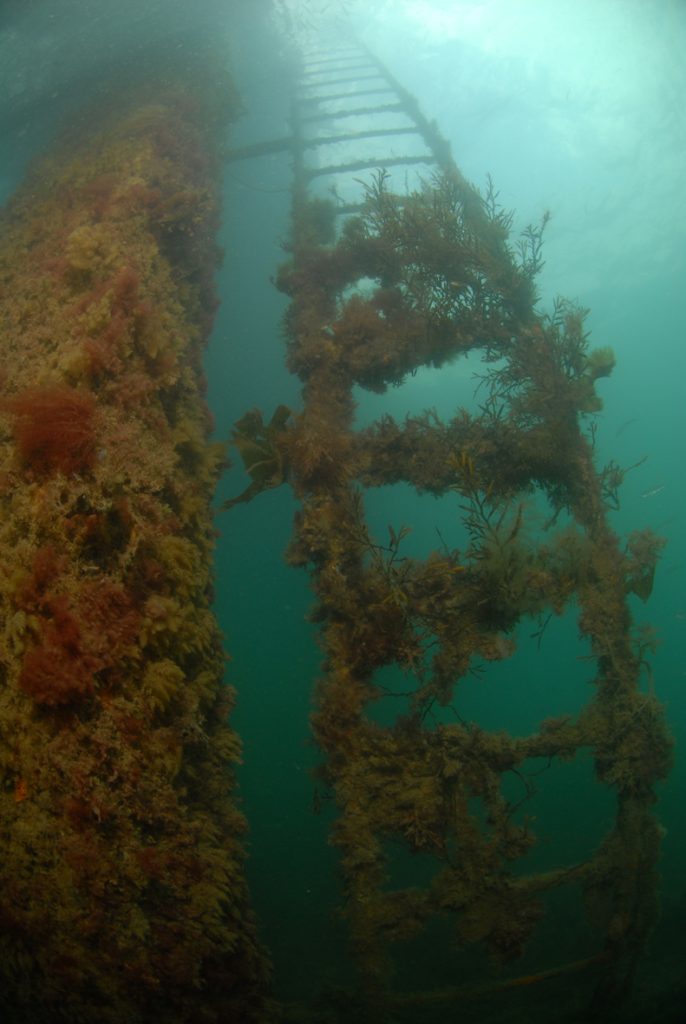
Wherever you choose to enter the water, there are two basic choices that you can make; stay under the main pier or swim out to the standing legs of the old pier. If visiting the legs of the old pier it’s worth checking this out visually for orientation before entering the water, to ensure you don’t miss them and avoid the hazard of the dive boat pontoon.
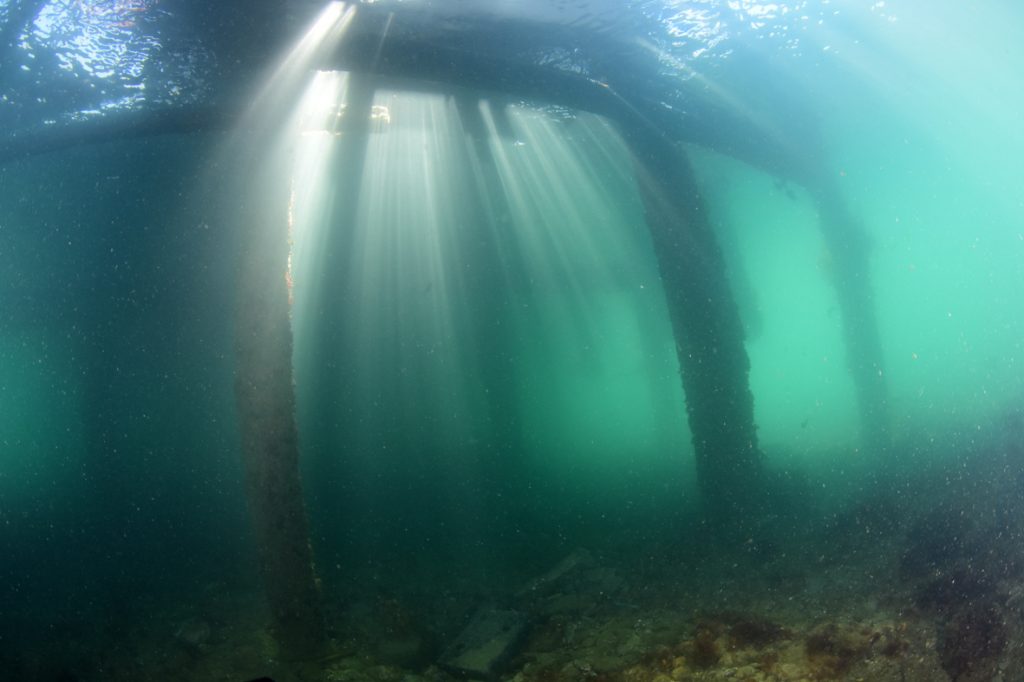
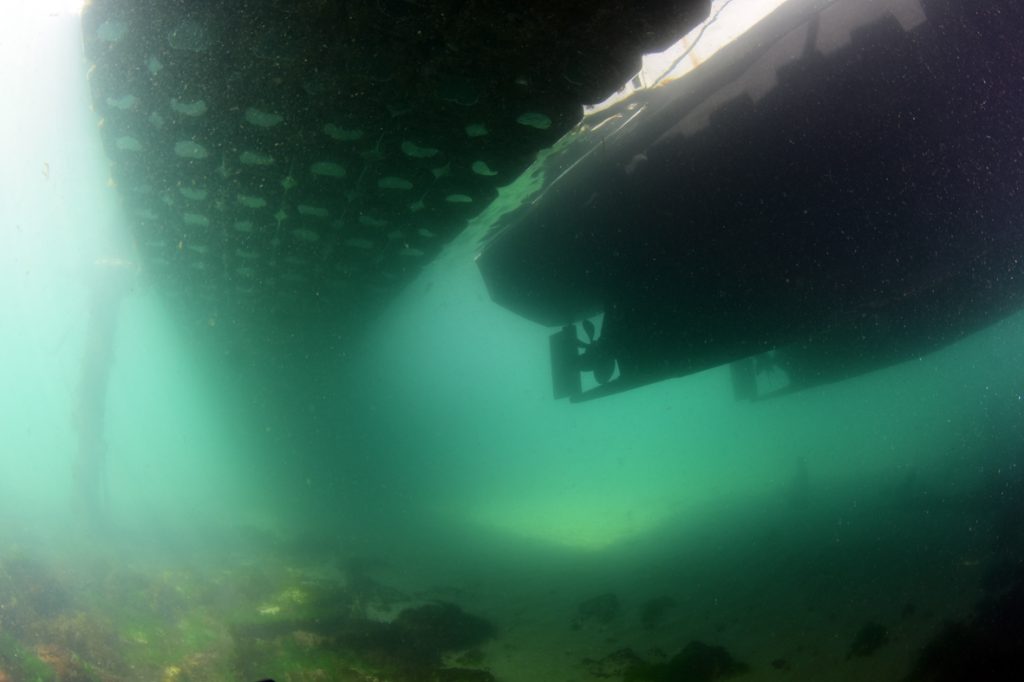
Essentially, the dives under and around Swanage Pier are “naturalist” dives with the added vistas of the pier structure and discarded former pier legs. It’s the kind of place where an observant diver who’s not in a hurry can be rewarded with some interesting sightings. The dive is quite popular with photographers, with good macro subjects and even wide-angle possibilities if the visibility is good. In fact, on my most recent visit, I’d almost go as far as saying that the shafts of light peeking through reminded me of diving Bonaire’s Town Pier many moons ago.
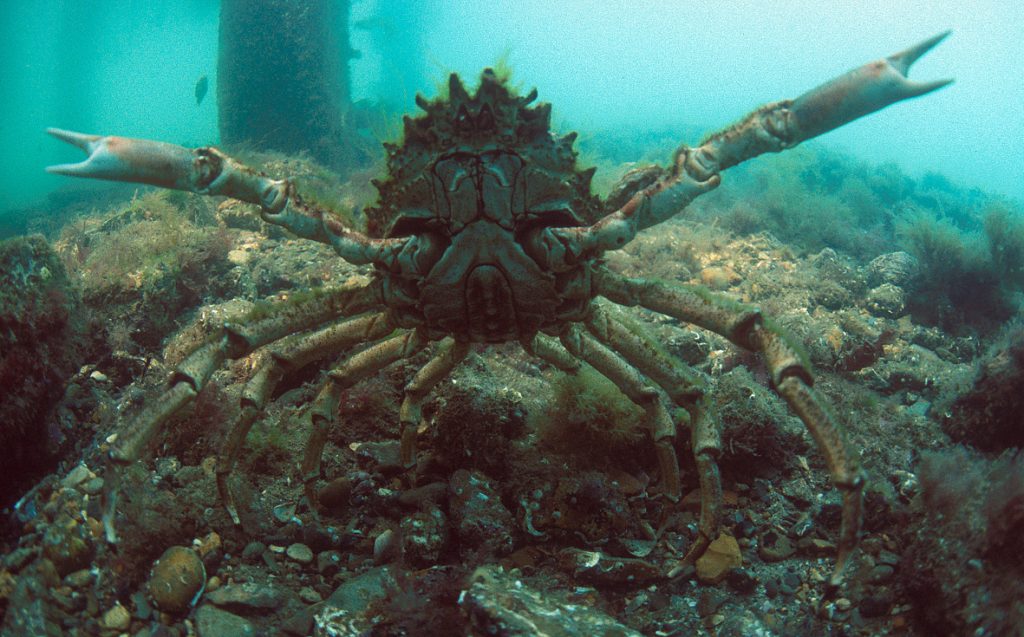
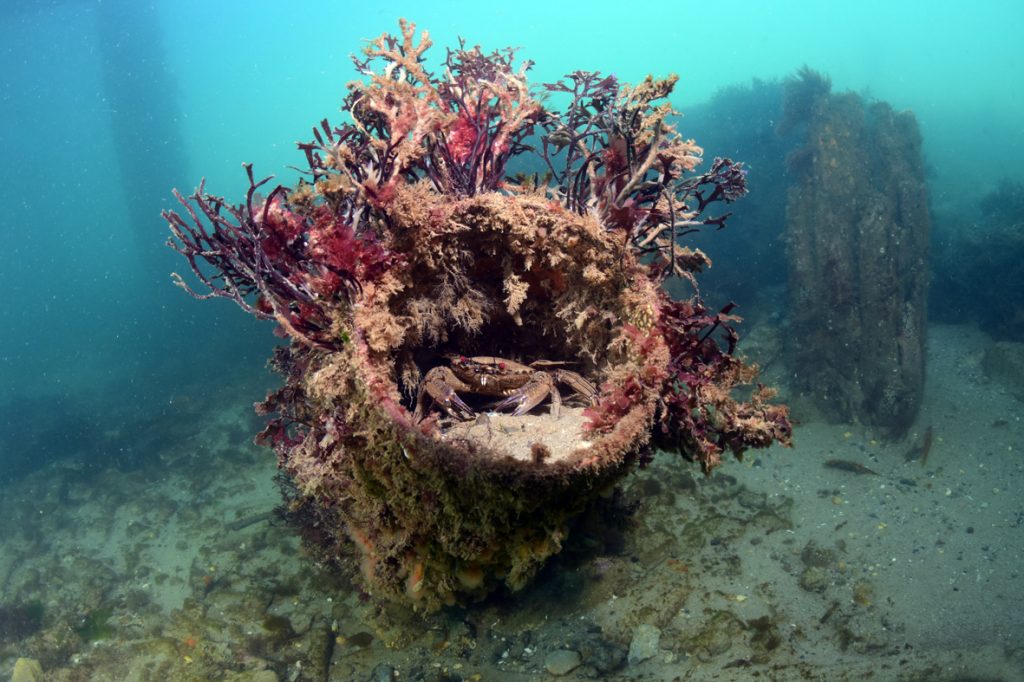
It’s really a case of moving slowly and looking carefully to see what you can see. On previous visits I’ve seen lobster, flounder and John Dory among the highlights. Most recently I spotted what I believe to be a baby spider crab and saw a large school of grey mullet around the area of the old pier legs (sadly not close enough for photography).
In summary, Swanage Pier is a perennial favourite and iconic dive site that is ideal for divers of all abilities and interests; training dives, marine life spotting, photography and so on. Some combine it with other dives in the area, many of which depart from the pier itself. It’s also quite sociable in that it’s easy to meet other divers (sounds like a diver dating venue!) where you learn about recent sightings, prevailing conditions and the dive experiences that others have had.
Swanage Pier is a good place. If you haven’t done it yet, perhaps it’s time to get yourself inducted!
Dive Centres & Pier Opening
For fills or other dive related supplies you’ve got the “on pier” dive centre, Divers Down.
If you need to contact them for any reason in advance, visit www.diversdownswanage.co.uk or call 01929 423565.
If you wish to contact the Swanage Pier Trust for opening times, visit http://www.swanagepiertrust.com/
Type of Dive
Very shallow shore dive (easier at high tide).
Depth
Exact depth will vary depending on tides and where you choose to go, with the maximum being 5 metres. Due to this, you need to ensure you have sufficient weight to stay down.
Marine Life/What To Look Out For
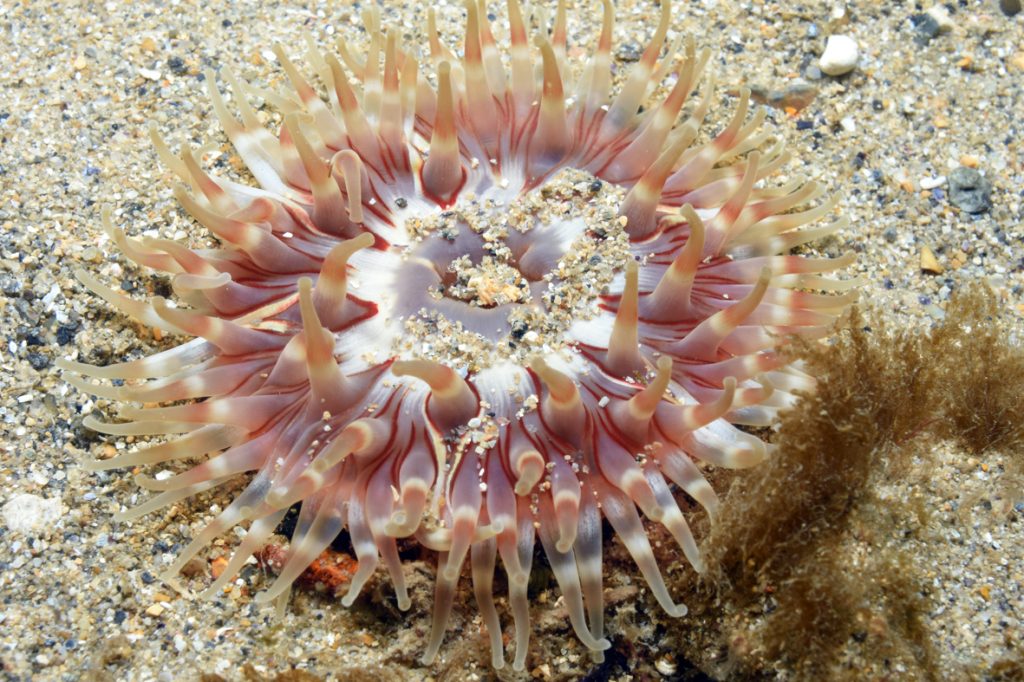
Swanage Pier is good for sightings; depending on the time of year, expect spider crabs, edible crabs, velvet swimming crabs, tompot blennies, pipefish, wrasse, bass, flounder, prawns, anemones, jellyfish and blennies. You might also be lucky to see lobsters, cuttlefish, scorpionfish, schools of grey mullet and even John Dory or angelerfish. Who knows, there could perhaps be seahorses somewhere in the area of the pier, as they’re known from nearby Studland Bay around the other side of Old Harry Rocks.
Visibility
Variable depending on wind direction, run off and other factors, but can be 6 to 8 metres if you’re lucky. On less ideal days, it can be very much reduced. An average is probably 3 or 4 metres.
Seabed
Flat with sandy expanses, extensive weed/seagrass beds, occasional rocks, rubble patches, discarded pier legs and beams.
Hazards
Boat traffic, low visibility, disorientation (surprising easy in poor visibility), slippery steps, rocks/boulders (when entering/exiting the water), fishing line, sharp edges, overhead beams.
Accommodation
There’s a big choice of accommodation in Swanage and its environs to suit all budgets. On my most recent trip, I chose a bed and breakfast close to the pier. There are plenty of B & B’s, hotels and apartments in and around the town. For those wishing to camp, there are options in the area.