
A Return Visit to the Lembeh Strait, 16 Years On
Text by Jeremy Cuff/www.ja-universe.com
Photography by Jeremy & Amanda Cuff/www.ja-universe.com
The Lembeh Strait in North Sulawesi (Indonesia) is an iconic dive destination for very good reason. This narrow channel, swept by currents, creates ideal conditions for a profusion of weird lifeforms to thrive. Over Christmas 2018, we returned there, 16 years on from our initial visit back in 2002. Here’s what we found, and the thoughts it generated…
Way back in 2002, we were immersed (literally, I suppose) in our burgeoning interest in dive travel and underwater photography. It was a period of time when I was starting produce images and features worthy of publication and we had plenty of plans. In May of that year we had travelled to Bonaire in the Caribbean where we first tried out our new digital SLR cameras underwater (using slide film back then) and looked forward to our upcoming trip to the Lembeh Strait that same autumn, to continue our diving and underwater photography odyssey.
Sometime after Bonaire, we discovered that Amanda was pregnant (with our son Zac), so it would change the dynamic going forward. As we’d already booked our trip, staying at the Kungkungan Bay Resort (“KBR”), we decided to still go, but Amanda would have to sit out the diving for obvious reasons. For me, the diving was a revelation as I encountered “critter after critter” most of which was new to me. It was, of course bittersweet, as Amanda was unable to participate. We vowed that we would return one day and dive Lembeh together.
Fast forward to 2018, and Zac is coming up to 16. He’s booked on a two-week school trip over the Christmas holiday, so we seized the opportunity to come good on our vow. Though there are a number of other options these days, we decided to “retrace our precise steps” and stay again at “KBR”.
The journey from Manado airport to the Lembeh area is about an hour and a half to two hours depending on traffic, but soon a dual carriageway will link Manado to the port town of Bitung that sits at the southern entrance to the strait. It will apparently reduce the journey time to 30 minutes. We could see it as we flew in, carving a path through the forest.
It saddened me to see it, to be honest. The fast world is here, too. As we’re all surely aware, debates are raging around the planet about habitat fragmentation and destruction, the “opening up and development” of once pristine areas, the effects of human generated pollution and rubbish, excessive and pointless consumption, the loss of biodiversity, climate change and the resulting acceleration of extinctions. This part of Sulawesi encapsulates this struggle, and one that is replicated in countless other places around the world each and every day. We must ask ourselves whether or not this is progress, and whether things really can continue like this.
As a parallel, think about the criss-crossing spaghetti of roads and railways that have long since carved up, dissected and divided any significant tracts of wilderness here in the UK. It’s a testament to the resilience of species that some semblance of biodiversity still exists here, but it’s under immense pressure and is disappearing fast. Clearly, the same is happening in North Sulawesi. The world is so “human-centric”, but it needs to be “life-centric”. It isn’t at all balanced. That’s easy to say, but very difficult to achieve, as to varying degrees we all feed the flames whilst trying to fight the fires. It’s hugely complex.
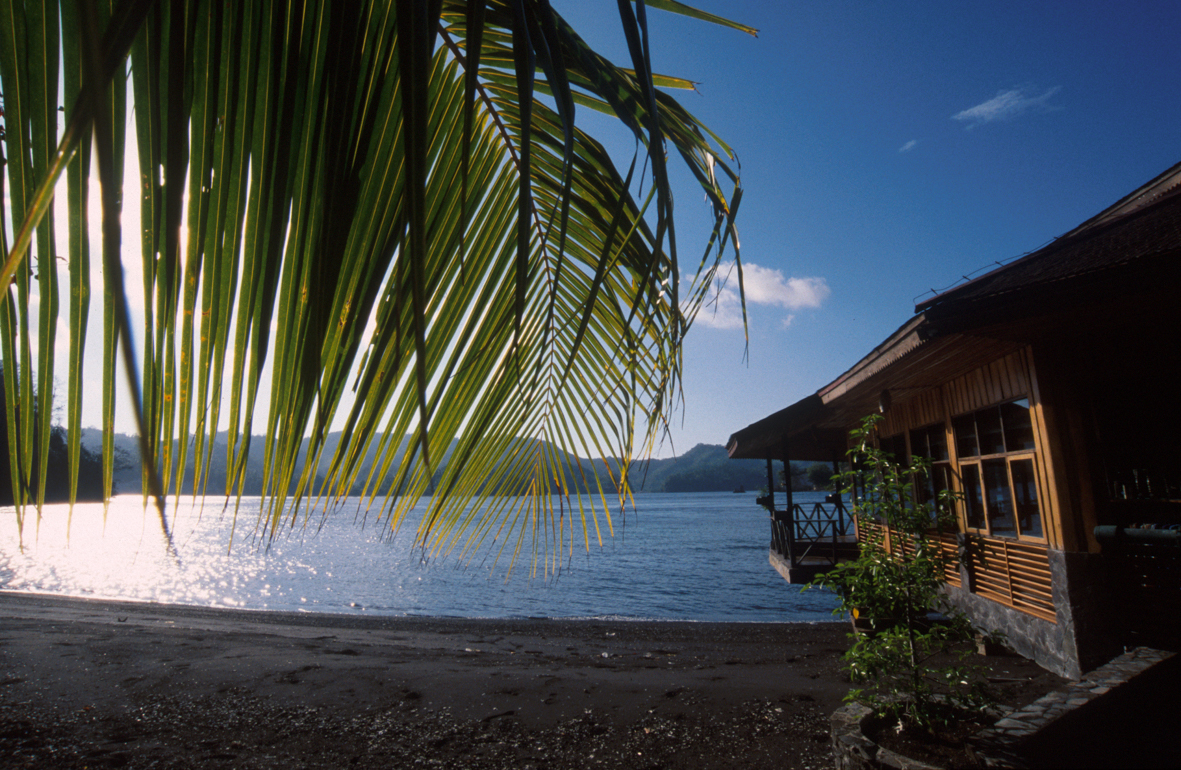
Though the memory can play tricks, KBR was very much as we remembered it from 16 years ago. Little had significantly changed, which was a good thing, as it felt near perfect back then. We learned that some of the original staff were still involved, such as Fritz, the restaurant manager.
“KBR” was probably one of the first of a kind in terms of dive resorts (certainly in this part of the world) and could be considered a pioneer, the original deal. A lot of diving related development alone has happened in the area since 2002 which was noticeable even before we travelled out – we could tell by the number of dive resorts that we could find online. According to a British couple that we met at KBR who’ve visited every year since 2010, there’s now a whopping 18 or 19 dive operations in the Lembeh Strait area. I wondered if all this was really necessary.
More people and more development sadly bring more rubbish, more destruction, more pollution and more disturbance. The one thing that was noticeably worse was the amount of rubbish in the water, either on the seabed itself, or in the form of floating broths of plastic and other human detritus. These flotillas are pushed and pulled up and down the strait (and beyond) by the incredible currents that make the area special, sometimes accumulating at certain dive sites before being moved on to another spot when the current changes. Even the boatmen now have to be more vigilant in case they ensnare their propeller in a tangle of rope, hit a felled tree stump or a creosoted fence panel.
Comfortingly, the diving style and ethos of KBR had remained intact, with friendly and keen dive guides imparting their knowledge and spotting skills for the benefit of guest divers. Without them, you would see but a fraction of the critters. They also continue to encourage diver behaviour that is respectful to the environment. I wondered if that was universal across all the dive centres and resorts now present.
During our ten days of diving, we had some memorable experiences, sightings and encounters. At the dive centre, guests are encouraged to write (realistic) wish lists on a white board; the guides would then do their best to make those sightings possible, sometimes consulting friends who work as guides at other dive operations in order to make the dream come true.
Our list consisted of Blue Ringed Octopus, Mimic or Wonderpus Octopus (either would do), Rhinopias (a kind of scorpionfish), Cockatoo Waspfish, Flamboyant Cuttlefish, Hairy Frogfish and for a bit of fun, the Megalodon (an extinct giant shark for those who don’t know of it). We managed everything except the Rhinopias, the Mimic and the Wonderpus.
Having already seen both Mimic and Wonderpus octopuses in Bali, a Christmas day sighting of two Blue Ringed Octopus specimens completed my bucket list trio of “cool octopuses”. I was pleased and able to get decent images as well. It’s amazing that such a small creature harbours enough venom to kill around 25 humans.
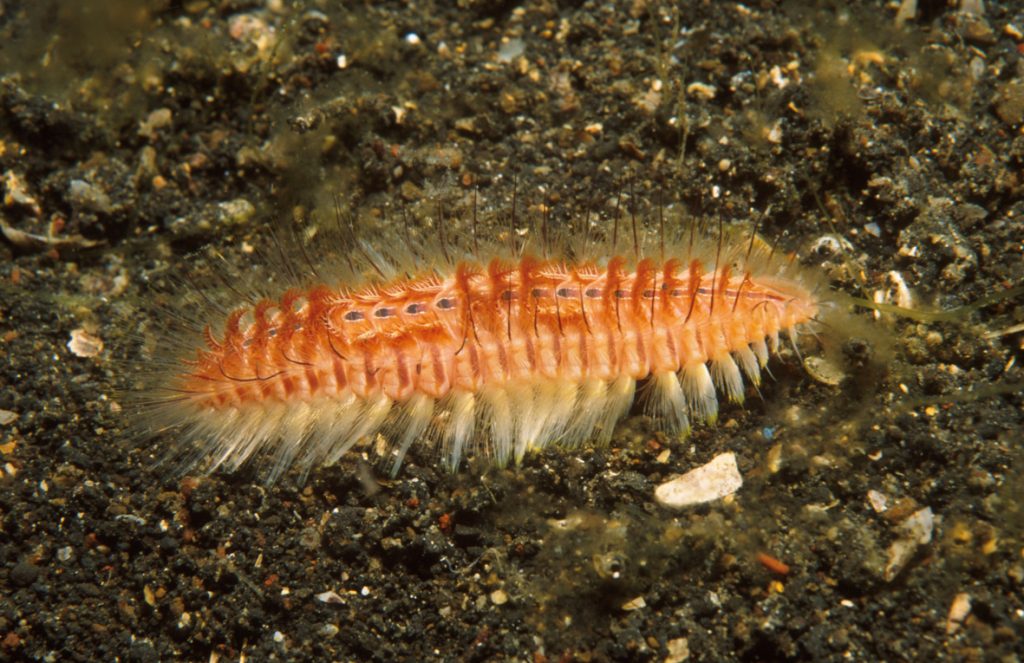
One place I really wanted to return to was Retak Larry, a “muck dive” site where I remembered squid laying eggs on a piece of rope right in front of me. It’s still good, but there was much more rubbish littering the sea floor. This time, the prize encounter was one that eluded me last time, the Bobbit Worm (or Sandstriker), a fearsome predator which can be found here on night dives. From a human perspective, this creature can be quite disturbing and has the ability to stop people getting into the sea, even in areas where they’re not found!
Despite the human onslaught, Lembeh is still special and continues to give sanctuary to a multitude of ridiculously strange and obscure creatures. The tiny thread of a pipefish that Fian (our dive guide) spotted underneath some non-descript coral (did he already know it was there, I wondered?) or the Pontohi Pygmy Seahorse, not even discovered when we visited in 2002. Or maybe the miniscule baby boxfish circling a tiny twig, like a swimming yellow pea. Or perhaps the small white-ish cuttlefish, levitating above the sand like Eva from Wall-e (the kids’ film with an environmental message).
If I’d not been there before, I think I would have been very happy (with the exception of the rubbish) as I would have had no comparison, but of course I did have that comparison. We still enjoyed our visit and it was still rewarding, but for me it was tinged with sadness. It just didn’t seem quite the same – yes, there’s still a lot to see but there wasn’t the abundance and intensity of encounters compared to 2002. But don’t let me put you off from travelling there. You’ll see lots of amazing “weird stuff” and it’s still a major “critter capital of the world”.
One can question oneself about experiences like the one I’ve described and whether your own part of the equation is helpful or detrimental to the situation. I think on balance, managed ecotourism can be and is in many circumstances very helpful. I suppose the difficult line to establish is where “managed” becomes “unmanaged”, where “development” becomes “over-development” and where protected areas are no longer adequately protected, or protected at all.
Whilst ecotourism may not be a perfect solution, as it can sometimes create unintended consequences, it does bring some benefits in that a single visitor can create another small reason for a government and a local community to preserve and take greater care of its’ natural heritage, not just to the benefit of humans, but to the benefit of planet as a whole. And lots of small reasons add up to one big reason. One phrase I stumbled upon recently summed it up perfectly; “There’s no Planet B”.