

Text & Photography by Jeremy Cuff/www.ja-universe.com
In this issue, we head to offshore waters for a slightly humorous take on the “Above 18 Metres” series, on a quest for Blue Shark encounters. As this is a snorkelling trip, you might even attain a depth of 18 inches! For reader continuity and familiarity, we’ve kept the general format of the series, but with a couple of tweaks….
Diving or snorkelling with sharks is normally associated with the Great White encounters in South Africa, South Australia or Guadalupe in Mexico, or perhaps the Osprey Reef dives in the Coral Sea off North East Australia that attracts mostly reef sharks. But to some people’s surprise (and to a tabloid journalist’s delight whenever the story has made the wider media), you can also do it here in the UK with the target species on our trip being Blue Sharks.
Personally, I’d been aware of the Blue Shark encounters off the coast of Cornwall for some time, so last December when I was planning some things for the New Year, the Cornish Blues again bubbled to the top of my “to do” list. Though I’d already done two Blue Shark trips previously, I fancied doing it again.
Options for this type of trip are very limited due to the “niche” nature of the subject matter and the relatively small “time window” in which the sharks can be reliably seen, and the weather is potentially most stable. I chose to go with shark enthusiast Charles Hood, who is friendly, knowledgeable and keen to share his interest in sharks. The trips run out of Penzance (weather permitting) between late June/early July and early October, and his success rate of finding “the Blues” is around 95%.
The Blue Shark is a species of the open water and deep reefs, with a global distribution that covers tropical, sub-tropical and temperate zones. They are known to cover great distances, and are thought to utilise currents such as the Gulf Stream to reach waters around the UK and Europe.
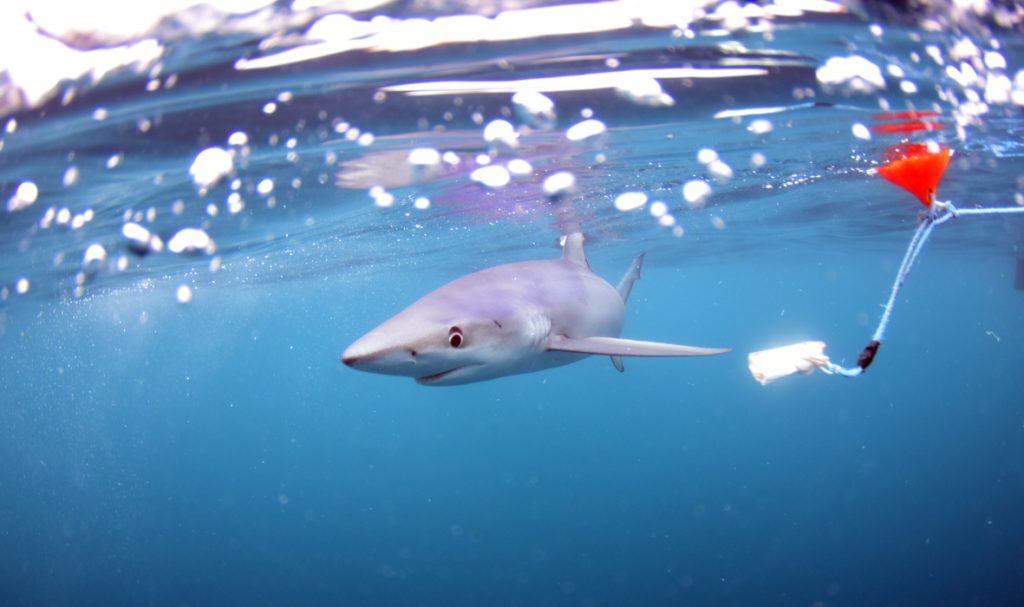
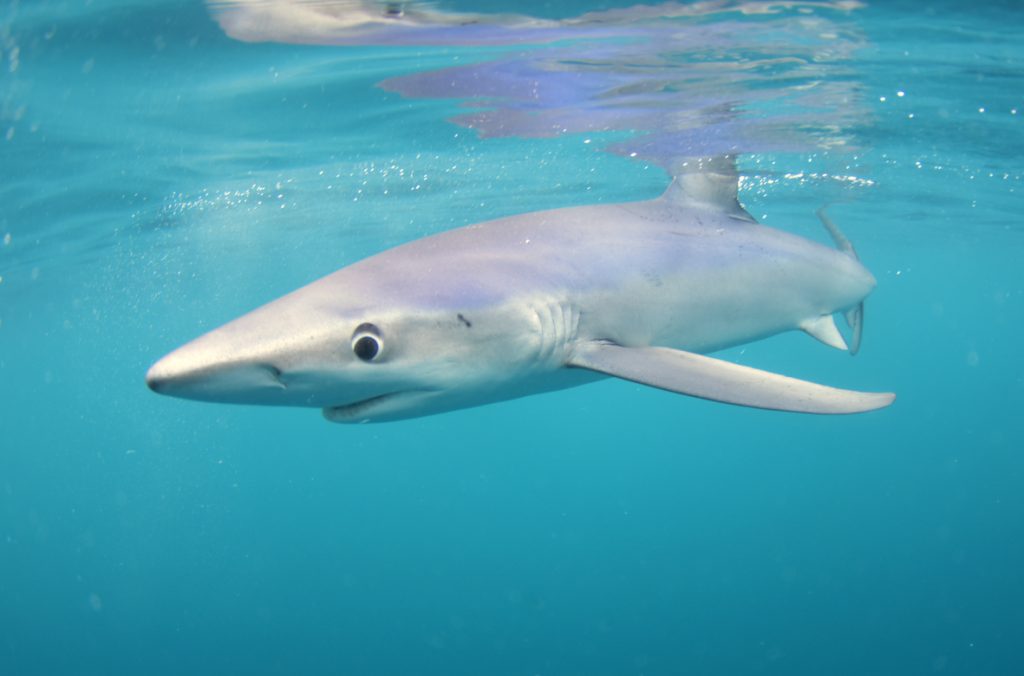
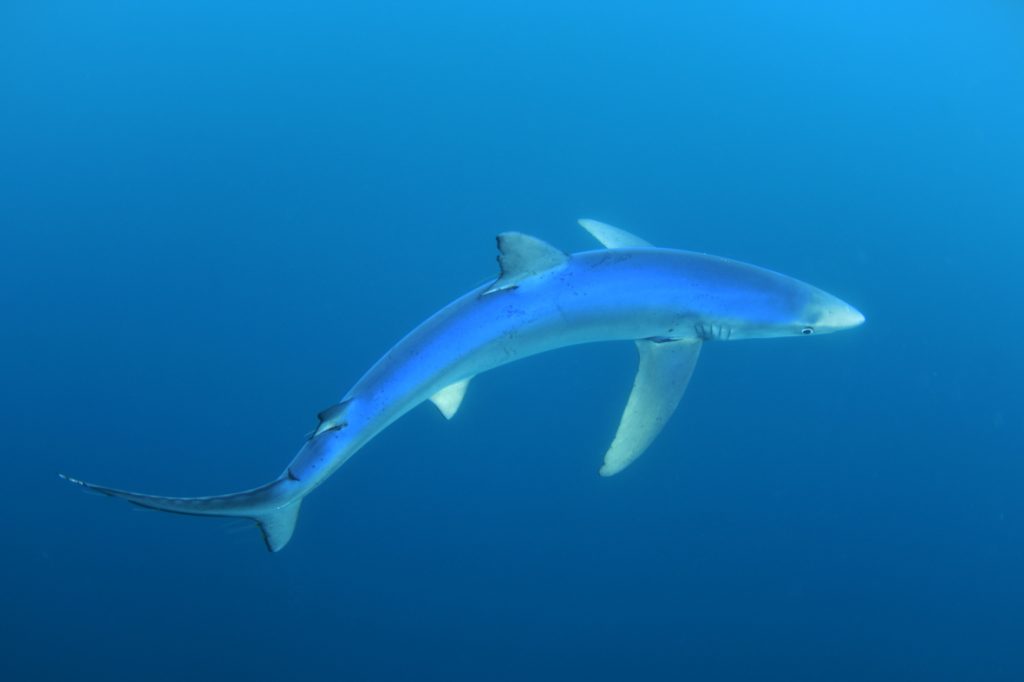
Appearance-wise, they are very sleek and clearly suited to their pelagic lifestyle. They are known to hunt small fish and cephalopods (especially squid), though they’re also thought to feed on bottom dwelling species on occasions. Their colouration on the back and flanks, though always blue as their name suggests, can differ markedly between individuals; from a blue tinged grey to a very deep blue, which contrasts with a white underside.
In terms of size, they can attain an impressive 12 ft (3.8 metres) in length, though most specimens encountered will be significantly smaller than this. Coincidentally, a record Blue Shark was caught by fishermen somewhere off Penzance in August 2017 – it was a massive specimen. It’s worth Googling it to have a look at the picture. Thankfully, it was returned to the water, though we didn’t manage to encounter it on our trip!
ARRIVAL AT THE “SHARK SITE”
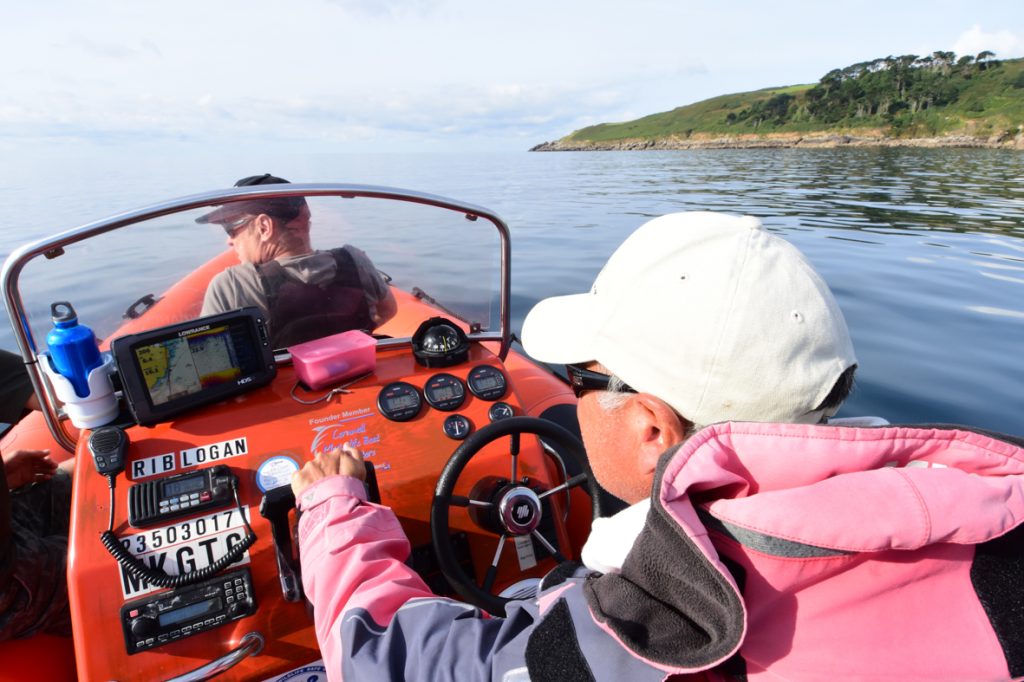
The meet up for the trip is around 8.00-8.30 in the main Penzance car park next to the harbour and slipway (where Charles launches his boat, RIB Logan). There’s plenty of space and I’ve never seen it full, especially first thing in the morning.
In terms of the shark “site” itself, Charles aims for a general area in which the sharks have been reliably encountered in the past through trial and error, rather than a specific seamount or pinnacle that approaches the surface. The area is about 15 miles offshore and around 17 miles from the starting point of Penzance.
Once the engine is switched off, Charles gets to work attracting the sharks, as we drift with the current. Nothing is guaranteed in the ocean, and it’s certainly possible to spend all day in seemingly perfect conditions without any sightings whatsoever. Whilst we waited, we wondered what would our encounters would be like?
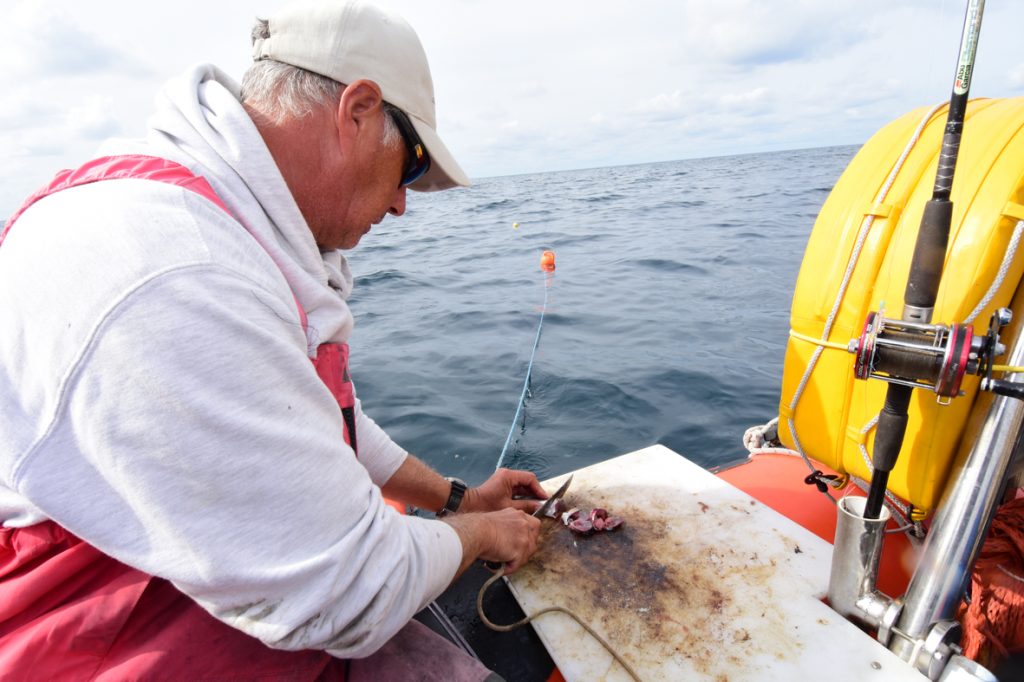
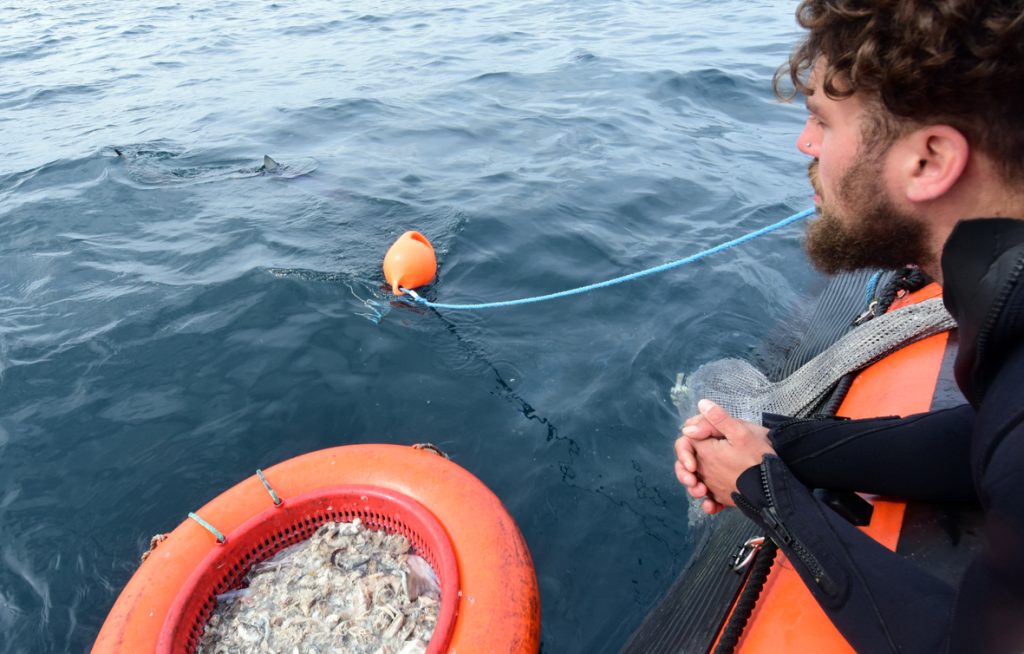
It would be almost impossible to encounter Blue Sharks without something to attract them in, so Charles uses pre-prepared chum which creates a slick that leads to the boat, which he deploys as soon as we’ve arrived in his chosen area. The chum is quite rancid, and won’t suit those with a squeamish disposition or anyone who gets badly seasick. Even whilst in the water, you’re very aware of it as you tend to spend most time in the “best area” which is down current of the chum basket. If you swallow any water, you can taste it!
As the chum spreads out to cover a wide area, there has to be some way of making the boat and the area immediately around it the focal point of the shark’s investigations, so that they can be easily seen. Charles does this by supplementing the chum (which remains in the water all day in the “chum basket”) with some fresh mackerel that he catches en route, throwing in small pieces at regular intervals. He also attaches larger pieces of bait to a rope suspended by a buoy, which is floated a few metres from the boat. Any shark that investigates it can usually be seen breaking the surface which alerts everyone to its presence. Then, once the sharks have become more confident, Charles can slowly draw the bait towards the boat, hopefully bringing any interested shark with it and into clear view.
DIVE (WELL, THE SNORKEL) BRIEFING
As already mentioned, this is a different take on the above 18 metres series in that it’s snorkelling rather than diving. So, rather than spending your time somewhere in the “above 18 metres zone”, you’ll spend your time on the surface in the “above 18 inches zone” (unless you manage to duck dive down)!
As a generalisation, it tends to be divers that do this trip, but non-divers can also participate, though it’s important that they’re fully prepared in terms of the gear required and are comfortable with the likely conditions and circumstances they’ll find themselves in.
Back in 2016, at the same time of year (early September) I did the same trip with Charles and got horrendously seasick, even though I don’t normally suffer badly with it. I was so ill that I was in the water puking and retching whilst trying to photograph sharks – it wasn’t good.
This time, I sought out some decent seasickness tablets and ensured that I took the required dosage before setting out. It seems that the “open ocean swells” have a different kind of movement which can catch people out, so be prepared. You’ve got nothing to lose and everything to gain by taking them. Happily, I was completely fine on the 2017 trip.
Other essentials are staying warm, remaining hydrated and bringing the correct gear. It’s surprising how easy it is to get cold out at sea, even though it may feel warm and balmy onshore – warm coats or hoodies (ideally waterproof) and hats are therefore essential. Also, make sure you bring food and plenty of drink to keep yourself going. Don’t underestimate the conditions (which can, of course change considerably throughout a day).
In terms of gear, it’s up to the participants to bring everything they need, as Charles doesn’t have room to carry spares onboard for those who’ve forgotten something important. The checklist is mask, snorkel, wetsuit (5mm minimum), fins, boots, hood and gloves. As the sharks can be attracted to bright and light coloured objects, Charles won’t allow anyone into the water without a hood and gloves as protection. A weight belt is also preferable for balance and posture in the water, counteracting the buoyancy of the wetsuit.
In terms of the sharks themselves, the first sighting of the day isn’t the signal for everyone to jump straight into the water, whilst hollering and thrashing around. Instead, Charles advocates a period of “confidence building” whereby the sharks are “encouraged” to become more comfortable and bold around the boat, which is best achieved by the participants remaining on the boat and slowly kitting up, while he works the chum and bait.
THE ENCOUNTERS
No one day is the same on this trip, either in terms of the number of sharks seen, or the confidence (or lack of) exhibited by the sharks around the boat and snorkellers, which can affect the quality or duration of the encounters.
This trip had a similar start to my previous 2016 trip; a wait of between 1 and 2 hours before our first “Blue” turned up, a small specimen in this instance. When the fin and tail broke the surface next to the bait, a wave of anticipation swept across the boat. The sharks tend to be skittish and wary initially, so we waited until they became more accustomed to the boat and the bait. Then a larger pair arrived resulting in the disappearance of the small specimens that had begun to gather confidence. It was as though the larger pair had driven them away.
At that point, it was time to get wet and see if they would stick around. I was the “guinea pig” and had a few close buzzes all to myself before the others got in. They seemed not to like all of us in the water at once and gradually moved away, so we decided to get out for a while and watch from the boat. We then experienced a lull in the activity until the early afternoon.
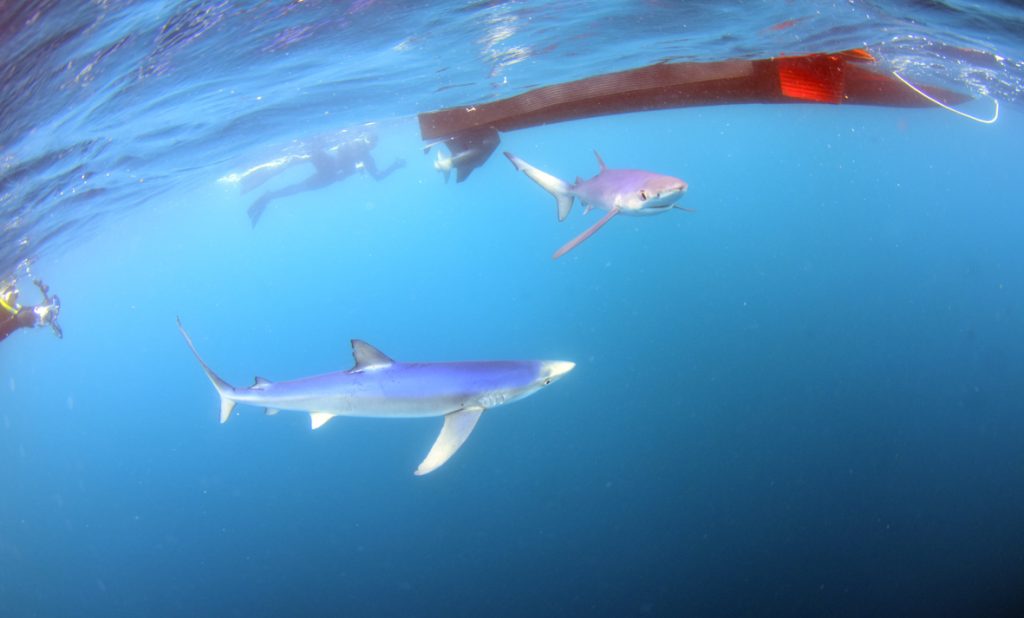
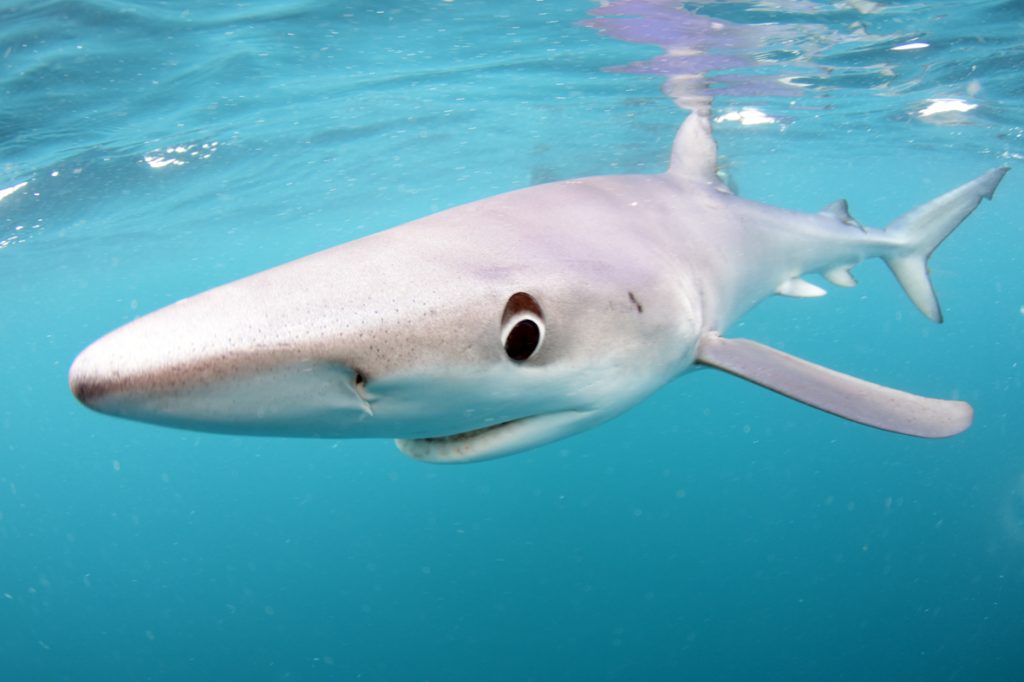
Just as we were beginning think that we’d had the best of the day, a larger specimen of around 6ft (1.8 metres) in length turned up, confidently checking out the bait and chum basket. This was our opportunity to get back in the water. We then enjoyed a prolonged encounter with this large, bold specimen as it moved between us, around us and sometimes right towards us, even bumping us with its snout on a few occasions. I wouldn’t say it was intimidating, but you certainly give it respect. Charles said it was unusually bold for a larger specimen, as they normally tend to be warier and more circumspect. During the day, we also noticed that the sharks had more than a passing interest in the propeller. Sharks see and perceive the world in a very different way to ourselves and may have found the electrical field of the metal almost as irresistible as the chum.
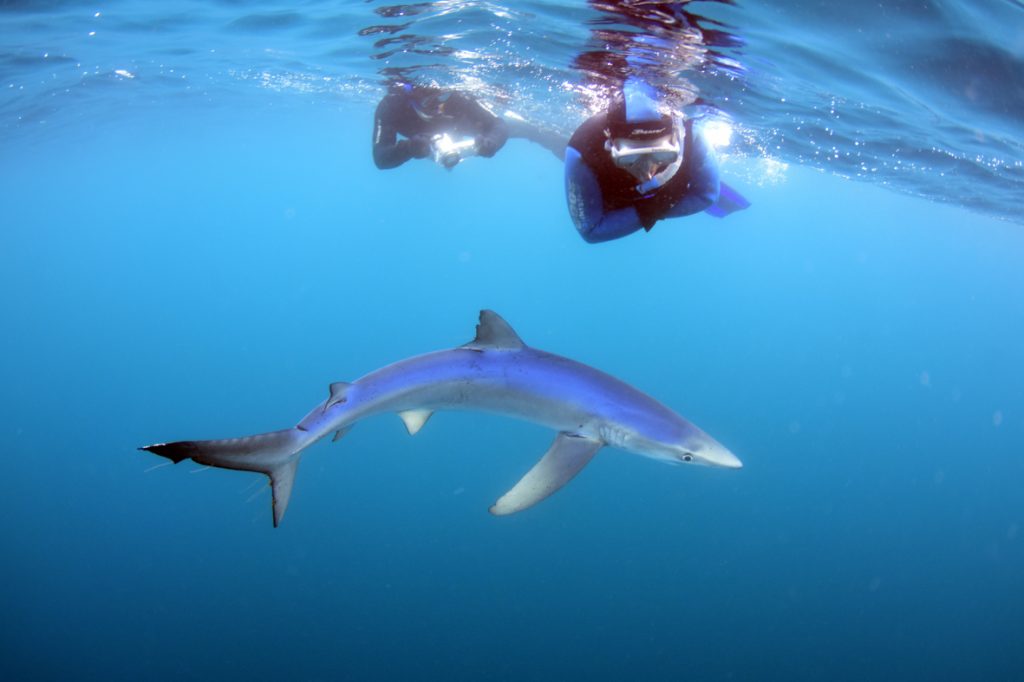
Though not as many sharks turned up on our day compared to a very active set of encounters from the previous days trip, we were lucky to get this late encounter – it made the day. On one special day, Charles reported an incredible 20 sharks around the boat!
As we headed back to Penzance, amid gathering winds (that would cancel the following days trip), everyone was happy. I imagined what the headlines of some tabloid journalist reporting on our trip would be (“Killer sharks sighted just off UK shore…” or some nonsense like that). But that wasn’t the reality; we’d had a unique and rewarding experience, encountering a species that rarely comes into contact with humans. That evening in the pub, there was a contented tiredness among our group, and I slept like a log that night. It was a good day.
FACTFILE
Encountering Blue Sharks in Cornwall
As far as I’m aware, you have two options for Blue Shark encounters in the South West, either with Charles Hood based out of Penzance, or Atlantic Divers based out of Newquay.
The Charles Hood trip which is the one described in the feature is very good, and allows snorkelling with the sharks (maximum of 5 participants). The Atlantic Divers trip is also good, but is a cage dive trip, where participants take turns to enter a two-man cage to view the sharks.
Charles Hood
Chynoweth
Chynoweth Lane
St Hilary
Cornwall
TR20 9DU
T: 07712 622440
Web: www.charleshood.com
Atlantic Divers
To contact Atlantic Divers, visit;
or call
T: 01637 850930
M: 07860 927833
Type of “Dive”
Actually, it’s a snorkel. As you can drift a fair distance with the current during the day, you could call it a “drift snorkel”!
Depth
Probably around a mammoth 18 inches, unless you duck dive down. As you’re in full wetsuits (which are very buoyant), I didn’t see anybody try the “duck dive”.
It is a good idea to take a weight belt which helps to counteract the buoyancy of the wet suit, and to provide better stability and posture in the water.
Marine Life/What To Look Out For
Blue Sharks (hopefully several). It’s also possible that you could see dolphins (we did), porpoise, sunfish or even basking sharks. Charles said that on one trip, what he believed to be a porbeagle shark once investigated the chum, but came in and went very quickly. Don’t rely those kind of surprises, but you never know what might turn up. Expect a few jellyfish in the water as well.
On the topside, seals are possible, especially on the rocks close to the coastline. “Twitchers” can expect to see several seabird species such as fulmars, shearwaters, guillemots, storm petrels and gannets.
Visibility
Out at sea, away from the influence of river run off, the water tends to be clearer. It is, of course infinitely variable, depending on wind direction, current, plankton & other factors, but can be six to ten metres if you’re lucky.
Seabed
It’s down there somewhere, but you can’t see it!
Hazards
Sunburn, dehydration, cold and seasickness are the main hazards and not to be underestimated.
Make sure you take decent seasickness tablets (you’ve got nothing to lose and everything to gain), plenty of fluids and some warm (ideally waterproof) clothing. If you don’t, a day of misery could await you.