
Text & Photography by Jeremy Cuff/www.ja-universe.com
Cage diving with sharks is normally associated with the Great White encounters in South Africa, South Australia or Guadalupe in Mexico, or perhaps the Scuba Zoo dives that used to happen on the Great Barrier Reef attracting mostly reef sharks. But to some people’s surprise, you can also do it here in the UK with the target species being Blue Sharks…
I’d been aware of the Blue Shark encounters that were possible off the coast of Cornwall for some time, so last December when I was planning a few things for the New Year, the Cornish Blues bubbled to the top of my “to do” list.
Options for this type of trip are very limited due to the “niche” nature of the subject matter and the relatively small time window in which the sharks can be reliably seen. I chose to go for the Atlantic Divers trip, which runs out of the south west surf capital and summer party town of Newquay. It’s run by Chris and Annabelle Lowe, a very friendly, enthusiastic and knowledgeable couple who offer a limited number of Blue Shark cage diving trips each season from late June through to August.
During the days prior to the drive down to Cornwall, I regularly checked the weather forecast which looked fine for the day of the trip itself. However, the winds were quite high on the days leading up it, so I hoped the conditions would have settled enough to allow the trip to go ahead. After a call from Chris and Annabelle to confirm my attendance and check any requirements for kit, I felt fortunate that it would go ahead as planned, as I later learned that the previous day’s trip had been cancelled due to the winds.
The format for the day was to meet at Newquay’s diminutive harbour at 9am to load the gear into the boat, followed by a briefing in a nearby classroom where Chris and Annabelle described the day’s activities, as well as wider issues of marine and shark conservation, especially the work of the Shark Trust with whom they enjoy an association. We learned, for example, that there are more than 30 species of shark known from UK waters.
With all the loading, formalities and briefings done we set off under clear blue skies, heading out to sea in the residual swell from the previous days high winds. We would keep going until the land was a distant strip on the horizon, to a general area where the sharks have been known from past experience, in around 60 metres of water.
The Blue Shark is a species of the open water and deep reefs, with a global distribution that covers tropical, sub-tropical and temperate zones. They are known to cover great distances, and are thought to utilise currents such as the Gulf Stream to reach waters around the UK and Europe.
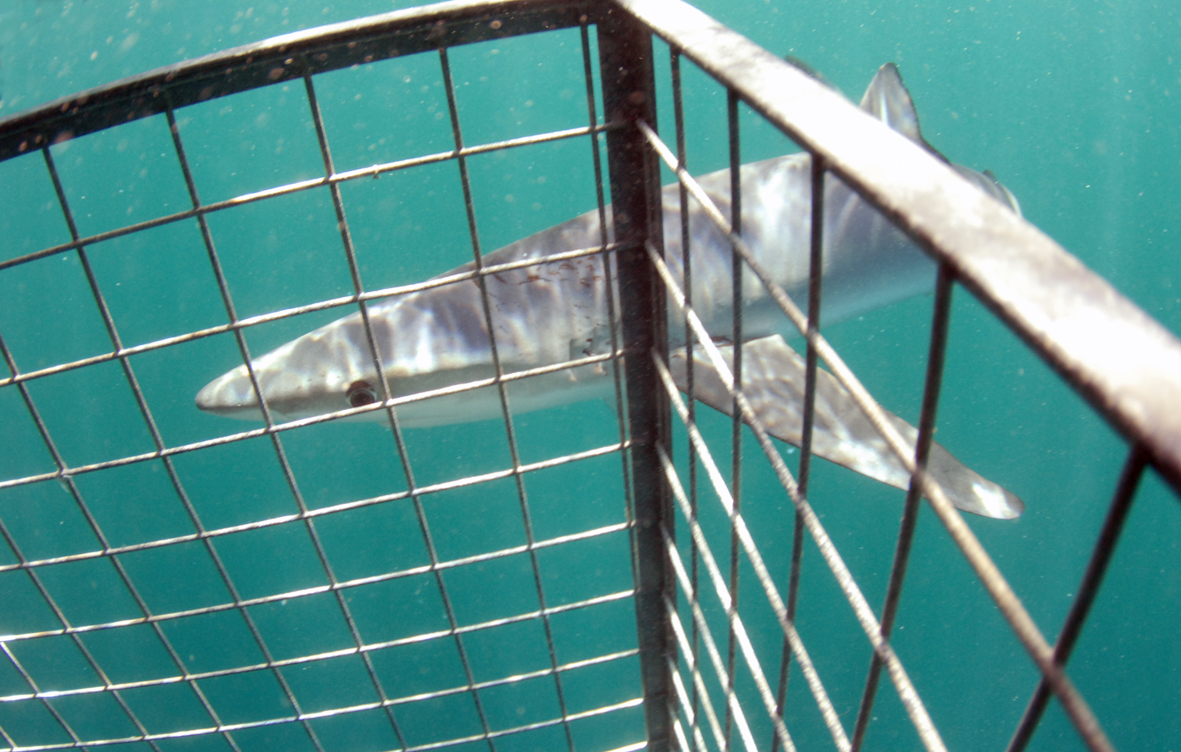
Appearance-wise, they are very sleek and clearly suited to their pelagic lifestyle where they are known to hunt small fish and cephalopods (especially squid), though they are also thought to feed on bottom dwelling species on occasions. Their colouration on the back and flanks, though always blue as their name suggests, can differ markedly between individuals; from a blue tinged grey to a very deep blue, which contrasts with a white underside. In terms of size, they can attain an impressive 3.8 metres in length, though most specimens encountered will be significantly smaller than this.
It would be almost impossible to encounter Blue Sharks without something to attract them in, so Chris uses chum made up of herring which creates a slick that leads to the boat, which he deploys on the approach to his chosen area.
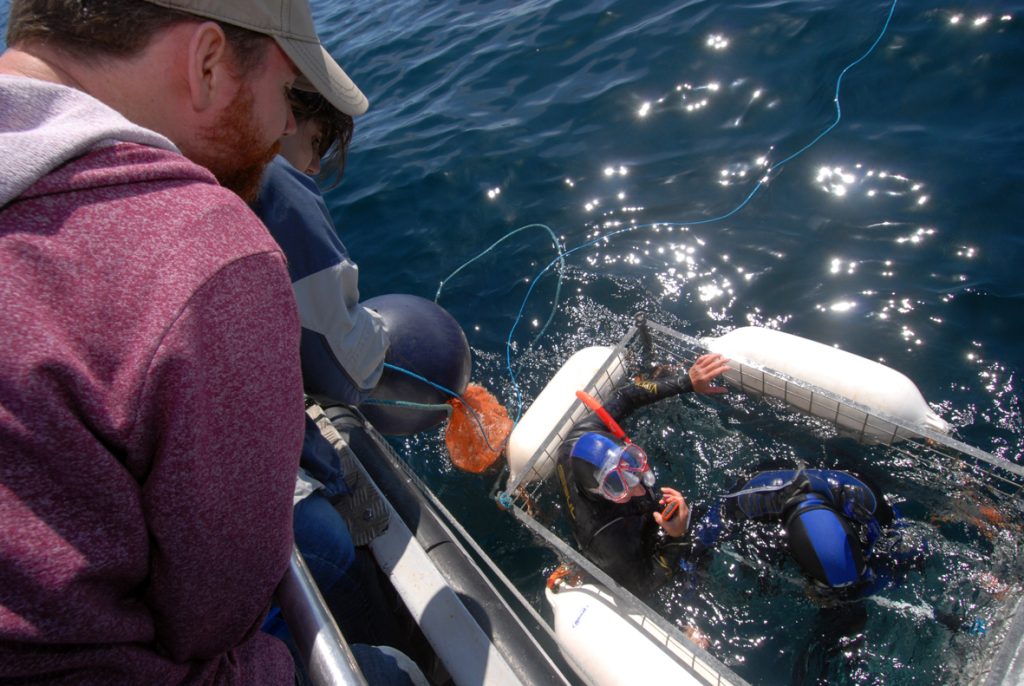
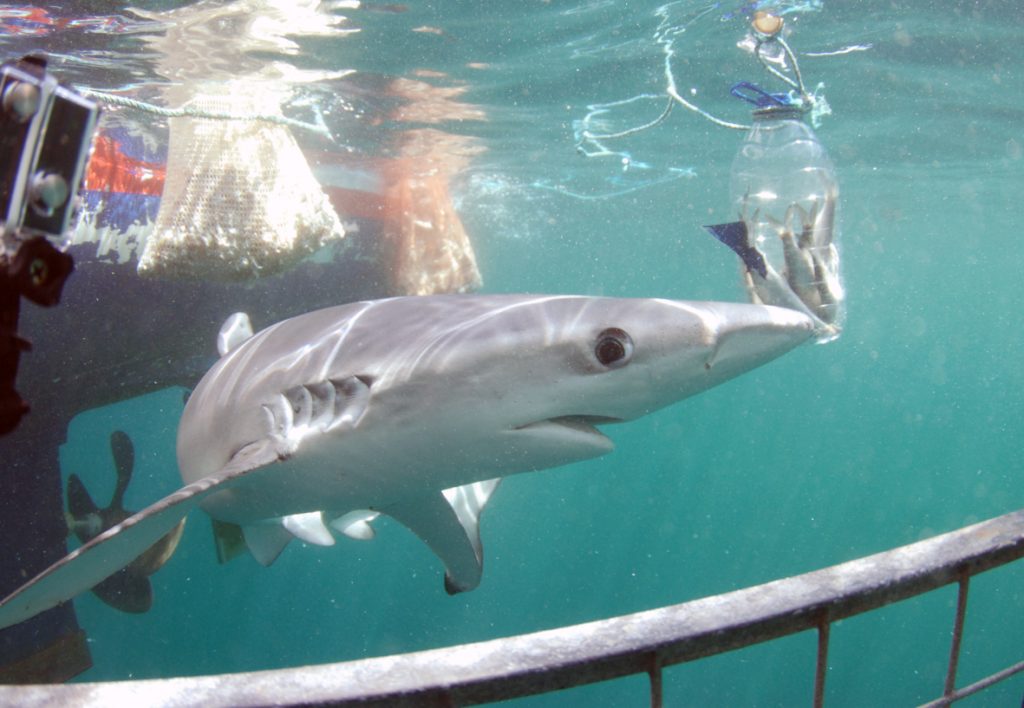
Once we’ve arrived and the engine is switched off, the cage is lowered into the water and we wait, drifting with the current. Nothing is guaranteed in the ocean, and it’s certainly possible to spend all day in seemingly perfect conditions without any sightings whatsoever. I hoped for at least a few sightings from the cage, but would we get any close encounters?
As the chum spreads out to cover a wide area, there has to be some way of making the boat and the area immediately around the cage the focal point of the shark’s investigations, so that they can be easily seen. Chris does this by filling a holed plastic bottle with herring and attaching it to a rope, which is allowed to float 10 or 15 metres from the boat. Any shark that investigates it can usually be seen breaking the surface which alerts everyone to its presence. Then, with divers in the cage, Chris can slowly draw the bottle towards the boat and cage, hopefully bringing the shark with it and into clear view.
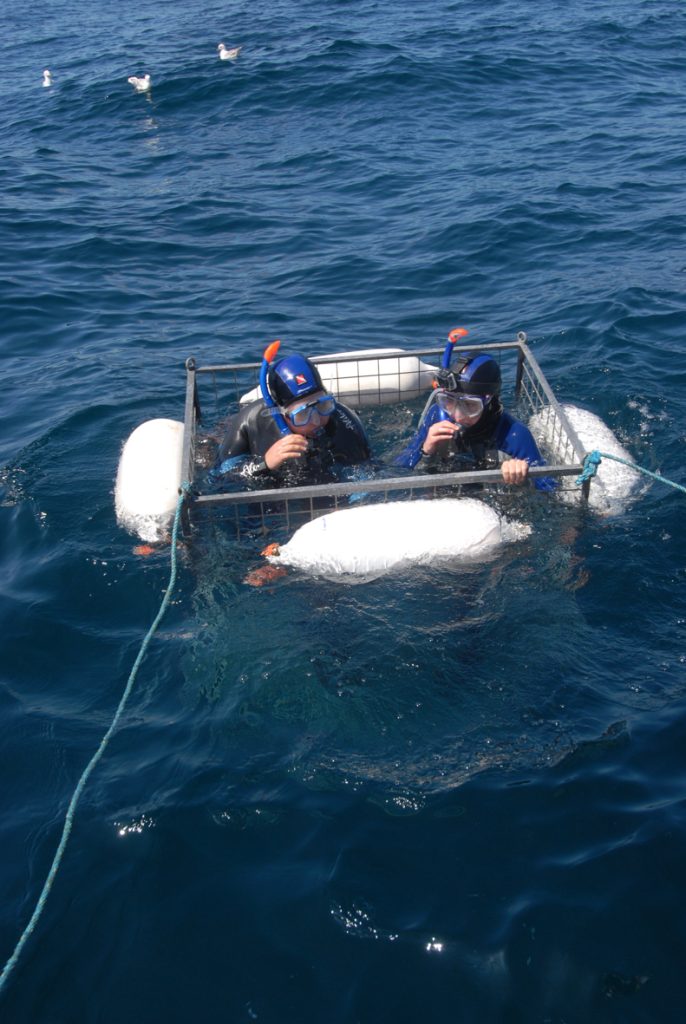
The cage itself is small, but with enough room for two divers to comfortably fit in whilst allowing a bit of room to move and look around. It’s suspended by floats to keep it buoyant with a convenient viewing slit beneath the water line. Whilst not in use, it is stowed at the rear of the vessel from where it’s lowered and retrieved from the water using a winch. Once in the water, it’s moved to the side of the boat from where it is accessed. Initially, it looks a bit tricky to get in and out of, but it’s not as difficult as it looks.
Before anyone climbed into the cage, Chris explained a few more useful tips and facts such as suppressing the urge to shout, whoop, celebrate and talk loudly if a shark appears, which along with clunking footsteps and excessive splashing, is thought to frighten them. Another clue to their presence can be unsettled seabirds such as the fulmars that will often bob around close to the cage and boat hoping for titbits of food. He also told us that the “boat record” was seven Blue Sharks at one time and that it’s not impossible that something very rare and big could turn up such as a Porbeagle, Mako or Thresher Shark, as they are known sporadically from the general area.
After probably a couple of hours of waiting, a fin and tail broke the surface next to the plastic bottle; it was a Blue Shark, our first of the day. A wave of excitement swept across the boat as the pairs of cage divers prepared to get in. To avoid any grumbles among the participants, Chris and Annabelle do a “number draw” to determine who gets in first. This seemed to work well to get things started, with a general relaxation of the running order naturally occurring as the day progressed, as some divers opted to sit it out and watch from the deck, as the sharks will sometimes circle the boat.
The first pair of divers to get in the water had a very good encounter with the first shark which briefly granted some close passes of the cage. They came out beaming, as others hurriedly prepared for their turn. During my first visit to the cage, I saw the shark but the views were fleeting and not conducive to any photography, which was a very difficult challenge in the buoyant cage that bobbed around in the swell. I also vowed to take my weight belt for the next “immersions” as my 7mm wetsuit made it difficult to remain underwater and able to fully utilise the viewing slit.
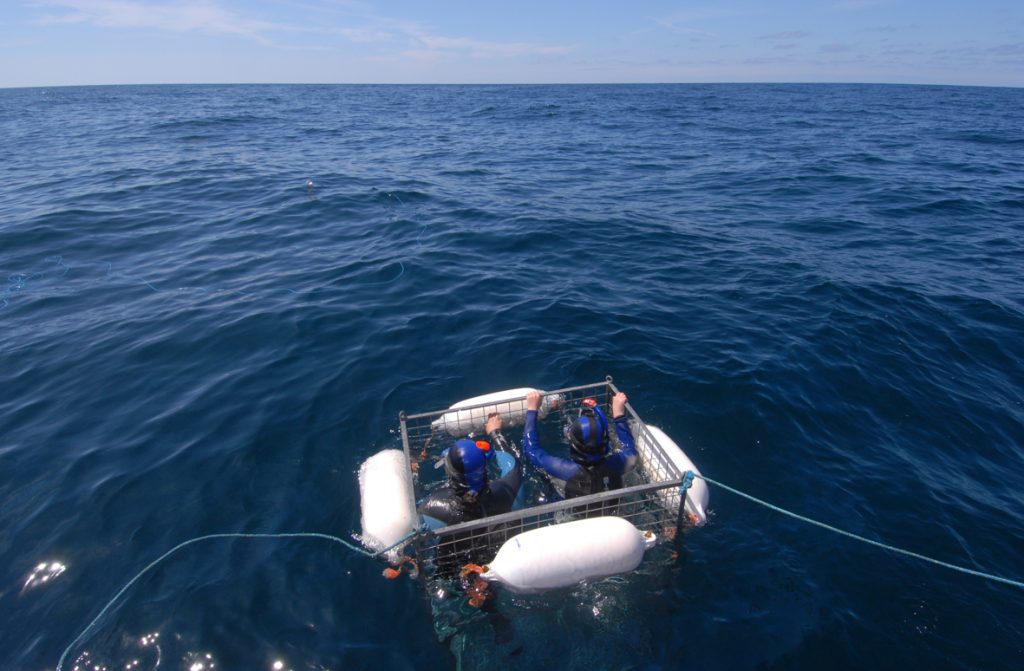
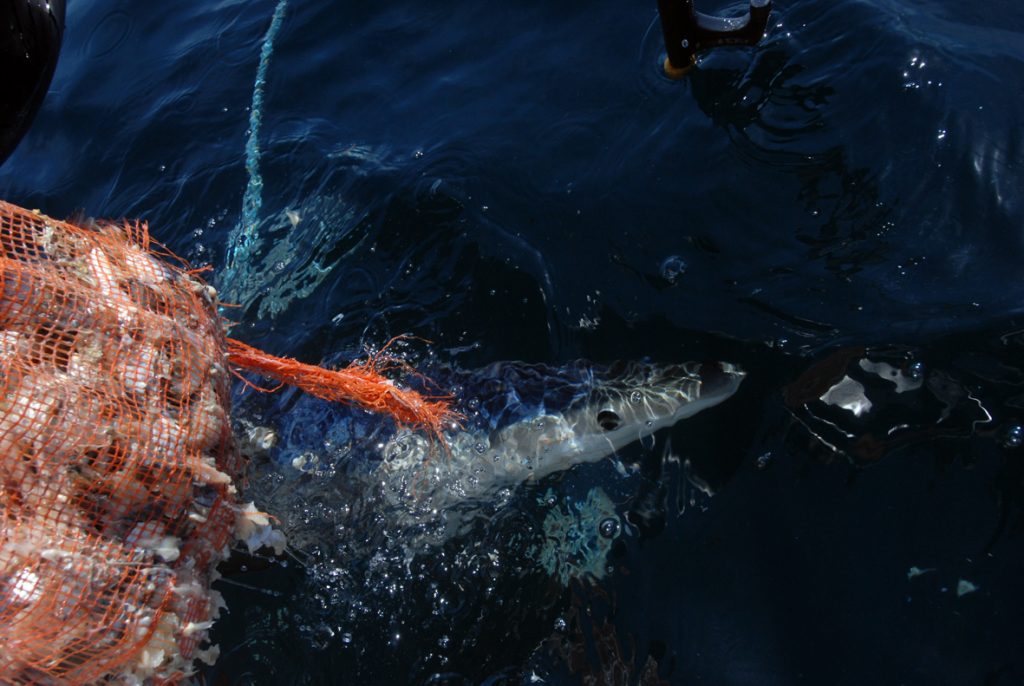
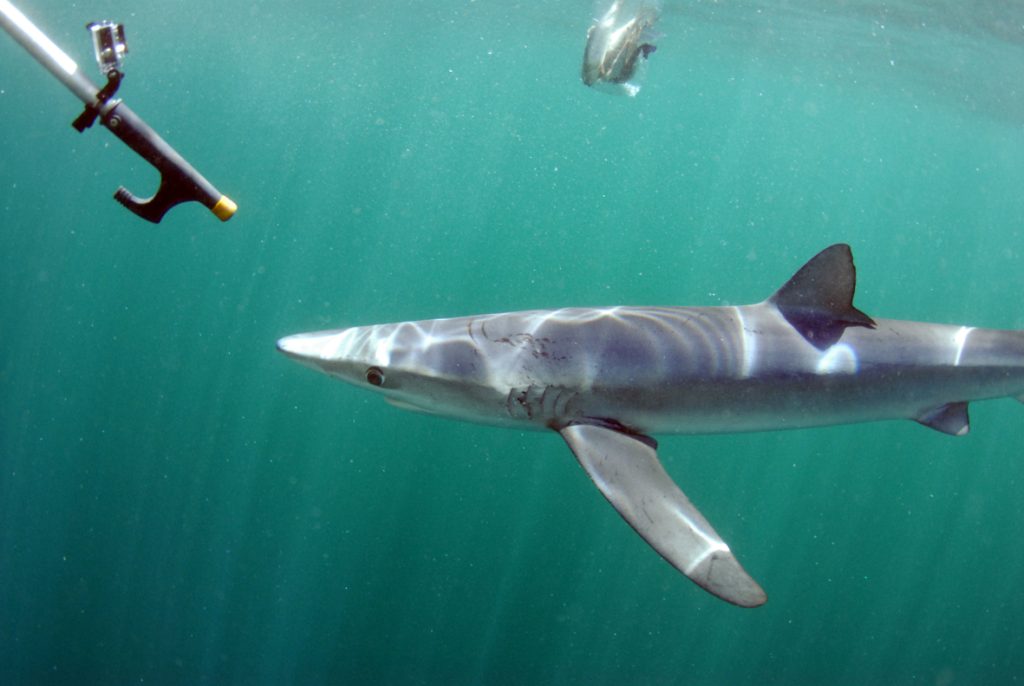
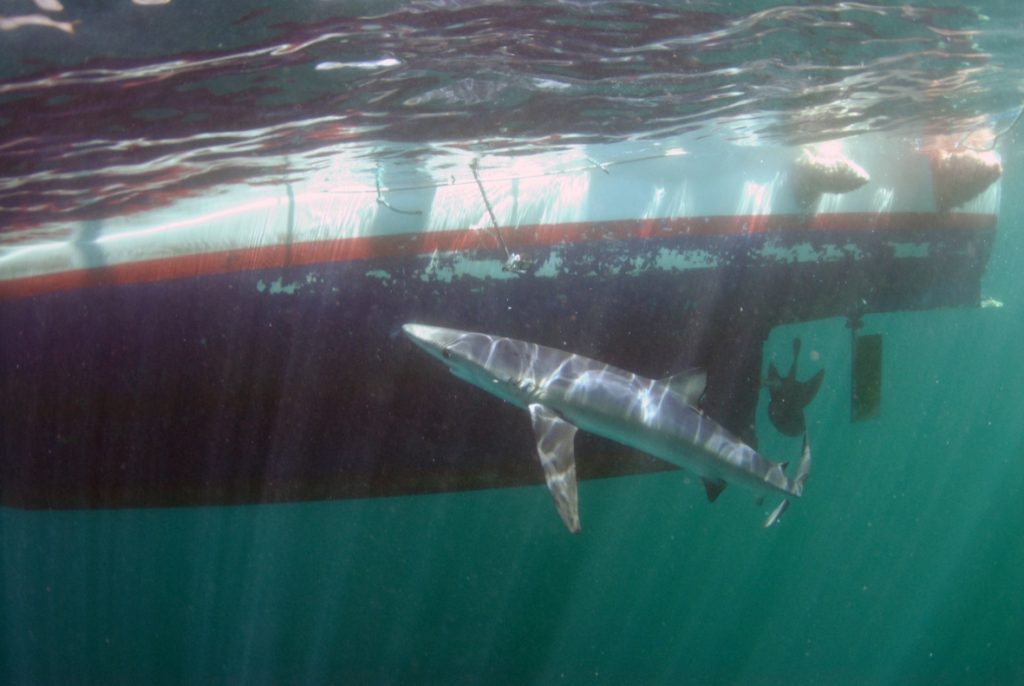
Over the day, we certainly had four sharks around the boat, and possibly five. Chris said that they can sometimes be bold, and I was fortunate enough to enjoy close encounters with one specimen passing close to the cage on several occasions, and another that actually investigated us by literally poking its snout into the viewing slit whilst we were inside. Later, the same shark spent considerable time checking out the underside of the boat and the chum bag which Chris would sometimes dangle over the side in addition to the floating “herring filled” plastic bottle.
Strictly speaking, this isn’t of course scuba diving in the true sense of the word (as the only supplied air is from a snorkel!), but it’s certainly one that can only appeal to people who like the sea, and the life that lives in it. Though this trip won’t go ahead if the conditions are too rough, the swell from the previous days winds turned out to be somewhat “puke inducing”, as several of the shark snorkelers wrestled with bouts of seasickness during the day, including quite unusually myself. The remedy is to take sea seasickness tablets before setting out – you’ve got nothing to lose and everything to gain by doing so.
If the Blue Sharks aren’t enough or they don’t put in an appearance, this trip is also good for other wildlife sightings; we were lucky to spot a couple of Sunfish at the surface, and for “twitchers” you can expect to see several seabird species such as fulmars, shearwaters, guillemots, storm petrels and gannets. There’s also the possibility of basking sharks, dolphins, porpoises and even the odd passing seal.
For fans of wildlife and wilderness, it’s great to think that you do this kind of thing here in the UK. Like the venomous adder on land, it’s good to know that there’s still edgy and wild creatures left in and around the UK for those who are prepared to seek them out. Overall, we had great day, coming face to face with this fantastic species of shark. It was very worthwhile.
Factfile
Where, When & Who
I chose to go for the Atlantic Divers trip, which runs out of the south west surf capital and summer party town of Newquay in Cornwall.
It’s run by Chris and Annabelle Lowe who offer a limited number of Blue Shark cage diving trips each season from late June through to August.
To contact Atlantic Divers, visit;
or call
T: 01637 850930
M: 07860 927833
Trip Details (as taken from the Atlantic Divers website)
Departs from the old historic Newquay Harbour at approximately 9am and the trip lasts about 8 hours but if a shark comes along late in the day and tide allows we will stay longer so allow for this when parking. Please wear warm clothing (as even in the summer it can get chilly out on the boat). Bring packed lunch and something to drink, wet suit and mask if you prefer your own and sea sick tablets should you need them as the boat does not return to shore for sea sickness.
Wet suit, mask, snorkel and diving boots are provided if required all instruction and shark tuition, shark literature, hot drinks and chocolate biscuit are included in the price of £105 per person.
A deposit of 50% is required to secure booking, the remainder to be paid on the day prior to the trip leaving. Trip is subject to weather conditions. Deposits will be returned less a £5 booking handling fee should the trip be cancelled. Potential shark adventurers are advised that these sharks are not caged animals and whilst every effort will be made by the Skipper to attract the shark to the boat a sighting can not be guaranteed and if this would cause you any distress then this is not the trip for you.
Terms and conditions apply when booking, please see this section and ask for more information when phoning for booking.
Will The Trip Run?
This trip won’t go ahead if the conditions are too rough.
If it does go ahead, even a very modest swell can easily cause sea sickness. The remedy is to take sea seasickness tablets before setting out – you’ve got nothing to lose and everything to gain by doing so.
It’s a case of hoping for the best with the UK’s fickle weather, and checking with Chris and Annabelle before setting off, or getting up early.
Getting To Newquay
Newquay in located on the north coast of Cornwall.
It is easily accessed and well signposted from the main A30. In the summer months, traffic can be very busy in Cornwall, so it’s worth allowing plenty of time to get there.
Accommodation in Newquay
There’s a very wide choice of hotels and campsites in and around Newquay to suit all budgets and tastes.
Parking at Newquay Harbour
If driving, it’s worth making sure that you get to the harbour early, as parking is very limited.
Shark Information & Conservation
Good information about shark species and the efforts made to conserve them can be found on the Shark Trust website. Please visit;
Other Options
It’s also possible to snorkel with Blue Sharks with renowned shark photographer Charles Hood. For details, please visit;