Text by Jeremy Cuff/www.ja-universe.com
Photography by Jeremy Cuff
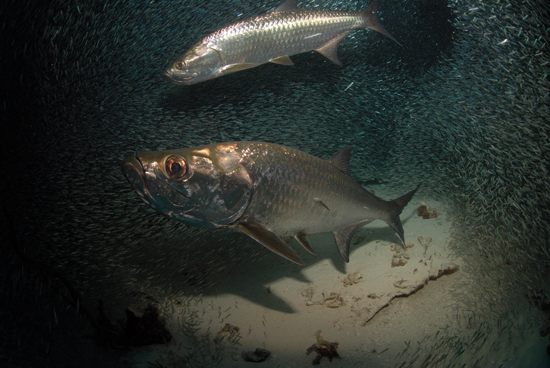
Capturing the feeding Tarpon at Silver Caves on Belize’s Lighthouse Reef wasn’t just a case of “pointing and shooting”. Here’s the thinking and strategy that went into getting the shot…
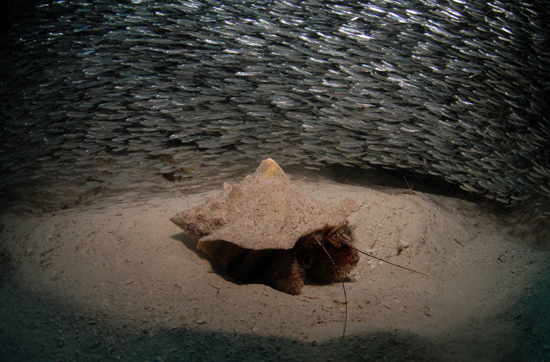
When Captain Jay of the Belize Aggressor said that we were diving at a site called Silver Caves, it sounded interesting, as it was named after the silversides that frequent a cave in the reef, often numbering in their thousands. As the silversides had been seen when the boat visited the site during the previous week, we were optimistic that they would still be there.
The Idea
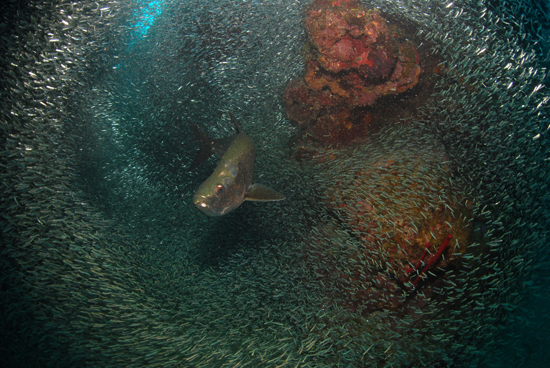
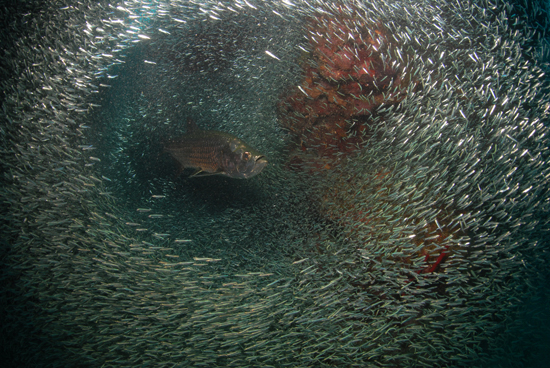
On the first dive, I made a beeline to the cave, which thankfully brimmed with countless silversides. There was a lot of activity going on, with tarpon and groupers everywhere, feeding on the bonanza. I immediately saw that it had great photographic potential, if only it could be unlocked.
On the first dive, things proved frustrating for the first twenty or thirty minutes as most of the other divers from the boat also went to check out the action, often kicking up sand in the cave entrance. Photographically, it was very difficult, so I decided to move away and wait until everyone had tired of the spectacle.
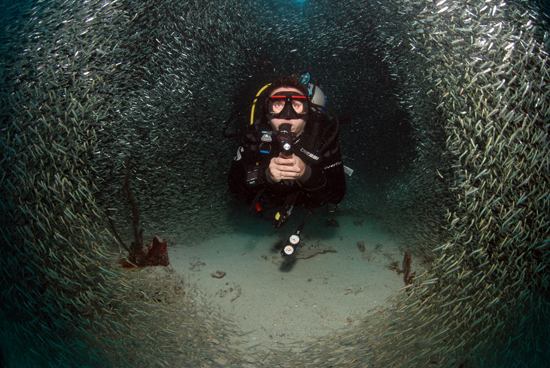
Once they’d all moved off along the wall, I spent some time having a better look, checking out the cave and trying a few things, including working with my wife Amanda who models for me when required.
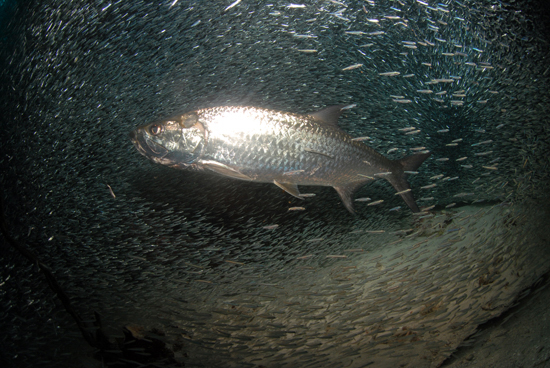
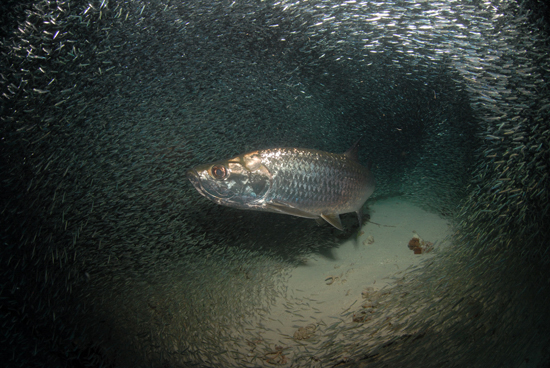
During the surface interval, I had a look at what I’d captured and decided to go back and spend the whole of the second dive around the cave. Though I had a couple of nice images from the first dive, what I wanted to capture was the feeding tarpon surrounded by silversides in the cave.
The Shot
There were always several tarpon in the area, all going in and out of the cave to seize a snack before coming back out into the open.
However, I soon worked out that if I waited inside the cave, among the mass of silversides, the tarpon wouldn’t enter, so I needed a different approach.
I decided to wait outside of the cave and watch what was happening and found that if I parked myself right outside the cave entrance, the tarpon still wouldn’t go inside as they would have to pass directly by me. But when I stayed further back and to the side of the cave, the tarpon began entering the cave again, into the mass of fish.
Once a tarpon was “committed” to entering the cave, I would follow it in. On each attempt, I couldn’t see the tarpon through the wall of fish, so I had to be ready for it to suddenly appear as the silversides parted. I also worked out that I needed to switch on my strobe’s pilot light so that I could see what was going on, and to prevent my auto focus “searching” in the gloom, and being unable to lock on to the subject.
With each tarpon encounter in the cave, I would probably get a chance for only one image in most instances, so it was a difficult and time consuming shot to capture. On some attempts, the tarpon would escape from the cave without me seeing it at all.
Both the silversides and tarpon’s scales are what I call “hyper-reflective” and therefore difficult to light correctly. Careful strobe positioning and reducing the strobe power was the only answer here to avoid the nightmare “whiteout” on certain parts of the fish, which can ruin an otherwise acceptable image. To help with this, I set the camera to show highlights which is a very useful function in helping to avoid this problem.
So, after two dives, I did get an image along the lines of what I was hoping for. Without a doubt, there are better images of this spectacle that can be captured, but I went away thinking that I did everything I could to get the result.
Of course, another two dives there would be very welcome!
Images taken on 1stAugust 2011 using a Nikon D200, 10.5mm Fish eye lens and a Subtronic Strobe. Camera settings ISO 200, 1/60thsecond, f8. Strobe power was probably quarter power.