
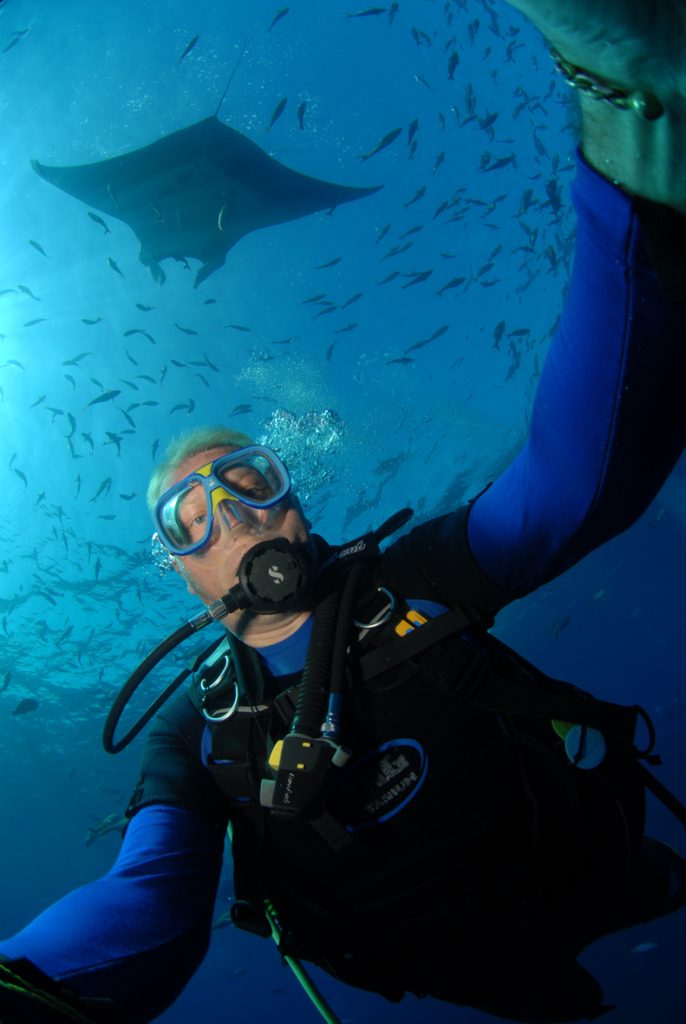
A Self Portrait With A Difference in the Socorro’s
Text by Jeremy Cuff/www.ja-universe.com
Photography by Jeremy Cuff
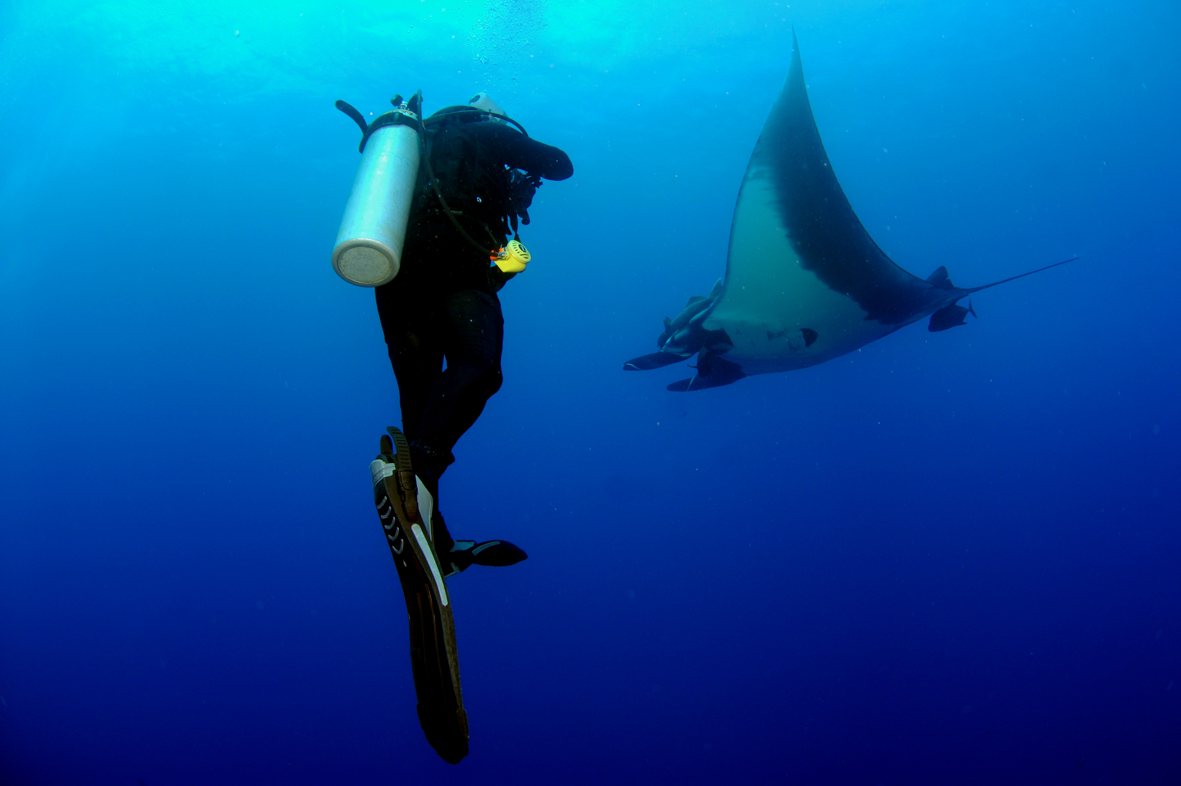
On encountering a manta ray, no diver in their right mind would look the other way would they?
Well, on one dive, in the remote Socorro Islands on Mexico’s Pacific side, I decided to do just that. It’d been an excellent week in this “big pelagic action” destination and I’d already bagged a decent set of images to illustrate some trip features that I was planning to publish, so on the very last dive of the trip, at the renowned Boiler site at San Benedicto Island, it seemed like the time to try something different.
The Idea
During the last three or four years I’d been taking “self portrait” images in swimming pools and and on safety stops using my 10.5mm fisheye lens (the ideal lens for this kind of shot), but what if I could get something more interesting into the image, such as a manta ray?
Boiler is an excellent dive site for manta ray encounters, but for whatever reason, the mantas seemed wary that day and weren’t keen on granting the expectant divers with any close passes during our visit. One specimen, however, had been circling around at the surface for some time, only moving away if any diver attempted to get close to it.
This manta presented the opportunity to try out my idea. I had little to lose as it was mission impossible to get close enough for a “conventional” shot. As long as I didn’t “chase” the manta, it would stick around.
The first thing to understand about self portraits is that they’re much easier without the additional factor of a moving subject that must somehow be included in the image, so it’s much better idea to try out some “static” pictures first.
In order to get them right, there are several things to consider, such as strobe positioning and settings, eye contact, the pose of the your own body within the image, background light levels and composition.
For the strobe, it’s primarily a case of getting the strobe lighting and positioning correct for your face (if indeed you’re using one, as they aren’t essential in all circumstances). Ideally, you want to light your eyes and face correctly, so it’s worth experimenting with this in order to get “in the zone” and understand the optimum settings for your particular brand of strobe/s.
Fish eye lenses, such as my 10.5mm, will distort arms and legs, so it’s worth spending time getting the best “pose” for your body. Basically, it’s a case of trying a few things such as outstretching you arms, lifting your chin, pairing up your legs and so on to see which works best, and is most pleasing on the eye.
Of course, it isn’t just the foreground that matters – the background must also be correctly exposed (and composed, if you’re planning to include any scenery, object or moving subject), so care must be taken to get this right.
The Image
In the case of the manta image, I had to be careful to avoid getting the sun into the image and getting a “whiteout”, so a constant awareness of the background and the whereabouts of the sun was essential. Sometimes, the sun can be hidden behind yourself, or a background object such as a boat silhouette that you’re wishing to include.
As far as composition goes, it’s much easier with a subject that doesn’t move, so the manta proved quite tricky, with many shots failing to get the required result. The only thing I can really say about it is that once I knew the general whereabouts of the manta, I would then turn my back to it, position my body and look for it’s reflection in the dome port, and using the auto focus to lock on to my face. It proved not to be an “exact science” but in the end I got something after quite a few attempts.
Though often unsaid in texts about how underwater images are captured, it’s also very important to have good buoyancy control. For the manta image, I was in mid-water, so it was vital that I maintained consistent buoyancy at my chosen depth in order for the image to work.
The resulting image was one of the last that I captured on the dive before the manta decided to move on. I was satisfied with it, but there are certainly better images that could be captured using this technique if the right opportunity presents itself.
The self portraits remain a “work in progress” and will be the subject of an upcoming Dive Photo Guide feature.
Image taken in the Socorro Islands on Mexico’s Pacific side using Nikon D200, 10.5mm Fish eye lens and a Subtronic Strobe. Camera settings ISO 100, 1/250th second, f8. Strobe power was probably quarter or eighth power.