
Text by Jeremy Cuff/www.ja-universe.com
Photography by Jeremy Cuff
The phenomenon of the “selfie” has been sweeping the digital landscape over recent years, with certain high profile selfies even making global news (for whatever reason they do). For underwater photographers, they can provide an interesting niche to explore…
Though self portraits or “selfies” are nothing new in photography, they have burgeoned with the advent of digital technology and social media, as people upload huge amounts of images and content detailing their daily lives, experiences and travels. Regardless of what we may individually think about the merits of all this fuss that seems to surround them these days, they do give underwater photographers something different to try.
As an underwater photographer, it’s easy if you’re not careful to get stuck in ruts of taking the same kinds of images each time you go diving, of which taking selfies is a diversion that can take you on some interesting little tangents.
Over recent years whilst on dive trips around the world (with a certain amount of “oblivion” of the selfie phenomenon going on in the wider world) and armed with my lenses of choice (a 10.5mm fisheye or 10-17mm zoom), I’ve sometimes spent odd bits of time taking underwater self portraits. I’ve taken them in swimming pools, in the shallows, on safety stops and even including wildlife as part of the idea.
To get started, you’ll ideally need a wide angle or fish eye lens such as those mentioned above (or an equivalent if not using a digital SLR). Initially, it’s probably best trying some selfies in easy conditions – perhaps in a swimming pool or off a beach where it’s easy to review the results quickly and figure out the kind of things that work best.
In order to get them right, there are several things to consider, such as strobe positioning and settings, eye contact, the pose of the your own body within the image, background light levels and composition.
For the strobe, it’s primarily a case of getting the lighting and positioning correct for your face (if indeed you’re using one, as they aren’t essential in all circumstances). Ideally, you want to light your eyes and face correctly, so it’s worth experimenting with this in order to get “in the zone” and understand the optimum settings for your particular brand of strobe/s.
Fish eye lenses will distort arms and legs, so it’s worth spending time getting the best “pose” for your body. Basically, it’s a case of trying a few things such as outstretching your arms, lifting your chin, pairing up your legs and so on to see which works best, and is most pleasing on the eye.
Of course, it isn’t just the foreground that matters – the background must also be correctly exposed (and composed, if you’re planning to include any scenery, object or moving subject), so care must be taken to get this right.
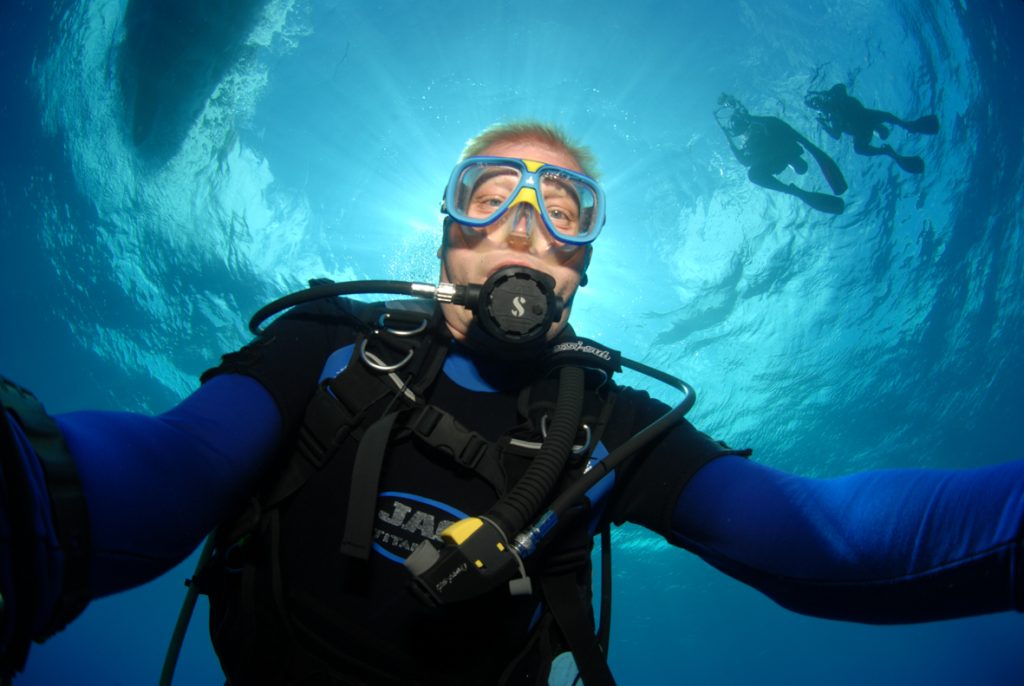
Care must also be taken to avoid getting the sun into the image and getting a “whiteout”, so a constant awareness of the background and the whereabouts of the sun is essential. Sometimes, the sun can be hidden behind yourself, or a background object such as a boat silhouette that you’re wishing to include.
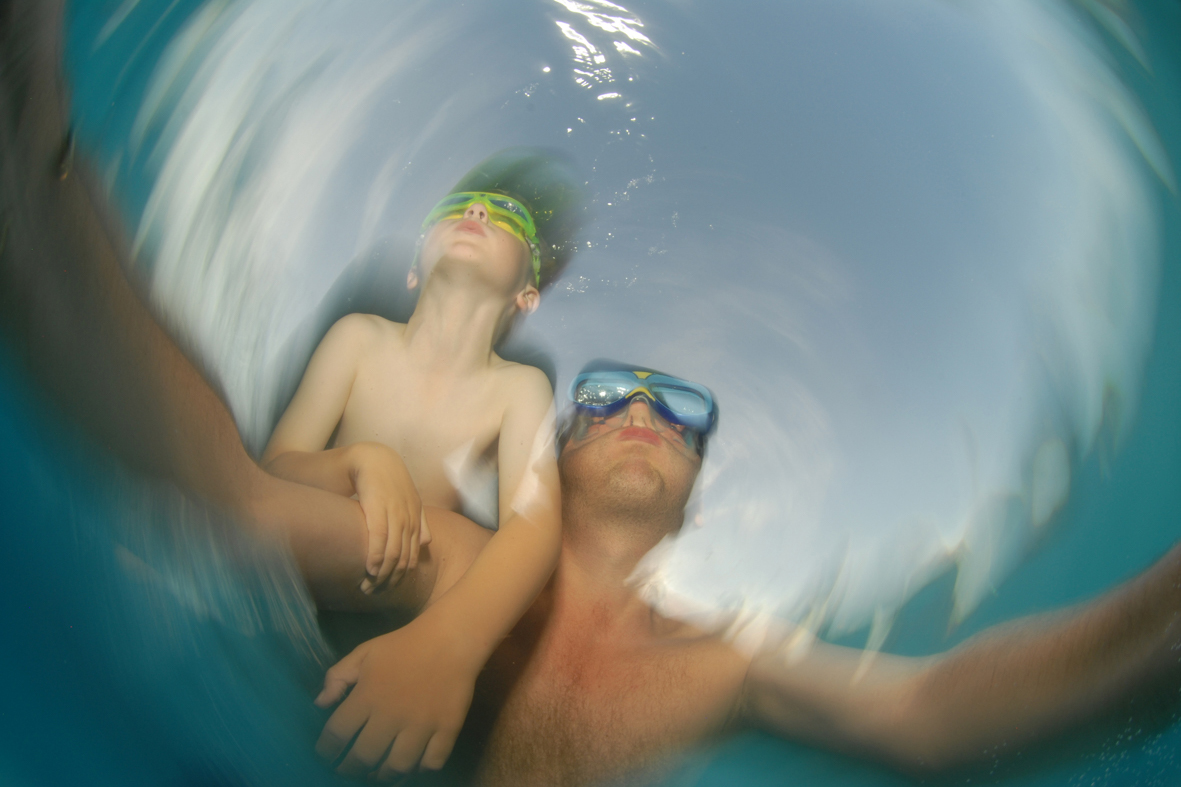
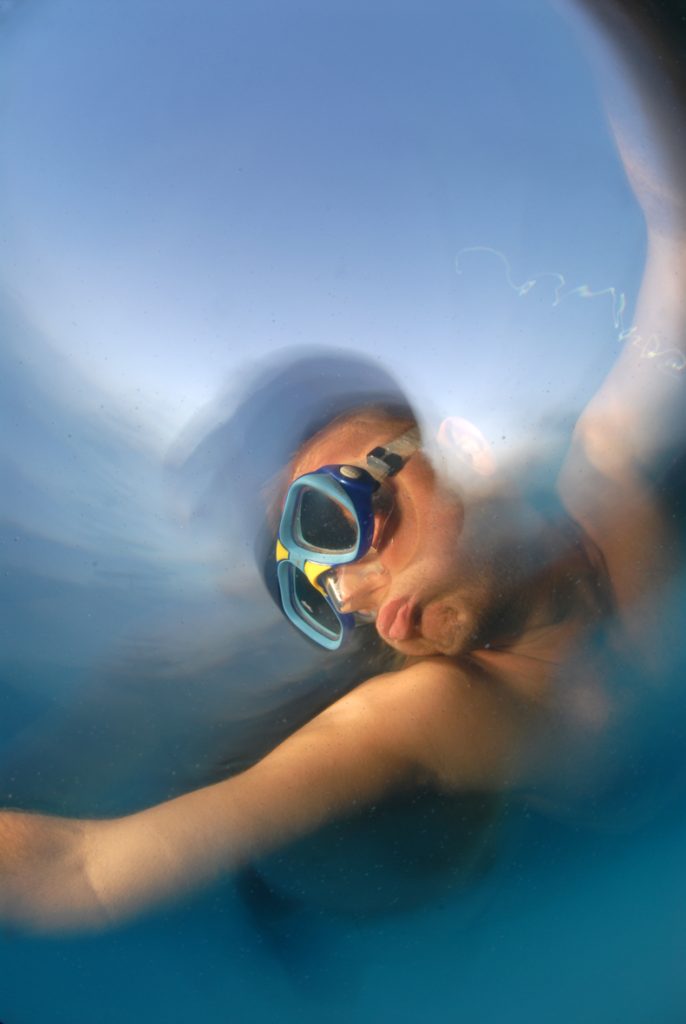
I’ve produced some interesting results by just playing around in swimming pools or the shallows without using scuba at all, armed with just a mask. During a trip to the Cayman Islands, I tried some images with slow shutter speeds in low light (at dusk) using the rear curtain sync flash settings which creates a unique impression of movement.
Other pool or shallow water shots that are worth pursuing are where there are interesting “backdrops” such as overhanging trees, fountains, colourful sunshades, tall buildings or other structures that can be included in the image. For example, at the Maldivian resort of Bandos, I spent a good couple of hours one afternoon wandering around the island, paddling into the shallows to try out ideas in what I considered the most interesting spots. Some worked and some didn’t.
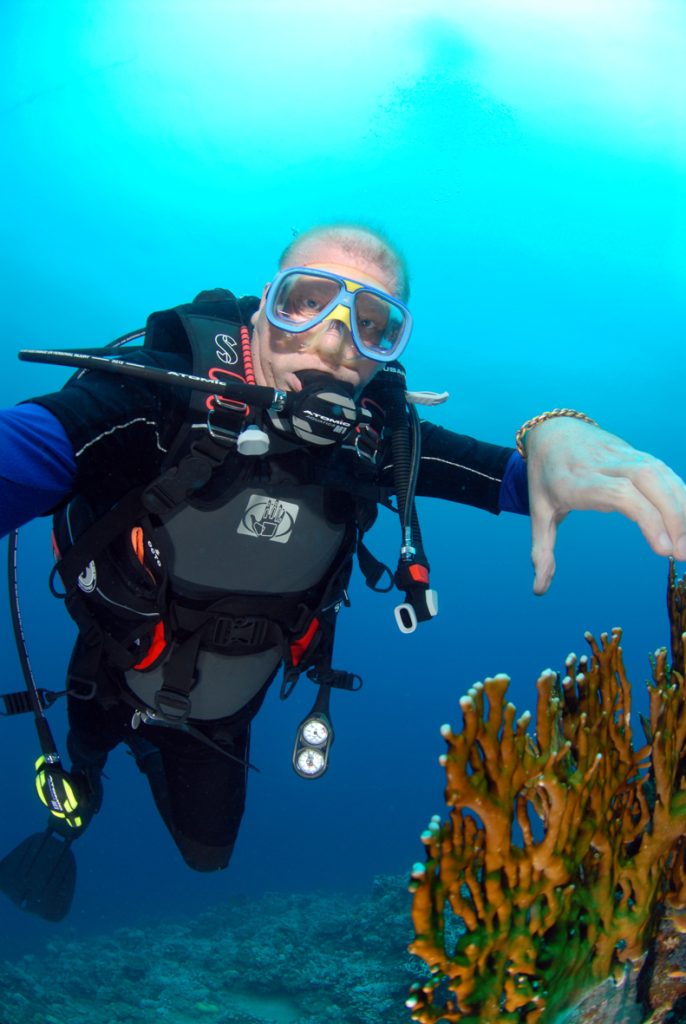
Moving forward to actual dives, the easiest selfies to take are those with static backgrounds such as a nice surface texture, a boat silhouette, or the underside of a jetty to make it a bit more interesting and give context. Recently in Egypt, at a dive site just south of El Quseir, I decided to try a few images of myself pretending to grab fire coral for the amusement of our son Zac. Going back a few years, whilst in the Socorro Islands on Mexico’s Pacific side, I was able to get an image of divers approaching the rib above me. To make this image work, I outstretched my arms and “hid” the midday sun behind my head.
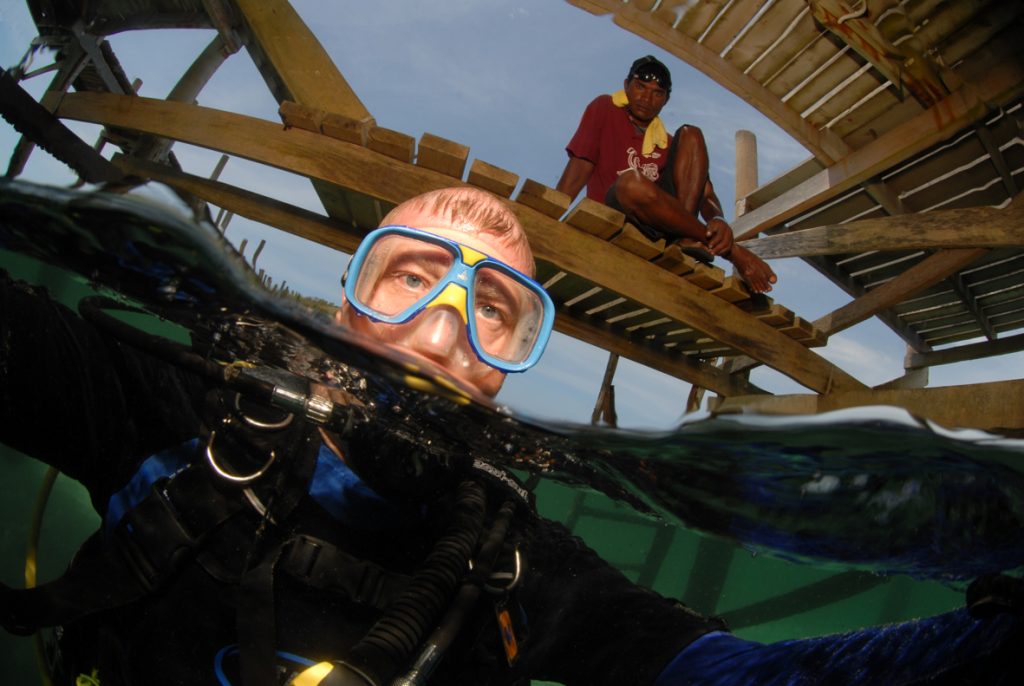
On a difficult dive trip to Loloata Island in Papua New Guinea several years back, where I was stricken with a horrendous sinus infection and unable to dive, I was still able to get some images by pottering around the surface waters by the jetty trying a few things. The best of the bunch was a split level selfie taken underneath the structure with one of the dive centre staff looking down to see what I was doing – it worked quite well.
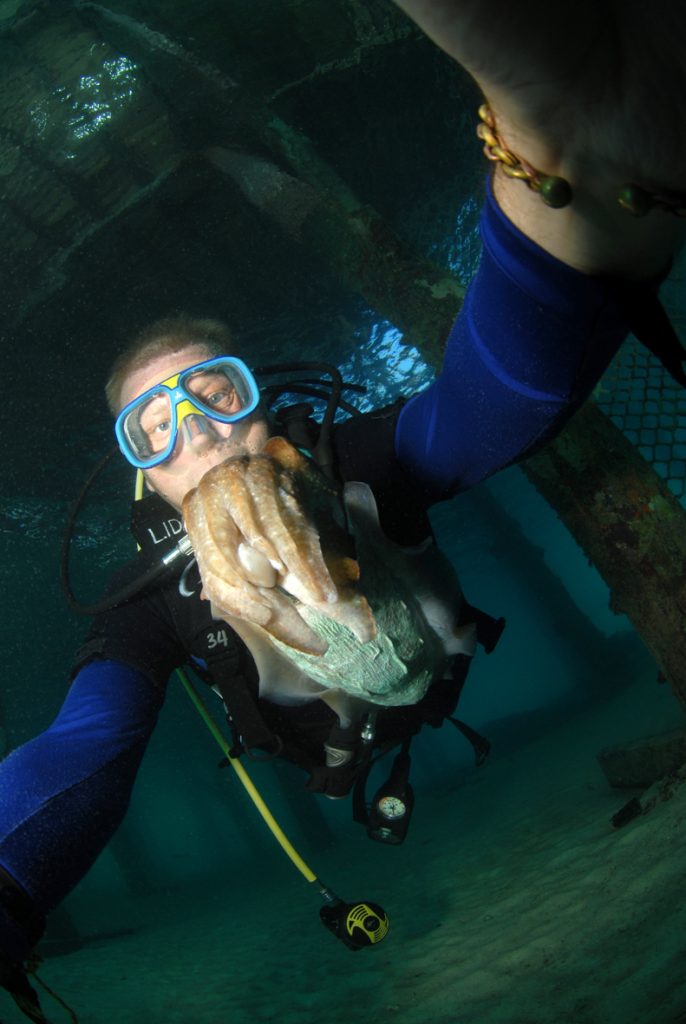
The most difficult selfies to get right are those that include wildlife. As a photographer, you’ve got to decide what kind of images matter to you most, so unless you’ve got a lot of time in one place or a very cooperative subject, you may have to make a choice as to what you want to achieve (i.e. between a conventional wildlife shot or a selfie that attempts to include the animal). Whilst diving in Borneo, at the idyllic Lankayan Island, we were treated to some very “reliable” cuttlefish that could always be found close to or underneath the jetty. Over a number of diving days, I was able to spend quite a lot of time photographing these fascinating molluscs, which included a bit of time on selfies – one of which was quite amusing, with the animal positioned in front of my face, with its tentacles looking like I’d grown some kind of mutant beard!
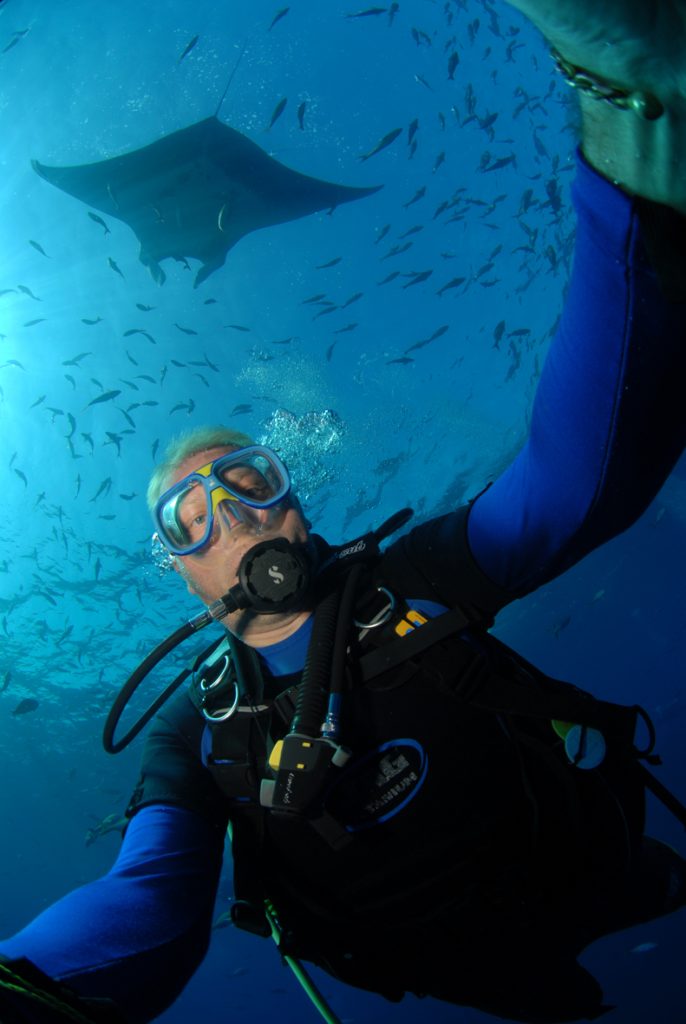
Perhaps the most tricky selfie to capture is when you want to include something unpredictable, fast moving and skittish, like a manta ray. In the “big pelagic action” mecca of the Socorro Islands I’d been fortunate in I’d already bagged a decent set of images to illustrate some trip features that I was planning to publish, so on the very last dive of the trip, at the renowned Boiler site at San Benedicto Island, it seemed like the time to try something different.
Boiler is an excellent dive site for manta ray encounters, but for whatever reason, the mantas seemed wary that day and weren’t keen on granting the expectant divers with any close passes during our visit. One specimen, however, had been circling around at the surface for some time, only moving away if any diver attempted to get close to it.
This specimen presented the opportunity to capture a selfie with a manta ray. I had little to lose as it was mission impossible to get close enough for a “conventional” shot. As long as I didn’t “chase” the manta, it would stick around.
Capturing the image proved quite tricky, with many shots failing to get the required result. The only thing I can really say about it is that once I knew the general whereabouts of the manta, I would then turn my back to it, position my body in an aesthetically pleasing way and look for it’s reflection in the dome port, using the auto focus to lock on to my face. It proved not to be an “exact science” but in the end I got something after quite a few attempts.
Though often unsaid in texts about how underwater images are captured, it’s also very important to have good buoyancy control. For the manta image, I was in mid-water, so it was vital that I maintained consistent buoyancy at my chosen depth in order for the image to work.
The resulting image was one of the last that I captured on the dive before the manta decided to move on. I was satisfied with it, but there are certainly better images that could be captured using this technique if the right opportunity presents itself. The self portraits therefore remain a “work in progress”.
If you want your selfies to stand out from the crowd, why not indulge yourself in shameless bouts of “underwater selfishness” and give them a try. They might even make the news!