
Text by Jeremy Cuff/www.ja-universe.com
Photography by Jeremy & Amanda Cuff/www.ja-universe.com
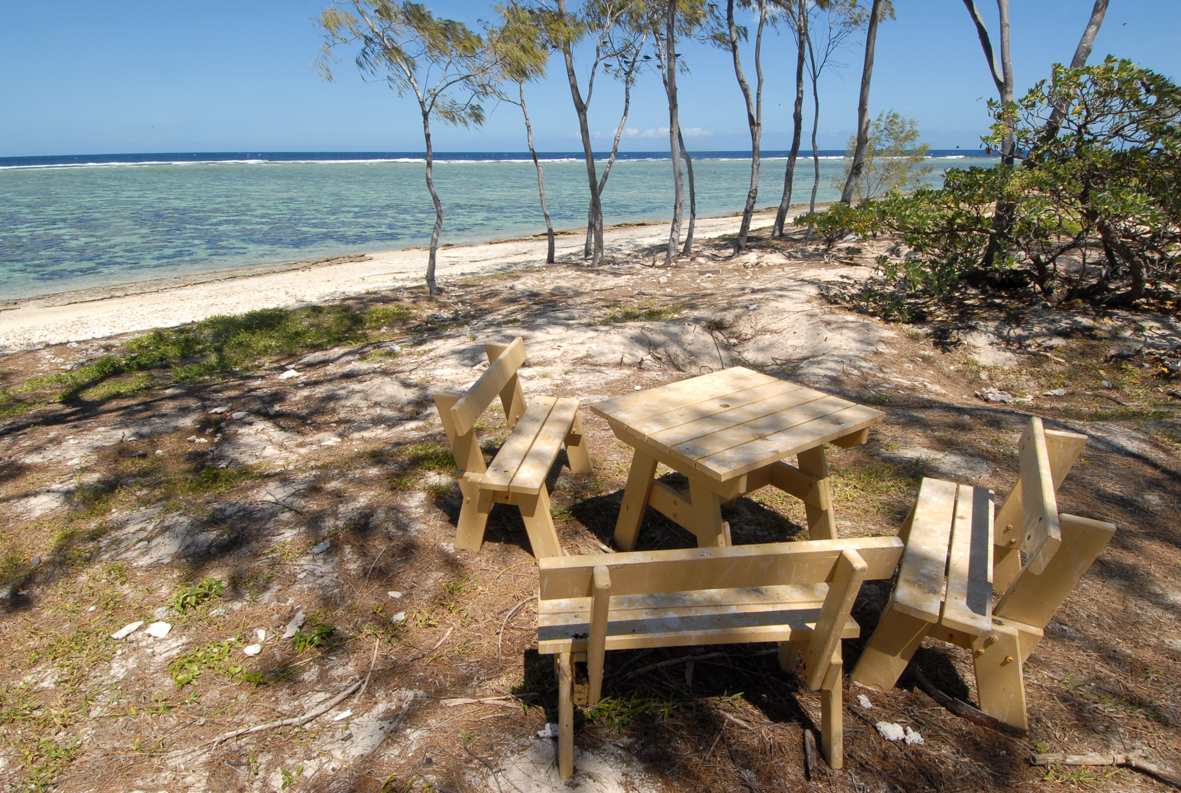
Lady Elliot Island is a tiny speck of land that marks the southern-most point of Australia’s Great Barrier Reef. The island has a surprisingly varied and turbulent history leading up to its current status as an “eco resort” which includes guano mining. We thought it was fantastic, with great diving, lots of birds, nesting turtles, hatching turtles and simple living. In fact, we can’t say enough good things about it…
Lady Elliot Island is a tiny speck of an island, appearing like a lone lily pad on a giant pond. It’s located at the very southern tip of the Great Barrier Reef and is geographically isolated, 80 kilometres north east of Bundaberg and some 40 kilometres south east of the Bunker Group, a cluster of reefs, cays and islands.
The only easy way to get there is by light aircraft, usually from the aussie rum capital of Bundaberg, the Gold Coast or Hervey Bay. It’s also possible from other locations such as Brisbane, Maroochydore, Town of 1770 and Gladstone if booking numbers are sufficient. As you approach the island by air, you get a heightened sense of adventure, circling around the island to view the reefs before bouncing onto the grassy runway, scattering seabirds in all directions.
There are many reports about the Great Barrier Reef being “wrecked” or bleached, which may well be true in some areas, but not here. During our research for the trip, the island looked so appealing with its “eco-resort” status that we were concerned that it could only be disappointing in reality, but we needn’t have worried. Lady Elliot Island surpassed our expectations in terms of the whole experience – excellent diving, nesting turtles, hatching turtles, teeming birdlife combined with simple, back to nature living. The expression “world class” is overused these days, but for us, it was certainly apt. It had that indefinable “wow factor”.
Whilst on the island, we learned of the recent comments of a visiting scientist, whose role is to monitor the status of the entire Great Barrier Reef ecosystem. Her conclusion was that the reef around Lady Elliot is extremely healthy. Even to a casual observer, the whole ecosystem appears to be intact and pristine.
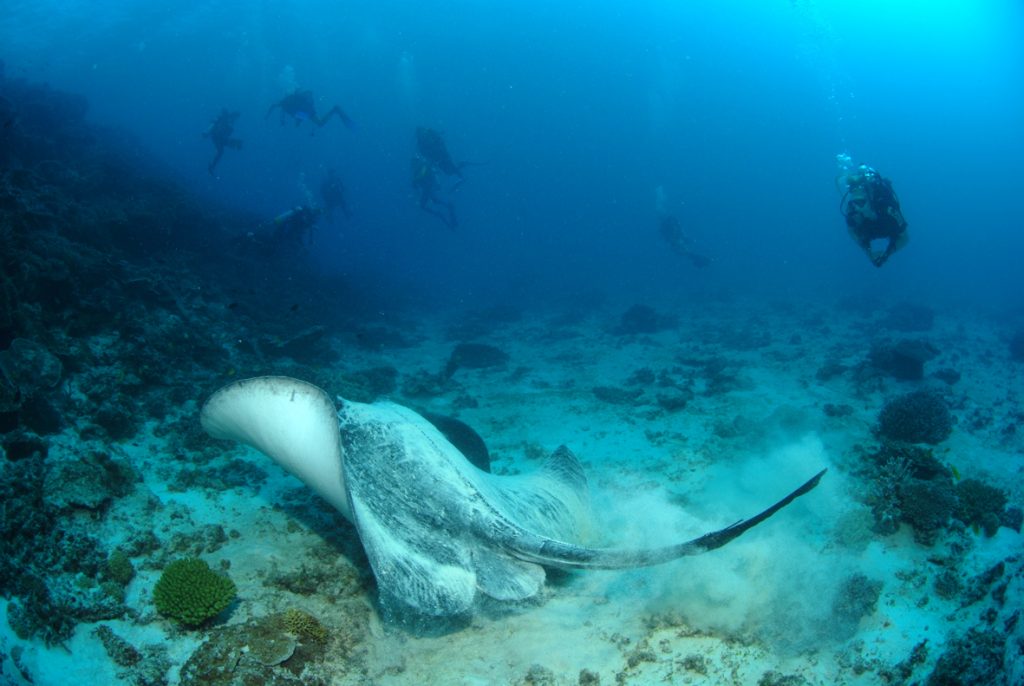
In three days of diving we logged manta rays, eagle rays, shovelnose rays, bull rays, reef sharks, leopard sharks, batfish, schooling jacks and barracuda, and a lot of turtles. The coral was in great condition, too, with the plate corals being particularly impressive. We didn’t see any dolphins during our stay but they are regular visitors, and there’s also the seasonal spectacle of migrating humpback whales.
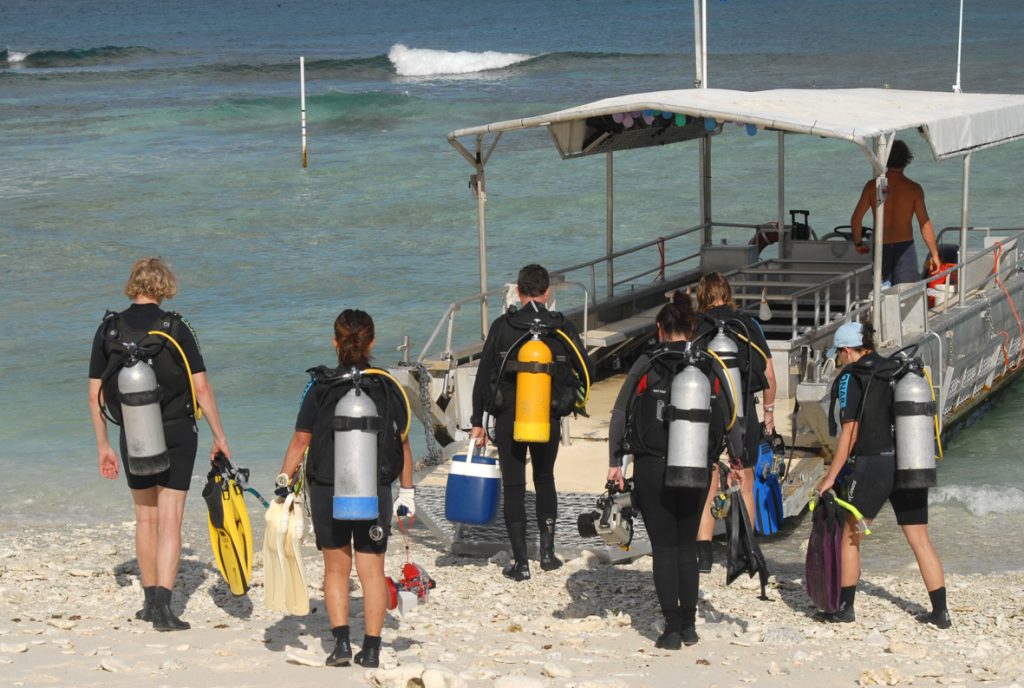
There’s no jetty on the island, so the dive boat is launched from the beach, on the sheltered leeward side of the island, close to the lighthouse. Depending on the tide, divers may have to navigate a walk over a designated area of reef flat with tanks and weights in order to get aboard. Anyway, it’s not too difficult and there’s always help from the crew if you’re unsteady.
Despite the relaxed, back to nature vibe of the island, the diving is operated to a strict timetable, as the dive team also have to lead snorkeling groups between dives. During our visit, the choice of dive sites was limited by a stiff breeze making the seas on the windward side of the island too difficult for the dive boat, but it really didn’t matter.
On the leeward side there’s also plenty to keep divers happy, with the underwater topography consisting of reef flat, a sloping reef, and bommies interspersed with sandy expanses.
Some of the bommies can harbour some big surprises. At Three Pyramids we spotted part of the body of a moray eel that had hidden itself within the labyrinth of the rock and coral. It was like we’d seen an anaconda – this eel was huge!
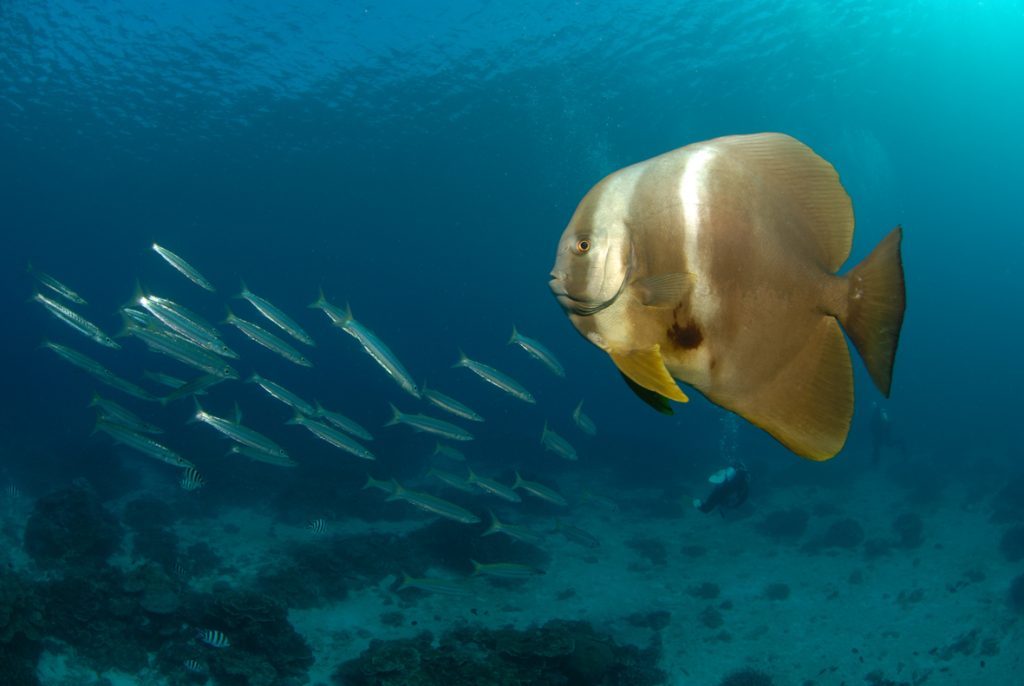
Batfish are common at Lady Elliot and are often “friendly”, or at least curious of divers, accompanying us along the reef on several of the dives, as if escorting us from bommie to bommie. Quite often they would latch onto a particular diver which caused some amusement among the dive group.
“Close buzzes” with the big stuff are certainly possible but not guaranteed, although you’re likely to have several good encounters over a few days of diving. Our first manta sighting was from a distance, at the Spiders Ledge site. As we explored the bommies and sandy expanses, I looked up to see a manta cruising the surface waters and for an instant it appeared to circle back towards us 15 or 20 metres below. But no, it changed course again and was gone.
Later the same day, at Lighthouse Bommies, we were treated to another encounter, this time a bit closer. A manta swept past across a sandy expanse, touching the sand with its cephalic lobes before rising slightly to clear a bommie and gliding majestically back into the blue. On our last day, we marvelled at another similar encounter, again at Lighthouse Bommies.
Since our visit, I checked Lady Elliot website to find the island has since been “invaded” by mantas, with more than 100 individuals being identified! The “normal” population has been estimated at about 40 individuals.
Eagle rays are also regularly sighted at Lady Elliot Island. I didn’t have any close encounters with these stunning rays unless you count one specimen that glided to within a few feet of me. I had my back to it whilst watching a bull ray!
Bull rays, a large species of stingray, are commonly encountered on the sandy expanses, and sometimes you might be lucky to see the uncommon and more skittish shovelnose ray which we only observed from a distance.
Lighthouse Bommies is a good place to see leopard sharks. They are normally found resting on sand and will tolerate a close approach if you’re prepared to be patient by edging slowly forward. We certainly saw two specimens at this site, and possibly three, although we couldn’t be sure if the third shark was the same specimen we’d observed at the beginning of the dive. At one point, a stingray glided directly over a resting leopard shark but it was too far away for photography. If only I was several metres closer!
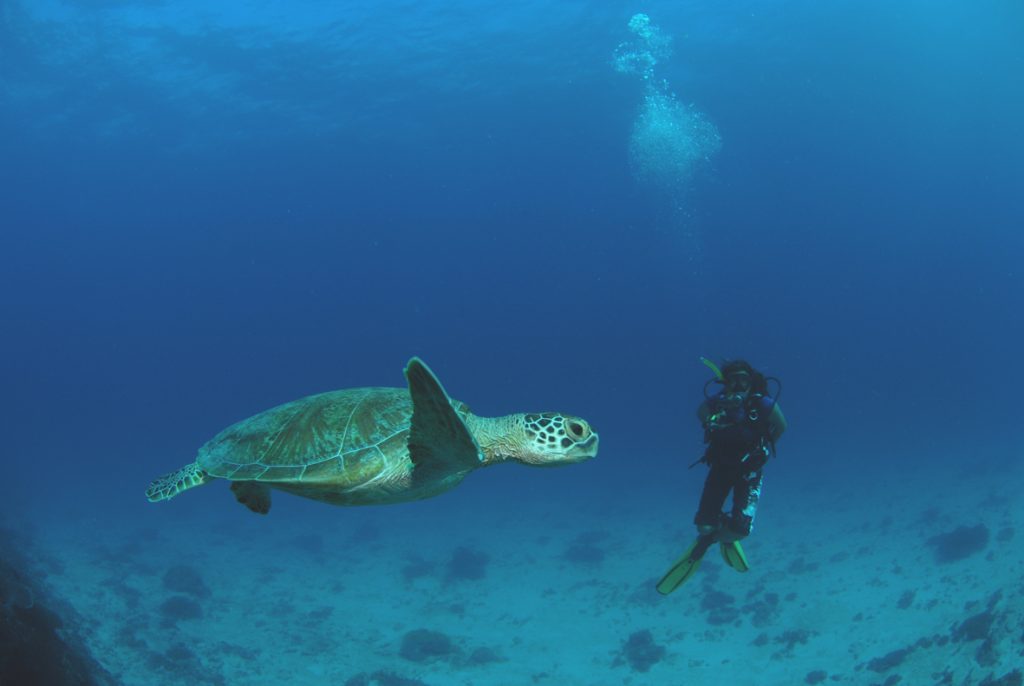
Turtles are really common here. Our visit in March coincided with the end of the nesting season and slap bang in the middle of the hatching season. If hatchlings are discovered on the island in the day, you are encouraged to hand them to staff so that they can be released at night, to give them a better chance of survival We were fortunate enough to witness a turtle laying eggs at the end of the airstrip, one of the last of the season. There can’t be many places where turtles are a hazard to aviation!
There are long term studies of the turtles being conducted at Lady Elliot Island. The staff give fascinating insights into what their work is revealing about turtle behaviour. The work is aimed at understanding their whole lifespan requirements, so that they might be conserved better in the future.
There’s even a small wreck to explore, a yacht called the Severance. The boat rests on a sandy bottom at about 20 metres, not far from the reef. You can dive the wreck and then head towards the island to finish your dive on the reef, or like us, stay there for the entire dive.
Around the Severance, there was plenty of action and photographic potential. Schooling jacks formed and re-formed into different shapes around the wreck, while sharks lurked on the edge of visibility. We were told that if we were lucky, mantas will occasionally sweep past the wreck, which would have made for fantastic photographs, but it wasn’t to be.
All the big stuff tends to keep you occupied, so we didn’t spend much time looking for the “macro” inhabitants although doubtless there’s plenty to see in this respect too. We asked about night diving, but they seldom happen due to the difficulty and safety of a boat launch at night with no jetty. I imagined that night dives would reveal some very interesting finds. Perhaps that huge moray might be out hunting in the open!
Although the price might be preventative for some, Lady Elliot is a great place for divers with families. We took our four year old son Zac, introducing him to snorkeling for the first time, which he loved. The reefs, birds, turtles and beachcombing possibilities are highly educational and there’s also a swimming pool and play area.
All in all, we thought it was fantastic, a reprieve from the relentless treadmill of modern life. A place of simple living, fantastic diving, nesting turtles, thousands of birds, and the smell of guano! And with that many birds, you will get hit. Like filling your logbook, it’s virtually guaranteed!
Over 3 diving days, we logged an incredible selection of big stuff, the things than can take years to find themselves added to your logbook. But it was more than that – Lady Elliot Island is one of those places that you wish you could linger for just a little longer.
Lady Elliot Island – A Short History
Lady Elliot Island has a surprisingly varied and turbulent history leading up to its current status as an “eco resort”.
It’s thought that the island began to form around 3000 years ago, mainly due to a drop in sea level of about 1 metre. The island reached its current size around 1000 years ago.
The island was first sighted in 1816 by Captain Thomas Stewart aboard the Lady Elliot ship on a voyage from Calcutta to Sydney. He named the island after his ship and continued his journey to arrive safely in Sydney. The island was sighted again in 1819 by Lieutenant Philip Parker King aboard the Mermaid who described it as “low and wooded”. It was then forgotten until 1843.
With the increasing colonisation of the Australian east coast, there was an associated demand for ships that served the new ports. Little detail was known of these waters, and with the frequent loss of ships, the Admiralty commissioned a major survey of the Great Barrier Reef area. It was no small task!
The first landing on the island was in 1843 where the naturalist J. Beete Jukes recorded a scene not dissimilar to what is there today. His notes made reference to the bird and turtle populations.
As an aid to safe shipping, a temporary light was erected in 1866 but it was soon toppled in a storm. It was followed by a more permanent structure which was completed in 1873. The island retained a permanent lighthouse staff for many years, until automation made the role redundant. Today, the original lighthouse keeper’s cottages are now used to house the resort staff.
The island’s fortunes went into a downward spiral when a lease was granted for the mining of guano. The resulting destruction was disastrous for the island as it was stripped of foliage and the nutrient layers of the “guano soil”. To make matters worse, goats were released to roam the island freely, mainly as a source of food for the lighthouse staff and any shipwrecked mariners. They weren’t eradicated until 1969.
Over the years, rumours of a ghost inhabiting the island have added a supernatural twist, with several accounts now in the public domain. Reports of mysterious footsteps, objects inexplicably falling and smashing, and even apparitions of a large woman have all been recorded by island visitors!
In 1969, the fortunes of the island began to swing towards conservation. Conservationist and businessman Don Adams suggested that an airstrip on the island would provide an easy access point to the southern part of the Great Barrier Reef. And with that idea, he came to an arrangement with the Commonwealth Department of Transport to build an airstrip in conjunction with facilities for tourism.
Today, the island has recovered much of its original foliage cover, with some areas still off limits to allow the regeneration to complete itself. The birds are back in force, the reefs are healthy and turtles can return to the beaches of their birth to lay eggs in safety and protection. Let’s hope it stays that way.