

Text by Jeremy Cuff/www.ja-universe.com
Photography by Jeremy & Amanda Cuff/www.ja-universe.com
The Great Barrier Reef is known the world over. But Australia has another big reef – the lesser known Ningaloo Reef. Is it great? Absolutely!
The Great Barrier Reef, on Australia’s eastern seaboard has a globally renowned reputation among travellers. For many, it’s the main reason to visit Australia. But there’s another lesser known “big reef” in Australia, on the western side. Mention its name and most people will draw a blank expression and say “never heard of it”. Amongst the diving fraternity, however, it’s a different story since the discovery of the annual whale shark visitations in the early 90’s. Its name is Ningaloo.
Ningaloo Reef is a 260 km fringing reef system that stretches from North West Cape at the tip of the Cape Range peninsula south to an area close to Amherst Point, south of the remote holiday resort of Coral Bay. Unlike its more famous counterpart, Ningaloo is close to the shore for the vast majority of its length, visible from the deserted beaches of the Cape Range National Park and Coral Bay.
For many divers, the main attraction of visiting Ningaloo is the annual influx of whale sharks, but there’s much more to it than that. The area has a wealth of excellent diving with the chances of some truly memorable encounters. In addition to the world’s largest fish, you might see wobbegongs, manta rays, reef sharks, turtles, potato cod, dugongs, dolphins and humpback whales depending on the time of year.
Ningaloo is seasonal and it’s important to get your timing right. We met a diver who was visiting Ningaloo for the second time. With a little embarrassment, he admitted to first visiting Ningaloo in November to see the whale sharks. The season is from late March to June. It was quite an expensive mistake.
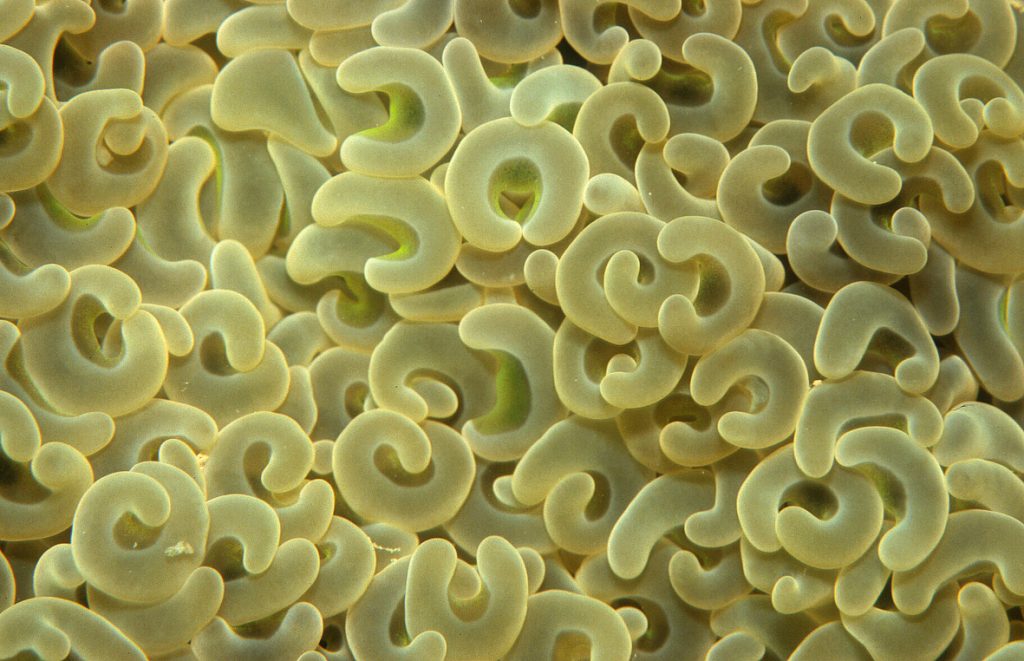
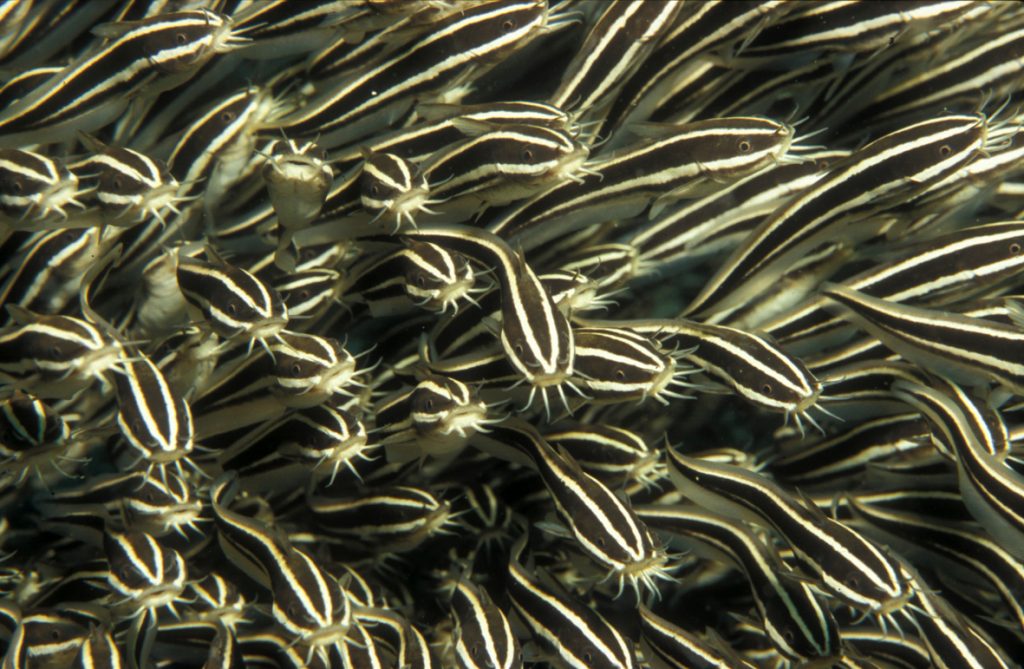
Lottie’s Lagoon, like most of the Coral Bay dive sites, is a shallow, easy dive. It’s a flat sandy area littered with coral heads, named after a large grouper that once frequented the area. Large brain corals are festooned with christmas tree worms and there’s plenty to see if you stop and look closely. We were rewarded with a scorpionfish, a playful free-swimming moray, a splendidly ugly frogmouth and two species of catfish, the endemic sailfin catfish and the more gregarious striped catfish.
The sailfin is an energetic fish with a blackish or dark chocolate brown colouration and usually solitary, whereas the striped variety are more sociable, the adults occupying holes in the coral formations. Juvenile striped catfish are less retiring, sometimes swimming in large groups out in the open, especially where sandy expanses adjoin coral reefs.
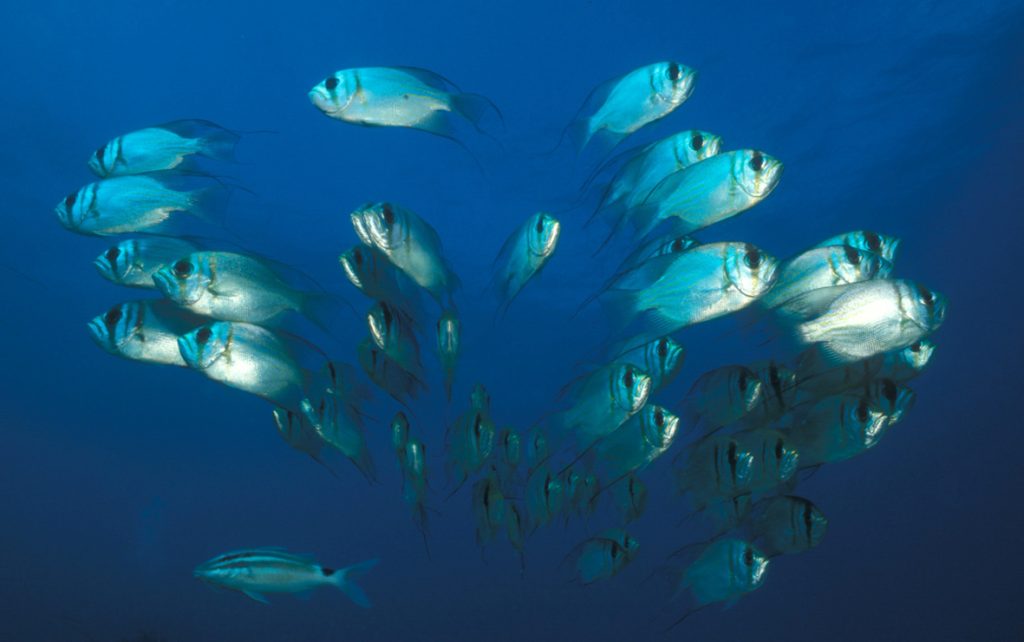
“Enjoy the surge”, said Susie, our dive guide at Heike’s Ledge, an excellent dive site located on the outside of Ningaloo Reef, facing the open ocean. It isn’t frequently dived– often the swells, currents and surges make safe diving impossible. The site consists of an area of ledges and overhangs that are home to a multitude of interesting fish and invertebrates. We noted cuttlefish, octopus, batfish, large groupers, morays, schooling snappers and incredible numbers of baitfish. Nearby, there’s a flat sandy area, home to stingrays and blue spotted rays.
Close to Coral Bay itself are Big Blue, Canyon and Asho’s Gap, all excellent reef dive sites. The corals here (at least 130 species are known from this area alone) are extensive, healthy and diverse, often forming huge towering formations. The stag, brain and cabbage corals are particularly impressive. Around these sites, you can expect many interesting encounters including grey reef sharks at known cleaning stations, large schools of trevally mixed with barracuda, spangled emperors and the occasional wobbegong.
Some distance north is The Porites, a seldom visited dive site. It consists of coral ledges and bommies peppered with holes and crevices that are home to large groupers, sweetlips and baitfish. As we approached the mooring, a Manta passed close to the boat, but we didn’t see any once in the water. It was doubtless attracted to the area by the large amounts of plankton suspended in the water.
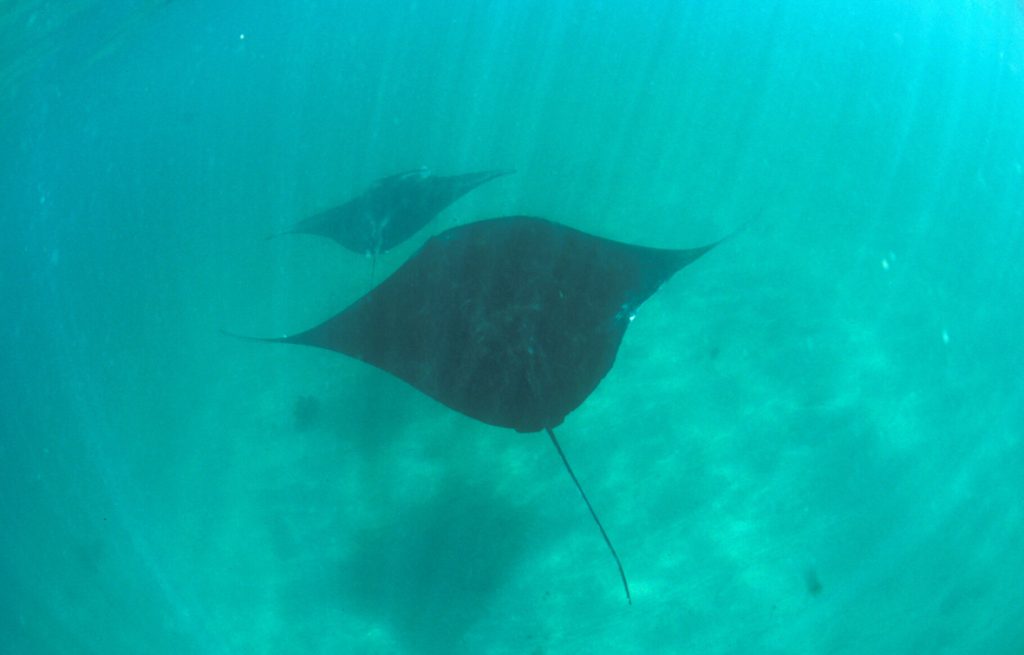
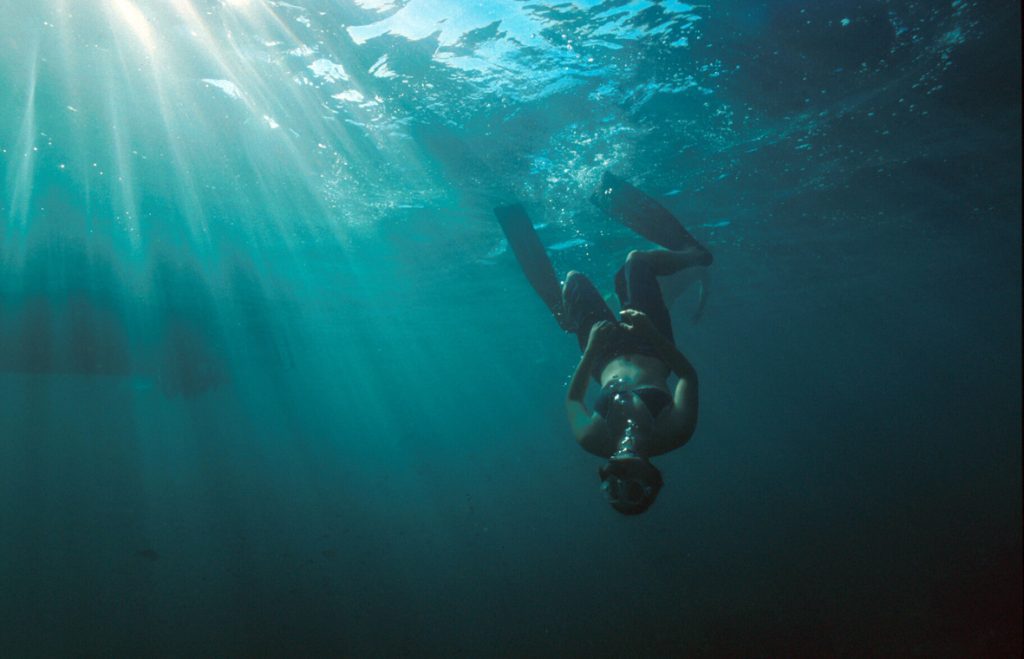
Manta Ray interaction tours are run all year round from Coral Bay and are extremely worthwhile. When Mantas are located by the spotter plane, the pilot will guide the skipper to within swimming distance of these magnificent rays. The basic procedure is to be ready and wait for the signal. One of the crew will enter the water first and locate the Mantas, indicating their position by a raised arm. The skipper then tells the snorkellers to enter the water and swim towards the raised arm.
The experiences can vary enormously – if the Mantas are on the move, you can expect a hard, breathtaking swim but on other occasions you might be lucky find them feeding, sometimes engaged in their unique “barrel rolling”, or hovering over a cleaning station.
Ningaloo, of course, is known for its reliable whale shark sightings, to the extent that the dive industry in Coral Bay and Exmouth has grown up around their appearances. Finding them, however, isn’t a foregone conclusion – they might be “big” but they’re not “that big” and it requires a lot of effort and infrastructure to locate even a single specimen. They can only be found on the outside of the reef, rarely if ever, entering the shallows. Neither are they always close to the reef – often they are sighted many miles out to sea.
As with the mantas, a spotter plane is deployed to locate these placid leviathans. Once a shark is pinpointed, the skipper deposits a guide in the water and manouvres the stern of the boat into the path of the oncoming shark. Then, the signal is given and the snorkellers enter the water, the raised arm of the guide helping to guide everyone to the passing shark, which is surprisingly easy to miss, particularly in low visibility.
An encounter with a whale shark is a truly great experience and we were lucky to swim with a 5-6-metre specimen at Coral Bay. Further north in Exmouth, a week later, it would turn out to be somewhat different.
In Exmouth, we’d booked three Whale Sharks adventures which all turned out unsuccessful. The crew said that this was somewhat unprecedented for the time of year. Ningaloo “virtually guarantees” whale sharks during the time of our visit and both the whale shark adventurers and the staff were disappointed. We also heard that since we’d left Coral Bay, they’d had no sightings either.
Little is known about whale shark behaviour and there was likely to be a reason, beyond our sphere of knowledge and understanding, for their non-appearances. Non-appearances don’t necessarily mean that there are no whale sharks in the area, it’s that in order to see them, they must be swimming at the surface. It’s thought that they spend much of their time at depth and more commonly visit the surface at dusk and into the night. Also, the presence of large predators such as killer whales are thought to “spook” them – perhaps there were some in the area. At least we saw one in Coral Bay – others weren’t so lucky.
Blizzard Ridge, Labyrinth and Gulliver’s are reef dive sites located close to the tip of Cape Range. On first impressions, the sites look disappointing, lacking the visual spectacle of the Coral Bay sites such as Canyon. That is, until the encounters start happening! Blizzard Ridge was especially fruitful yielding tasselled wobbegongs, white tip reef sharks, large batfish, schools of snappers, huge morays, stingrays, incredible swarms of baitfish and other surprises. At Gulliver’s, one group saw a hammerhead shark and a giant frogfish. Mantas, too, are frequently encountered at these sites.
Heading south, close to the Tantabiddi mooring used by the whale shark boats is Central Station. You can expect almost anything here and the conditions vary enormously. Of the bigger stuff, expect to see schooling fish such as threadfin pearl perch and snappers, large stingrays, blue spotted rays, turtles and white tip reef sharks. Mantas and leopard sharks are also sighted from time to time. Fans of the smaller reef residents will also find plenty of interest with mantis shrimps, juvenile striped catfish, baitfish and nudibranchs.
The Muiron Islands, located northeast of Cape Range is another excellent area for diving. We visited The Spit and The Maze, mainly coral ledges and reefs featuring some superb swim-throughs that were literally filled with walls of baitfish. Other star attractions were potato cod, stingrays, abundant schooling fish, several scorpionfish and a profusion of anemones.
The Harold E. Holt Naval Pier, usually referred to as plain and simple “Navy Pier”, has been voted as one of the top ten dives in Australia. To dive there involves a bus ride into a restricted area guarded by naval checkpoints. Our dive was almost cancelled thanks to a strong easterly that had been blowing for several hours. It didn’t look good – the surface was very choppy, there was a big surface current and the visibility was very poor.
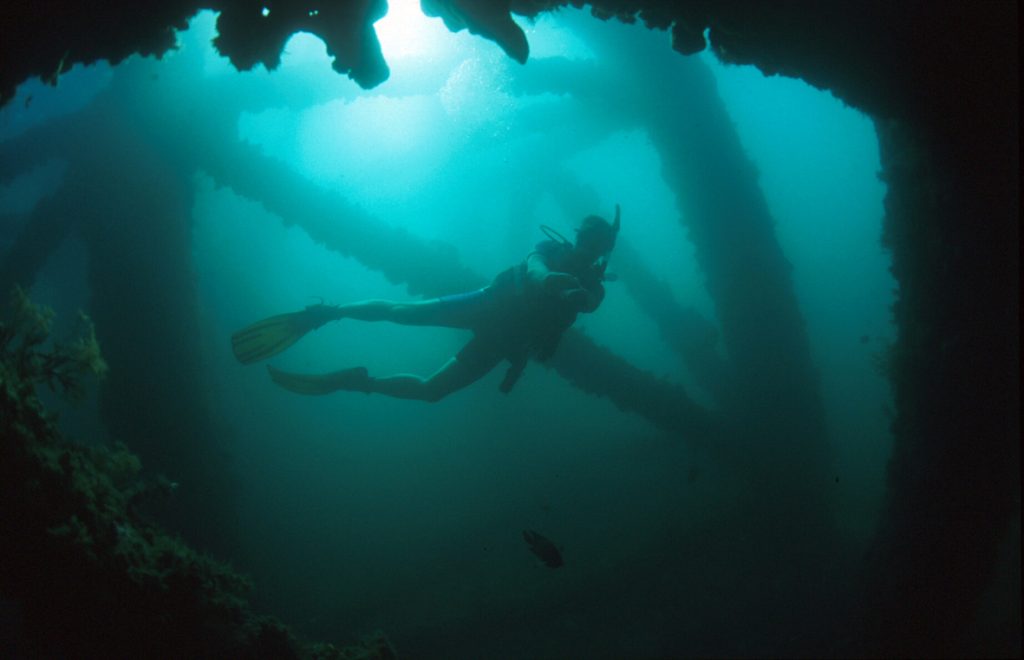
Luckily, we decided to wait, and as forecasted, the wind subsided. The visibility didn’t improve, but nonetheless it was an excellent dive with lots of memorable encounters. We listed wobbegongs, white tip reef sharks, schooling jacks, barracudas, moray eels, snappers, lionfish (including some very large specimens), threadfin pearl perch, filefish, stonefish and baitfish. Stingrays and turtles are also commonly sighted and even the odd appearance of a tiger shark isn’t unknown.
Encounters with Ningaloo’s marine mammals are possible at both Coral Bay and Exmouth, although it’s most likely that you’ll be watching them from a boat. On rare occasions you might be very lucky to see dugongs or a family of dolphins during a dive.
Australia is quite advanced in terms of conservation with marine mammals being an important facet to the efforts of the authorities. Rules designed to protect these rare and threatened animals are enforced by CALM (the Department of Conservation and Land Management) and prevent dive operators from knowingly allowing divers or snorkellers into the water with whales, dolphins or dugongs. Also, there are rules for swimming with whale sharks and mantas.
Overall, the diving at Ningaloo was generally excellent, although expect the conditions to vary enormously, even at the same dive site. During our visit, the visibility was often affected by suspended particles and plankton, so those expecting gin clear water might be in for a bit of a shock. The weather, and wind patterns in particular, has the biggest single influence on the choice of dive sites visited, so expect to change locations at short notice if the skipper decides that the conditions are unsuitable for safe diving.
As the area is relatively new to diving, there aren’t as yet a great number of known dive sites. This is fine for the “backpacking” diver who’s just passing through, but for anyone spending any length of time in the area, you’ll probably be repeating some of the sites several times over. It’s likely, however, that the dive operators will gradually open up new sites over coming seasons – there must be innumerable virgin dive sites awaiting discovery.
The Great Barrier Reef is known the world over. But Australia has another big reef – the lesser known Ningaloo Reef. Is it great? Absolutely!
Time of Visit: March/April 2005
Written in: May/June 2005