
Text by Jeremy Cuff/www.ja-universe.com
Photography by Jeremy & Amanda Cuff/www.ja-universe.com
Western Australia isn’t short of superb underwater experiences. Swimming with the sea lions of Green Head is certainly one of the most incredible and presents a unique opportunity for underwater photographers to get up close with these graceful, inquisitive and rare marine mammals. And the conditions are easy and safe too…
In October 2003, I attended the annual Visions of the Sea underwater photography and film event in London. As well as exposing delegates to the work of many excellent underwater photographers, “Visions” can also act as a source of inspiration about the places visited by underwater photographers. One of the guest speakers described his time in Western Australia – it sounded interesting and varied. So much so that it inspired us to go there. It took until April 2005 to make the journey…
Although Ningaloo Reef was an obvious attraction, we were also taken by the idea of the sea lion interaction encounters at Green Head, a tiny settlement of 300 people (when everyone’s in town) about 250km north of Perth.
We couldn’t find much information about the trip in any guidebook or on the internet, so we planned a two-night stop at Green Head en route north to Ningaloo, taking a chance on turning up and hoping that the trip would be running. Once in Australia, we were able to contact Sea Lion Charters and make a booking. Also, we changed our itinerary slightly giving us two visits to the sea lions, instead of the single trip we’d expected.
For us, Green Head seemed like one of the mellowest places on earth, helped by a windless blue sky, calm seas, pleasantly hot temperatures and a relaxed pace of life. First, we found Macca’s Mooring, our excellent Australian-style bed and breakfast accommodation and then headed for Sea Lion Charters, a stone’s throw down the road.
Sea Lion Charters is run by Rod and Ronnie Wilson, a friendly and helpful couple who started the trips 7 years ago, having visited the area for many years previously, mainly for fishing and recreation.
Photographing sea lions immediately conjures images of fleeting glimpses and deep, murky channels patrolled by hunting Great Whites. Although Great Whites (locally known as White Pointers) do indeed prey on sea lions and are known to inhabit the seas of Western Australia, certainly as far north as the Houtman Abrolhos islands further up the coast, the shallow and sheltered conditions at Green Head reduce that likelihood to a minimum. However, nothing is taken for granted, so Rod keeps a lookout for “anything that we don’t want to see” although they’ve never seen a shark around the interaction shallows.
The boat ride to Fisherman’s Island is about 20 minutes from Green Head. It’s an unremarkable collection rocks with a beach on the sheltered eastern side. There are actually two Fisherman’s Island’s – north and south – the sea lions live on the north, whilst a battered, ostracised male named Spartacus lives alone on the beachless south island. Occasionally, fur seals visit the islands, although the sea lions won’t tolerate their presence on the beach, so best place to look for them is on the rocks to the south.
We could see the sea lions hauled out on the beach as the boat approached, and a commotion of seabirds including a large number of shags and a nesting pair of sea eagles. The water was clear and calm as Rod secured the boat – the conditions were perfect.
So, what was it like? Well, I have to say, it’s a fantastic experience for all enthusiasts of marine life and for underwater photographers, it’s a photo opportunity “to die for.”
To do it, you don’t even need a tank – only mask, fins, wetsuit and camera. A weight belt is also useful if you want to get down onto the bottom with minimum effort. I used a weight belt on the second day and found it much easier for photography, concentrating on the work in hand instead of fighting the buoyancy of my wetsuit. The deepest water is little more than head height.
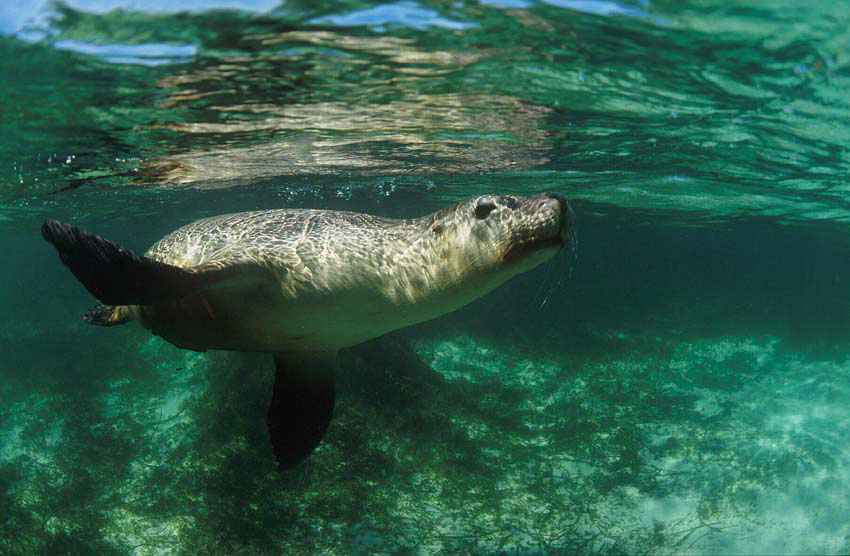
Sea lions are clumsy, awkward and quarrelsome creatures on land, but once in the water, they transform into graceful, playful, and inquisitive animals. It’s a real privilege to be able to observe them up close in this way, and in such easy conditions. The sea is, of course, the place where they must find their food and must therefore spend the bulk of their time. They are supremely adapted for it.
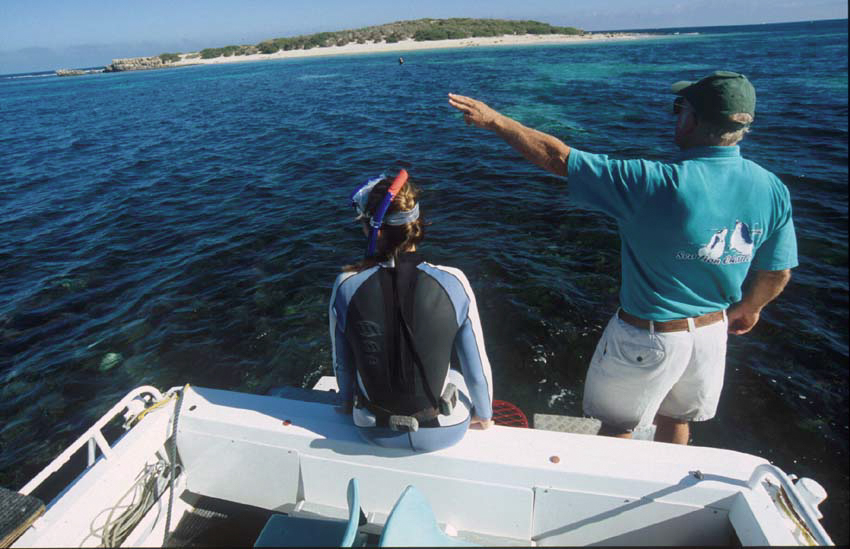
Before we entered the water, Rod and Ronnie provided a briefing about what to expect, and how to behave in order to get the most out of the interaction. The approaching boat will often be enough to attract a few sea lions into the water to investigate, but it’s the job of the snorkellers to keep them entertained. “The more acrobatics and somersaults you can perform, the more likely they’ll stay in the water”, was the advice. Rod always encourages somebody to be in the water at all times to keep them interested. His suggestion is “Blow bubbles, dive to the bottom, twist and turn, splash around a bit, and be playful.” Perfect for the inner child in everyone!
He also explained which areas to avoid, in particular the “nursery”, which is strictly off limits. Here, at the southern end of the beach, newborn pups are nurtured in relative safety away from the commotion of the main group. Also, any snorkeller tempted to haul out on the beach may get a completely different reaction from the sea lions in the water, so again, another area to steer well clear of. Rules laid down by CALM (the Department of Conservation and Land Management) make such an activity illegal, so as well as being attacked, you could also be prosecuted!
At time of our visit, the breeding bulls were out at sea, but some of the non-breeding, immature bulls were there, together with the cows and youngish pups. The bulls look menacing at first owing to their physical presence, but at no point are they actually threatening. It’s really up to each snorkeller to find a distance that they’re comfortable with, although photographers with wide angle lenses do, of course, need to get up close for the best images.
You can expect all kinds of tomfoolery from the sea lions. Fin grabbing is a particular favourite, particularly with the pups who will often latch onto a particular snorkeller, sometimes following them to the boat and waiting for them to return to the water. I had an interesting time with one of the young bulls who must have been able to see his reflection in my dome port, swimming right up to the camera and actually putting his mouth onto the glass. He was so close, I couldn’t even focus!
Using my Nikon F100/Subal housing set-up, I decided to work with the 16mm fisheye using natural light, liberated from the clutter of cumbersome strobes and arms. My wife Amanda also has an identical Nikon F100/Subal rig – she would work in the same way but with a 20mm wide angle. For film, we used Sensia 100 ASA slide film, although I did try a single black and white film, an Ilford Delta 100.
The excellent weather combined with our strobeless camera rigs was, I think, an ideal setup for photographing our agile subject matter, allowing for ease of movement in the water. Expect to indulge in duck diving, twisting and turning, swimming upside down and holding your breath whilst attempting to compose and lock onto the sea lions. I used shutter priority at 1/160th to freeze the movement and let the camera do the rest.
It takes a while to get over the sheer brilliance and uniqueness of the experience, and that the sea lions will stick around rather than flee at the merest hint of a human. After a while, I was able to get more into composing images rather than simply getting “record shots”. I found that in order to get the best images with dappled surface water, it meant planning the approach to a sea lion. Sunbursts could also work although it could be hit and miss as to whether they would be overexposed or not.
Serious underwater photographers could spend a week at Green Head doing nothing but this trip, aiming for that really special moment. I don’t think either of us managed a really special moment but the resulting images were solid, pleasing and improving over the two days. The easy conditions and the close proximity of the subjects mean that it’s possible to get a decent number of acceptable images from each film and over the course of each trip, it’s likely that a photographer will use a fair number of films. I certainly felt that I improved my technique for approaching them on the second day and started to think more about the angles of approach and what I wanted to achieve, being more discerning before clicking the shutter. Initially, it’s easy to be too “trigger happy”.
As the sea lions cavort in the shallows and interact with the snorkellers, sand, clutter and floating pieces of seaweed can be stirred up and affect an otherwise perfect image. We certainly had our fair share of these images where the commotion had impaired the water clarity. Again, it’s another issue to deal with in the quest for that “special image”.
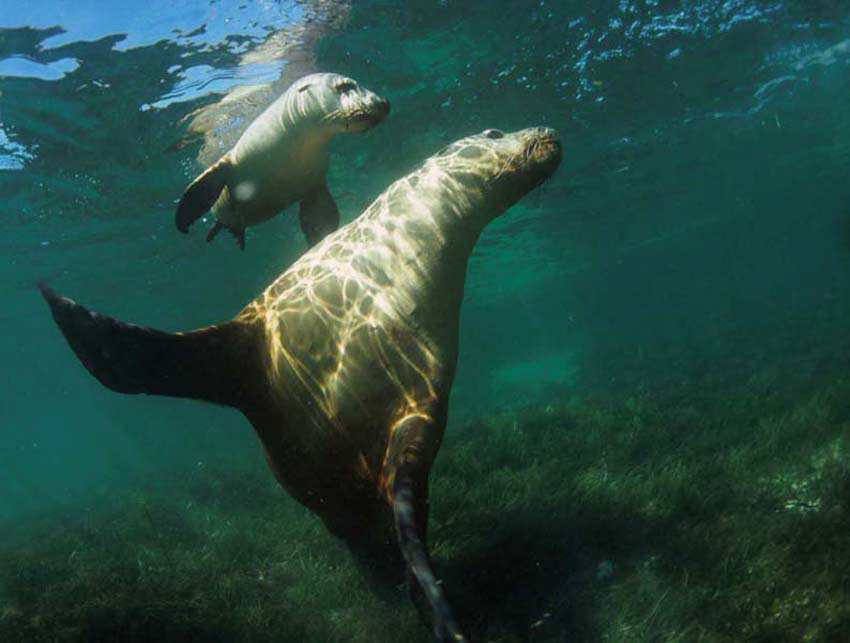
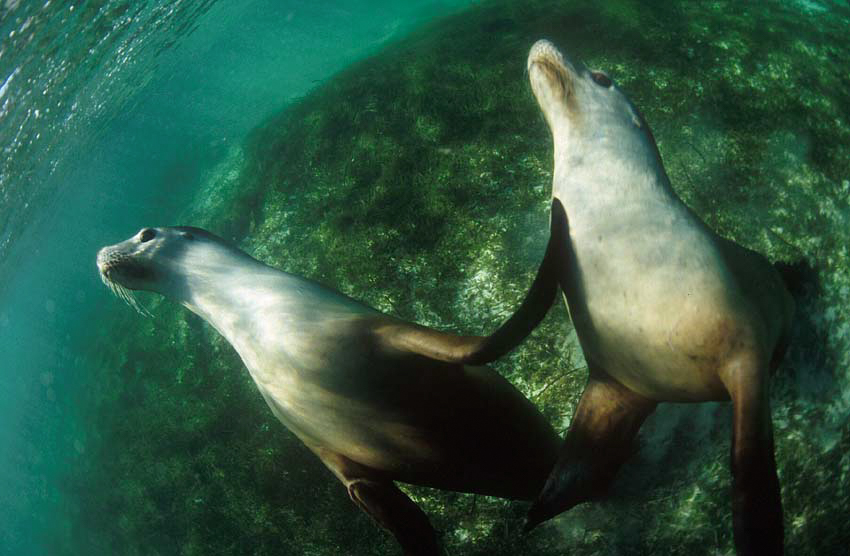
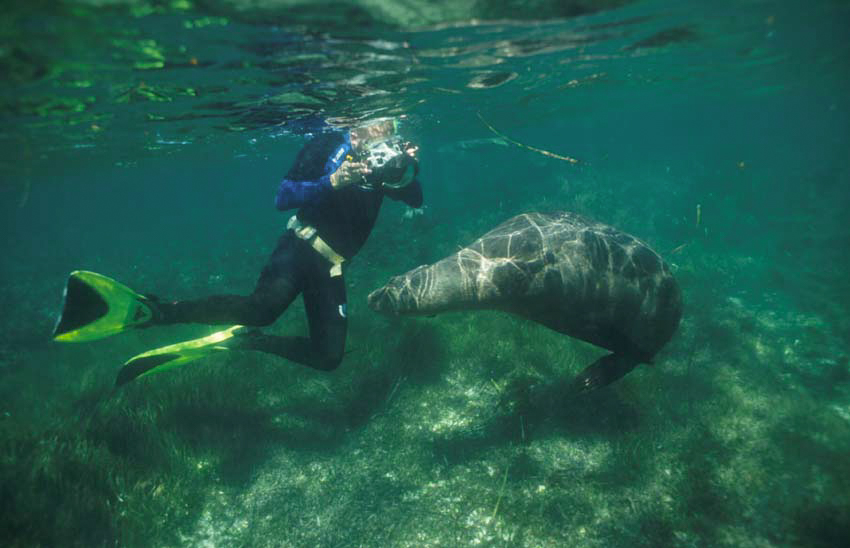
Featuring other snorkellers in the water can also make for interesting images, showing their actual interaction and close proximity with the sea lions. In order to achieve the best results, it might be wise to “work” with a snorkeller, discussing what you want them to do, what you’re going to do and hoping that a sea lion does the rest.
Schools of fish sometimes swim through the shallows, so an opportunity might exist for the fish and a sea lion to be photographed together, although for obvious reasons the fish won’t hang around when a sea lion approaches. A patient (and lucky) photographer might, however, get an interesting result.
Half and half opportunities are also possible for photographers using a fish eye lens. For example, the boat could be used as a background, or perhaps the head of a snorkeller. Also, the sea lions themselves will sometimes “sky hop” just long enough for an image to be composed. Given a few more days, and with enough images already “in the bag”, a photographer could also experiment with some different techniques such as blurring and panning.
Like people, the sea lions eventually get tired (or bored) and by the time 2 or 3 hours are up, most have returned to their beach. Mimicking their yelps and whoops will sometimes get them back into the water. I tried this technique and attracted the attention of one of the larger bulls. Suddenly, he rose up and lunged into the water, swimming straight towards me at considerable speed. For an instant I became concerned, although once circling me, he seemed inquisitive rather than aggressive.
Although not scientists, Rod and Ronnie have built up a considerable knowledge of the Green Head population and sea lion behaviour in general, and can assist visitors in understanding the behaviour and actions of the animals.
When asked about their most memorable experiences with the sea lions, Rod replied, “Too many to list, really. Perhaps the most memorable was when one of our clients was snorkelling around the boat looking for a sea lion when unbeknown to him, he was being followed. Suddenly, the sea lion pulled itself onto the swimmer’s back and sat there for a brief moment. Unfortunately, nobody was quick enough to grab a camera!”
“Basically, the thrill Ronnie and I get from the trip is the comments of enthusiasm that our clients express when they return to the boat after their swim”, he added.
You see, Western Australia isn’t short of superb underwater experiences. And it isn’t just about whale sharks and wobbegongs either! Add the sea lions of Green Head to its long list of attractions, preferably somewhere near the top. And it’s a fantastic photo opportunity, too.
Time of Visit: April 2005
Written in: May/June 2005