
Text by Jeremy Cuff/www.ja-universe.com
Photography by Jeremy & Amanda Cuff/www.ja-universe.com
Around five years ago, I made a solo dive trip to the Indonesian island of Bali staying at the Scuba Seraya Resort in Tulamben. I thought it was great and knew my wife Amanda would love the place too, so we vowed to make a family dive trip happen there at some point in the future. We just had to do it …
Winding the clock forward to early 2017, the idea of a visit came into sharper focus and seemed a much more realistic proposition for us. In the time that had passed, our son Zac had become both a teenager and a PADI Junior Advanced Diver with around 100 dives under his belt, which meant he could participate in most of the dives offered. We all fancied the idea of it, so we made a plan; settling on a two-centre dive trip staying firstly at Scuba Seraya followed by a crack at seeing the “Mola Mola” (Sunfish) at the more challenging dive sites of Nusa Penida, based at Padangbai.
Though it may seem like a travel writer’s cliché, Bali is often described as a haven of peacefulness and tranquillity; the kind of place where you can cast aside the stresses of modern life, get off the treadmill and recharge your batteries. It certainly has that aspect, but there are several other facets too, depending on what you’re looking for.
You can go for the partying, commercialism and surfing hotspots of the south coast centred around Kuta and Seminyak, or you can immerse yourself in the spiritual and artistic worlds in areas such as the cultural hub of Ubud, and among the numerous temples. Outdoor fanatics can revel in the excellent trekking possibilities, such as Mt Agung (more of which later), and other areas such as Mt. Batur and the West Bali National Park. Others will gravitate towards secluded spas and hideaways, and of course, scuba diving. Our particular angle was a combination of scuba diving and hideaways, with a short, sharp shock of the bustling commercial hub of Kuta for a single night at the end before heading home.
TULAMBEN
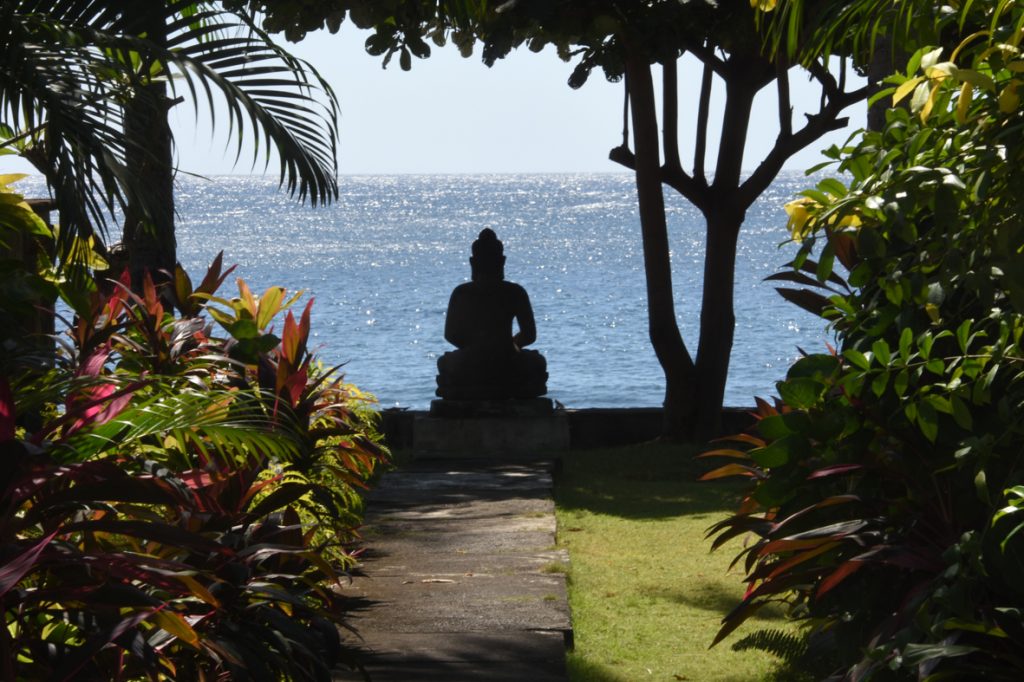
The Scuba Seraya Resort is located close to the village of Tulamben, a renowned area for diving on the North East of the island, just off the main coastal road. Thanks to the busy roads, it can take up to three hours to reach from the airport in the transfer minibus, but it’s very much worth it when you get there. The resort itself is rather like you’d imagine a Balinese dive resort to be like; lovely mature foliage and well-kept grounds, a black sand beach fringed by palm trees and attended by friendly welcoming staff.
As a backdrop to the area, there’s the brooding volcanic menace of Mt. Agung, which dominates this part of Bali. It was possible to trek Mt Agung until recently, as shortly after our visit in August, it decided to “wake up” again. During the time of writing this feature in November, quite a lot changed; the activity levels of Agung appeared to be reducing, but on the weekend of the 25th/26th November the volcano begun what many feared would be a major eruption. Areas considered to be in the greatest danger have been evacuated, including Tulamben.
One morning, I remember asking the dive crew if there’d been any recent rumblings or signs of activity from Mt Agung to which they said the volcano “was sleeping”. It now seems strange having had that conversation. It serves as a reminder that calmness and tranquillity cannot be guaranteed in Bali. Prospective visitors should keep a tab on what’s happening with Mt. Agung, even if it isn’t making news headlines.
The area around Tulamben is especially renowned for its fascinating “muck diving” and the Liberty Wreck. The term “muck diving” could be considered somewhat of a misnomer, as it’s really “sand diving” and in this case “black sand diving.” To me, black sand creates a different timbre to the water, making it seem more mysterious than the “white sand” variety; a darkness with secrets to unlock.
That sense of mystery and discovery is perhaps heightened by the name of the resort’s “house reef” which is called Seraya Secrets. It suggests that surprises and mystery surround it. Over the course of several dives, the site began to reveal some of them to us, mainly thanks to the helpful and friendly dive guides. Paing, who served as our excellent guide throughout our stay joked that the site is now called simply “Seraya”, as it “has no more secrets” thanks to the amount of diving conducted there over many years.
Good though Seraya Secrets is, most divers will wish to explore the wider choice of dive sites which can be accessed by the daily boat dives, most being no more than ten minutes away. As the boats are generally moored just off shore, the dive crew will cheerfully help anyone who is unsteady on their feet to navigate the boulders whilst wading through the shallows to the ladder.
The dive guides know the local sites like the back of their hands, and without their help most visitors would find but a fraction of the stuff. One of the great things about diving these black sand slopes is that small and non-descript looking bommies on closer inspection turn out to be hives of activity that are so good you could spend whole dives there, with a myriad of creatures cleaning and being cleaned, hunting and being hunted, eating and being eaten. Things to look out for include various shrimp, ornate ghost pipefish, moray eels and ribbon eels. Why certain bommies attain this “status”, while other similar bommies don’t is a mystery (at least to me). It must be something along the lines of how certain towns become more prosperous and sought after than other towns.
It’s also worth spending time out on the black sand itself, where you can discover all sorts of critters such as half buried scorpionfish and snake eels waiting for something edible to swim within striking range, plus hermit crabs, decorator crabs, flounders, cuttlefish, octopus and roaming groups of the bizarre shrimpfish (razorfish). Of the bigger things, skittish stingrays (a kind of the blue spotted variety) can commonly be seen gliding across these expanses.
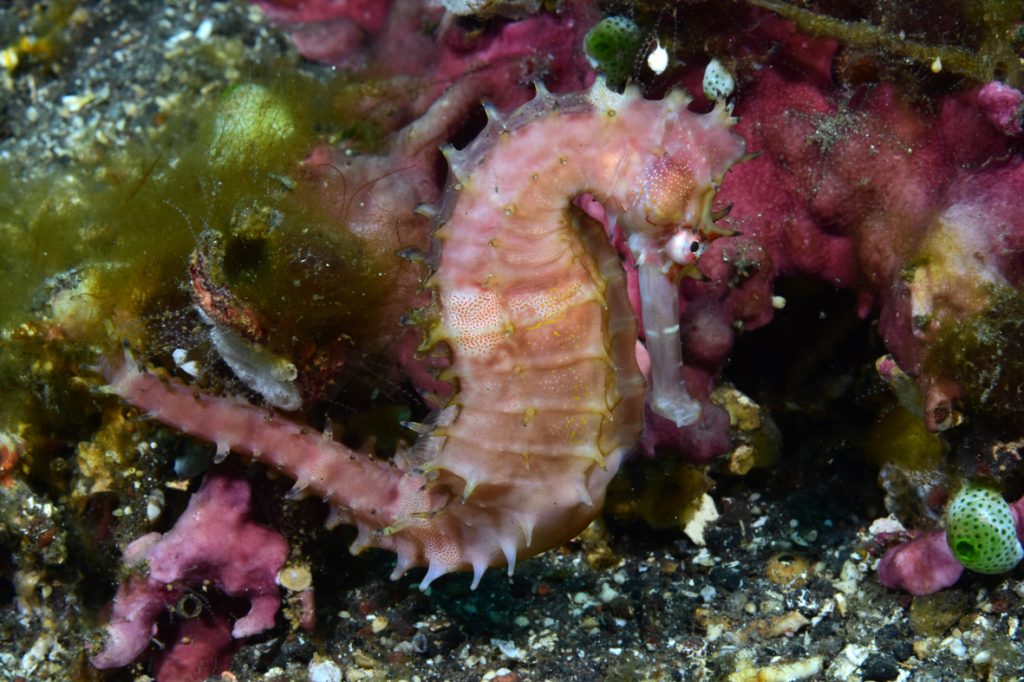
One such site that we visited was the excellent Sidem (originally known as Lombok View). In terms of underwater topography, it’s a sandy and weedy slope full of promise. For me, it’s become forever associated with the search for a prized Rhinopias scorpionfish, not only on this trip but also on my previous one. I’d frustratingly missed out on seeing one at the same site five years ago, and having been told that a fine specimen was again present at the site, I hoped this time it would work out. As Paing searched for the Rhinopias, there were plenty of other things to interest us. Especially memorable were seahorses, mantis shrimp, devil scorpionfish and a pair of harlequin shrimp, a beautiful but deadly species that specialises in dismembering and eating starfish.
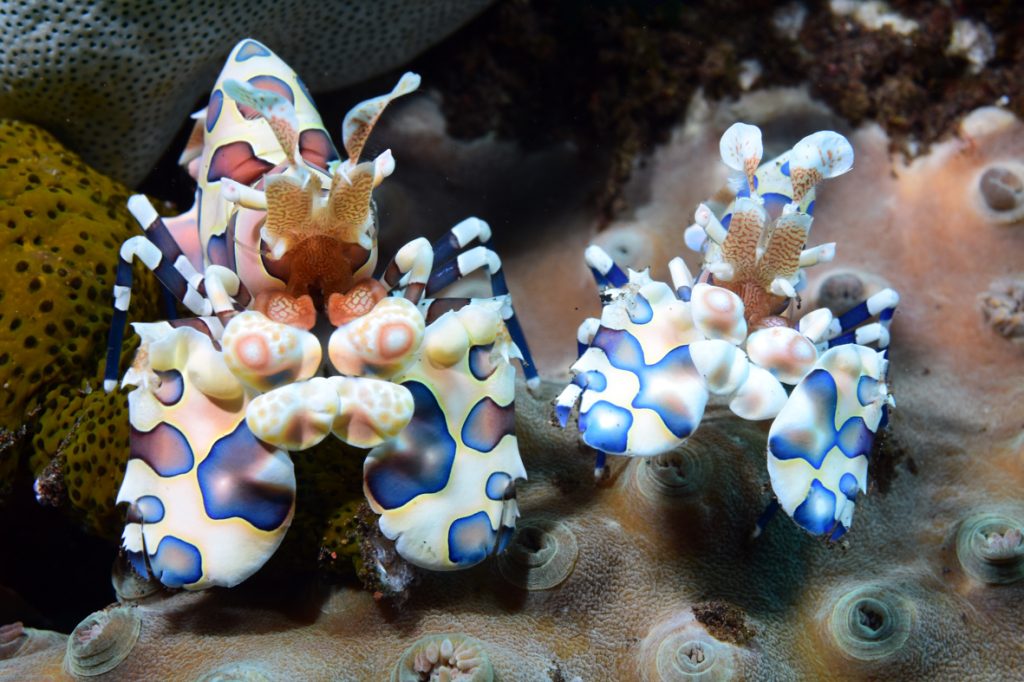
Whilst we were otherwise engaged with photographic opportunities and doing our own critter spotting, the search for the Rhinopias continued without success. After three or four dives at this site over the duration of our stay, it just wouldn’t reveal itself. The Rhinopias had eluded us, as it did with me five years previously. It really was a case of déjà vu. In a frustratingly funny way, we heard it had been rediscovered after we’d finished our last dive!
On my previous trip, I had a great encounter with a wonderpus (octopus), just along from Scuba Seraya at a site called Melasti. Another wonderpus would have been just fine, but the encounter we all really wanted was the mimic octopus, which is also resident in the area. We discussed this with Paing, who suggested that we try an area of Melasti, and also a site called Bulakan. Melasti is a great muck dive site, but we couldn’t find any octopus specimens during our dives. However, at Bulakan, we concentrated on the task and managed to glimpse a mimic before it disappeared into its sandy burrow.
Encouraged by the “glimpse” at Bulakan, we went back to try again. Early in the dive, we spotted an octopus, but it wasn’t a mimic or a wonderpus, it was a long armed octopus. It was a good encounter, but before long it managed to escape into a hole, so we resumed our search. Paing was really “in the zone” and a few minutes later, he signalled for us to stop; he’d spotted a mimic out on the sand. To prolong the encounter, he had to prevent the skittish mollusc from bolting down a hole, which he somehow managed to do. We then had a fantastic encounter with this amazing octopus lasting at least ten minutes, watching as it changed colour and contorted itself, at times adopting the “flounder” version of its various “alter egos”. It was a great dive, and an ambition fulfilled.
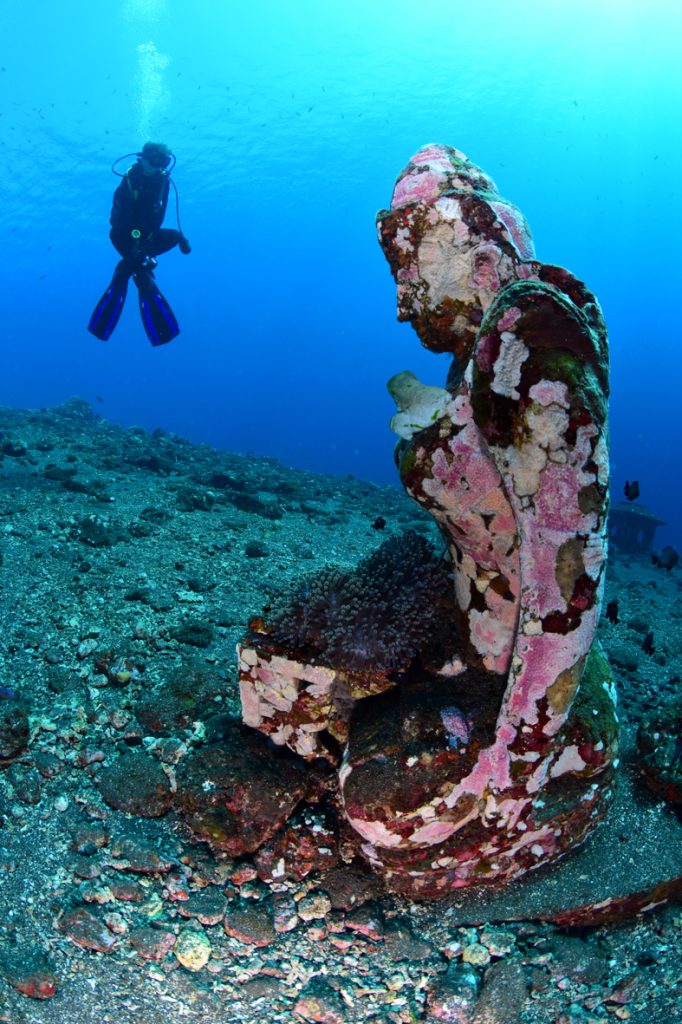
Around Tulamben, the local dive operations have placed artificial reefs and wrecks at some sites, with a view to attracting additional life for the benefit of both divers and the environment. These are always worth spending time around, where predators such as eels, scorpionfish, lionfish and frogfish can often be found feasting on the more concentrated amounts of prey. At Seraya, there’s some interesting structures to explore, and along at Tulamben itself there’s an underwater sculpture garden featuring various statues (such as Hindu gods) and an “aeroplane” wreck for added interest and novelty, though the actual structure had deteriorated since my visit five years ago.
One wreck that most certainly isn’t “artificial” (and one of the best known in the whole of the Far East) is the Liberty Wreck. This huge wreck is often the reason why divers visit the area and it’s not difficult to see why. It’s also unusual in that it can be done as a shore dive, though if staying at Scuba Seraya you’ll do it from a boat, which is easier.
Closeby is a cluster of dive centres and lodges ensuring that the wreck is often extremely busy with divers, which can be frustrating if you’re a photographer shooting wide angle. Trying to find an area or vista that you want to photograph without bubbles, arms, legs and fins everywhere can become a yearning on this wreck, but it is possible if you’re patient.
As the wreck is around 120 metres in length, ideally several dives are the optimum here in order to fully explore it. We managed three dives on the wreck, at different times of day including an early morning dip to see the resident bumphead parrotfish that bunch together at first light before scattering off for the day. We also encountered several turtles, and were told that schools of barracuda can sometimes be seen. Deep dives of around 35 metres are also possible if that’s your interest, but depth isn’t essential here.
Finally, Tulamben also has a few “coral dives”, though this isn’t the prevalent topography. We sampled Coral Gardens and The Wall, the latter of which has some impressive gorgonians and assorted reef growth to check out, including one coral fan that has pygmy seahorses if you know where to look and are patient. If diving The Wall, it’s worth ensuring that you start the dive in the shallow “black sand and rubble” area where there’s a large school of very photogenic fish to have fun with.
Overall, Scuba Seraya was a great choice for us. It ticked all of our boxes; seclusion, privacy, friendliness, freshly cooked local food, good diving and peacefulness. However, if planning to go there, do keep an eye on the activities of Mt. Agung.
NUSA PENIDA
We were very sad to leave the dive haven (or heaven!) of Scuba Seraya, but we still had some life left in our trip, with dives planned around the Nusa Penida area. Nusa Penida itself is an island located off the East of Bali, in the channel between Bali and Lombok. It’s best known for the phenomenally powerful movements of water between the islands and the seasonal gatherings of the weird and wonderful Mola Mola.
To dive there, we based ourselves at the quirky, enjoyable and eco-friendly Bloo Lagoon Resort, located on a headland above the bustling “dive friendly” town of Padangbai. Our primary reason for visiting was to get the chance of encountering the Mola Mola, which Amanda really wanted to see. We gave ourselves 3 dives a day over 3 days in which to make the dream come true.
Mola Mola (or Sunfish), of which there are more than one species, are known from most of the world’s seas, though they are rarely seen on dives. This area of Bali however, is a hotspot for them and quite a diving industry has grown up around the sightings. Bali’s Molas are a seasonal gathering, with the optimum time being July to October. Our visit coincided with this time window, but in the earlier part of the “season”. So, to slightly modify a Syd Barrett era Pink Floyd tune, we “Set The Controls For The Realm Of The Sunfish”.
Of the many possible choices in Padangbai, we chose Aquamarine, who we found to be a well organised and professional dive operator. Between Amanda, Zac and myself, we developed a “Mola Mola” chant and accompanying hand signal, as if to bring us luck. It was rather like the “Toga, Toga” chant from the American college comedy featuring John Belushi when planning a debauched toga party. But did it work?
We visited Crystal Bay four times over the three diving days, which might be better described as Crazy Bay. It can be “crazy” for two reasons; one is the potential strength of the currents out in the channel between Nusa Penida and its small neighbours Nusa Lembongan and Nusa Ceningan, and two, the phenomenal amount of dive boats and divers in the water. Amanda hated the first dive there (and I doubt that anyone actually enjoyed it) as the current was fierce, making it unpleasant and air consuming whilst we attempted to hold ourselves in position and hang on whilst trying to scan the blue water for Mola Mola. Some divers wouldn’t do the later dive there that day after the exertions of the first dive, though that was a mistake, as the current was much more “manageable” then.
On our second dive day, we visited another location off Nusa Penida called Toyapakeh. It was a pleasant enough site with a sloping reef, and at the time of our dive, a mild-ish current. We cruised the reef whilst looking out into the blue, but nothing much was happening. As we got into the second half of the dive I was beginning to think that our luck was out. Then, somewhere below us on the slope, there was a strange shape that jarred. It took a few moments to mentally process it, but when the penny dropped, I knew what it was. It was a Mola Mola, a big one. I signalled to Amanda and Zac, to make sure they’d seen it and then dropped down towards it, to around the 35 metre mark.
This strange and improbable fish was being cleaned by a few bannerfish, which is usually the reason they visit the reefs and walls. I approached slowly and carefully, but knew that it wouldn’t stick around for long, so there wouldn’t be many chances to capture images. The encounter was fairly brief but brilliant, as it circled us before heading back into the blue. After the dive everyone was buzzing; a heady mix of relief, euphoria, smiles, punching the air and whoops, and all the divers saw it. From what we heard, we had the only Mola Mola sighting that day, and possibly over the 3 days in which we dived the area. We felt happy and fortunate.
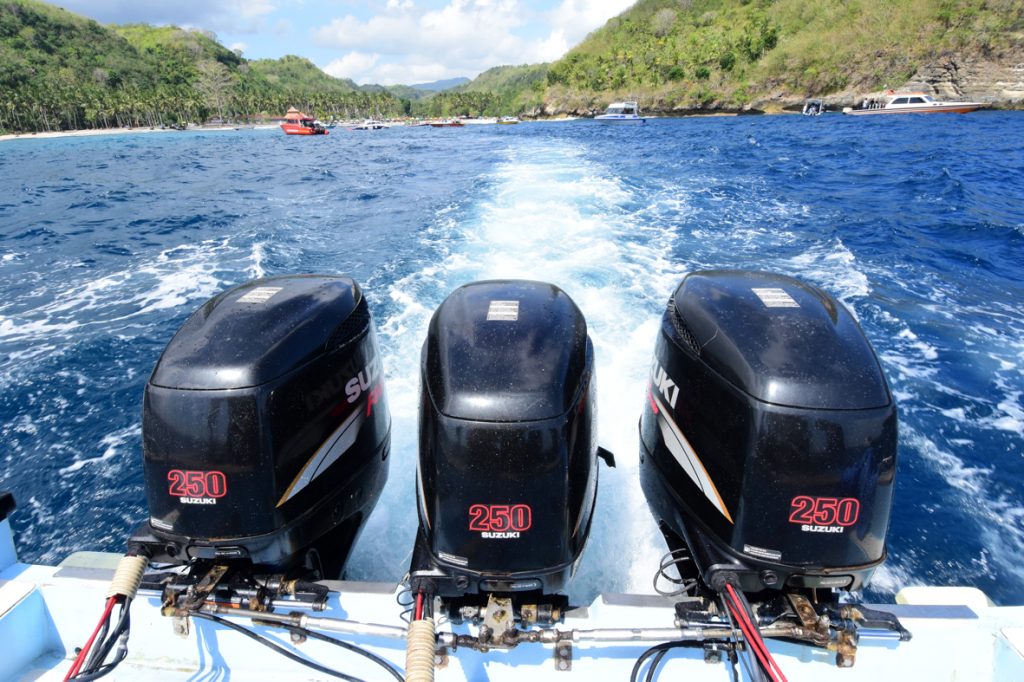
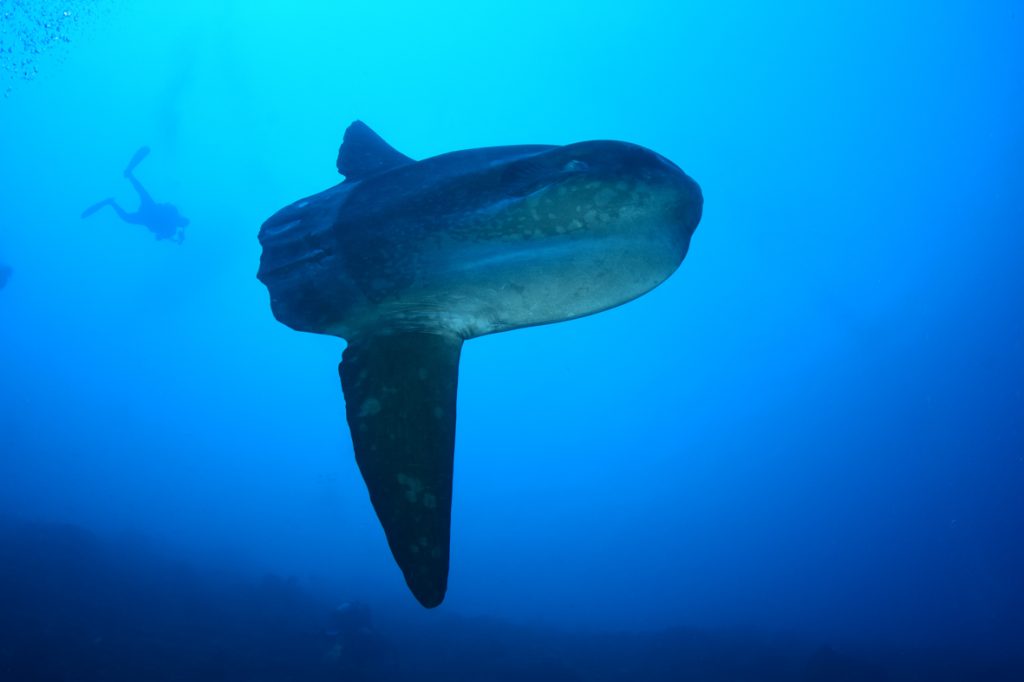
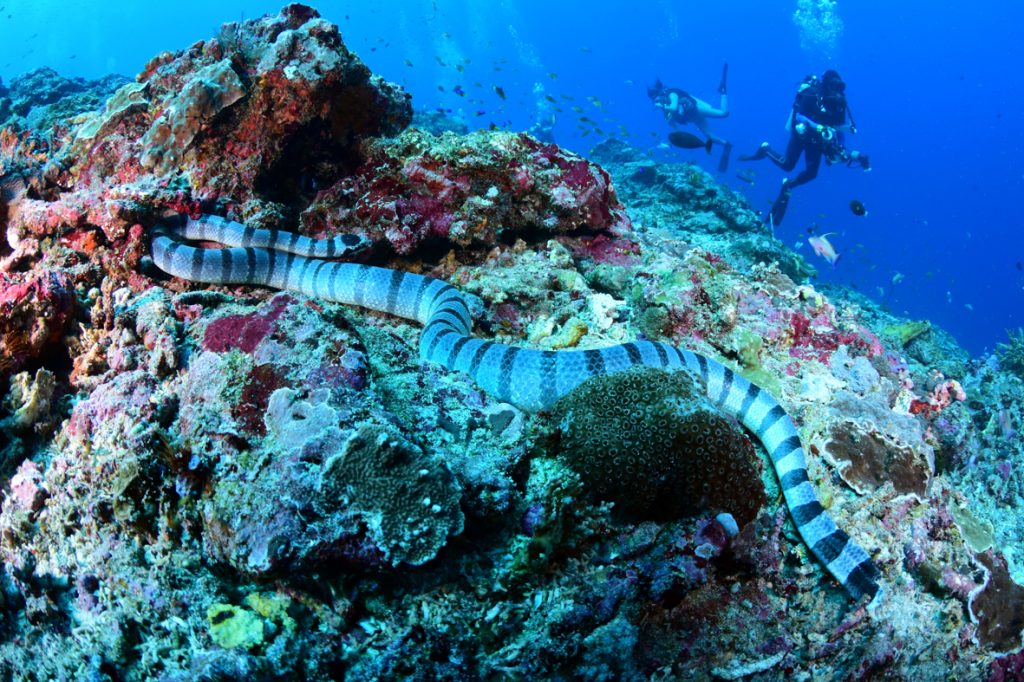
Given the amount of diving that goes on in this area, it’s was no surprise to hear that Mola Mola sightings have become less common in recent times, especially at places like Crystal Bay. One must surely conclude that it’s due to the incredible amounts of divers in the water. Without having any answers as to “how?”, if something could be done to limit, restrict or rotate dive sites without ruining livelihoods, it would surely help. In essence, the amount of diving being conducted is in danger of destroying the reason it has sprung up in the first place.
As I’ve dedicated most of this section of the feature to our successful Mola Mola quest, I musn’t forget to squeeze in some other important mentions, such as the presence of Manta Rays. On each diving day, we travelled along the wild Southern coastline of Nusa Penida to a site called Manta Point. Like Crystal Bay, it’s usually very busy with dive boats, but the mantas are virtually guaranteed. In fact, you might even see the two species of manta, the reef manta and the giant manta; we were fortunate and saw both. Other impressive lifeforms from the Nusa Penida sites we visited include turtles and some alarmingly large sea snakes.
A few words must also be said about currents and water temperatures. As touched on earlier, the general area of the Lombok Channel (including Nusa Penida, Nusa Lembongan and Nusa Ceningan) are affected by incredibly powerful movements of water, which includes upwellings from the deep. Nowhere is it more evident than on the journey from Crystal Bay to Manta Point where you’re likely to see and experience crazy, disturbed water and extreme currents from the safety of the boat.
On the dives themselves, especially at Crystal Bay, it’s vital to “read” the current and ensure that you don’t get into a situation from which you can’t get back to sheltered water, and be swept away into the channel. Also, you’re highly likely to experience some pretty chilly water at times, which can be a bit of a surprise in the tropics. This is mostly caused by the upwellings, which can create some very weird thermoclines, with its distinctive “fuzziness” at the division of cold and warm water. You can have your body in cold water whilst your outstretched arm is in warm water. In sections of the “upwelled” water, the temperatures can be as low as 16 degrees centigrade.
Anyone with any environmental consciousness can’t fail to be aware of the problem with plastics in the ocean, which is currently reaching a wider audience thanks to programs such as the Blue Planet. This problem might especially affect species such as the Mola Mola, as they feed on jellyfish, which a floating plastic bag very much resembles. It was therefore very heartening to see the local authorities conducting a beach clean-up at Padangbai (which admittedly very much needed it). It was a small step on a big journey that should be applauded (and repeated).
A late addition to this feature is to mention that Padangbai is currently outside the Mt. Agung exclusion zone, and therefore it’s business as usual assuming you’re able to travel there. As I’ve said in the Tulamben section, prospective visitors should keep informed as to the current situation with the Mt. Agung eruption.
Overall, we had a great time in Bali. We enjoyed the place, we enjoyed the people and we enjoyed the diving. And we’d given peacefulness and tranquillity a chance. In fact, the wider world could learn a lot from Bali – highly recommended by us on many levels.