
An Ideal Destination for Photographers with Families
Text by Jeremy Cuff/www.ja-universe.com
Photography by Jeremy & Amanda Cuff/www.ja-universe.com
Back in 1997, as diving newcomers, we’d visited the Maldives and loved the barefoot bliss and chilled out days of dives, sunsets, books and good food. Now, winding the clock forward to the present day, life for us has changed somewhat. We’re now regularly published underwater photographers and dive photojournalists, and we’ve also got an 8-year old son tagging along with us. We fancied the Maldives but the question was, where should we go…?
For whatever reason, the general assumption seems to be that divers and underwater photographers operate singly or as couples, but what happens if you’ve got a family? Where can you go to practice your art in a place that isn’t bereft of good subjects?
Liveaboards are mostly out of the question except for the unique family weeks offered by the Aggressor Fleet in the Caribbean, and exotic far flung dive resorts in places such as Raja Ampat aren’t always affordable or practical for even the most adventurous family. So where in the Maldives could we go to get that rare combination of good diving and family friendliness?
The Maldives are most certainly a suitable destination for children, but few of the islands are really set up for families wishing to dive, or for those with a modest budget. Visits to this Indian Ocean paradise certainly don’t come cheap, with some islands being prohibitively expensive for many people, whereas others are really only geared up for couples and honeymooners.
After some research, we found that the best answer for us was a mere fifteen minute speedboat transfer from the airport in the form of Bandos Resort, a long established island, popular with families, but with decent diving.
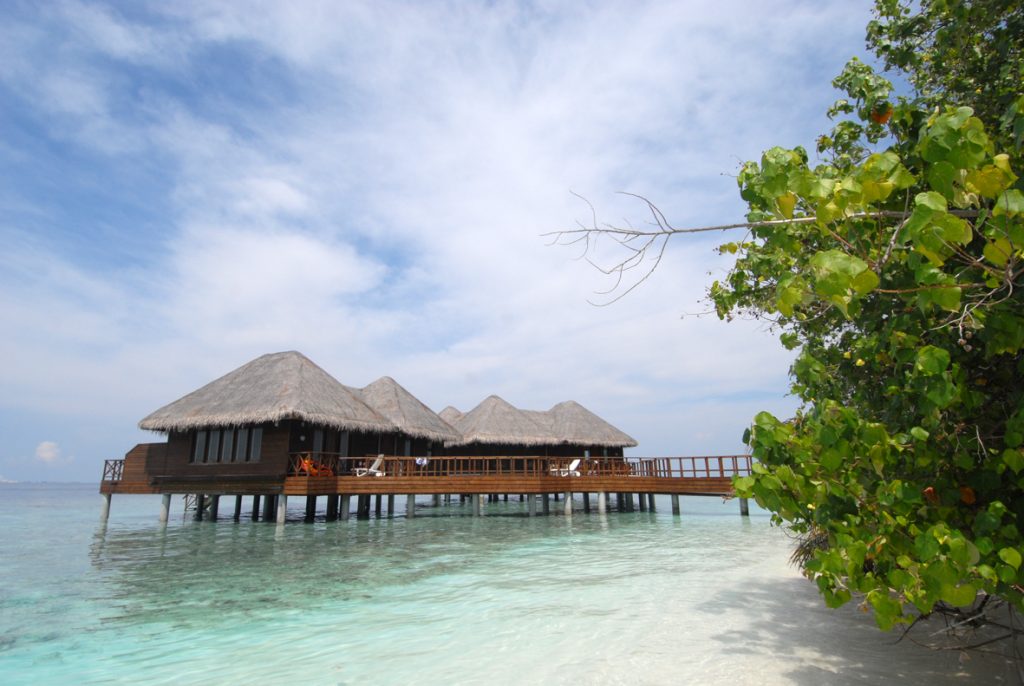
We went through our checklist of requirements – good house reef, a kids club, a choice of restaurants, a decent dive centre, a choice of dive sites, decent reviews and relative affordability (in the Maldivian scheme of things). It ticked all of the boxes, so we made the booking.
I can clearly remember the first time we visited this unique nation of around 1200 islands, of catching sight of the Maldivian capital Male from the plane. It’s perhaps one of the most improbable cities in the world, appearing like model buildings resting on a lily pad in a giant pond. It’s quite remarkable to behold.
The airport too, is a major feat of engineering, but no one wants to spend time pondering the logistics of how it was constructed, other than you’re glad they managed it. Everyone wants to head off to their respective islands, either by boat transfer or by using the Maldivian Air Taxi service to reach the further flung islands and atolls.
After the long flight, it was nice to know that our onward journey to the island would be short, and once we’d collected our bags and reported to the Bandos arrivals desk, we were soon escorted to the transfer speedboat and on our way.
Bandos is a very well known and established Maldivian Resort, with an excellent infrastructure that includes a medical centre and recompression chamber. There’s also a spa, a couple of shops, a gym, sports facilities, a water sports centre and a choice of excursions in addition to the facilities already noted. But what about the diving and underwater photographic potential?
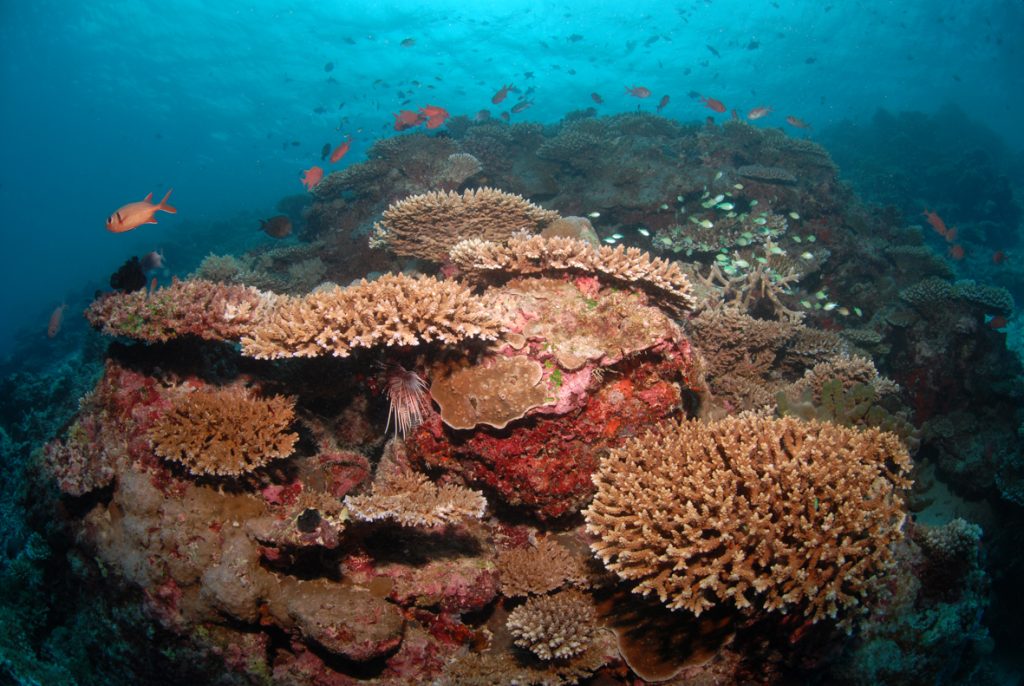
The house reef itself is worthy of a special mention, as it’s very good, and can most certainly keep divers entertained. It’s accessed close to the dive centre by an easy beach entry into a small channel, which leads out to the reef slope itself. You can head either left or right when you reach the drop off, though we tended to head right more frequently than left. It doesn’t really matter which way you go, as there’s little or no current to worry about.
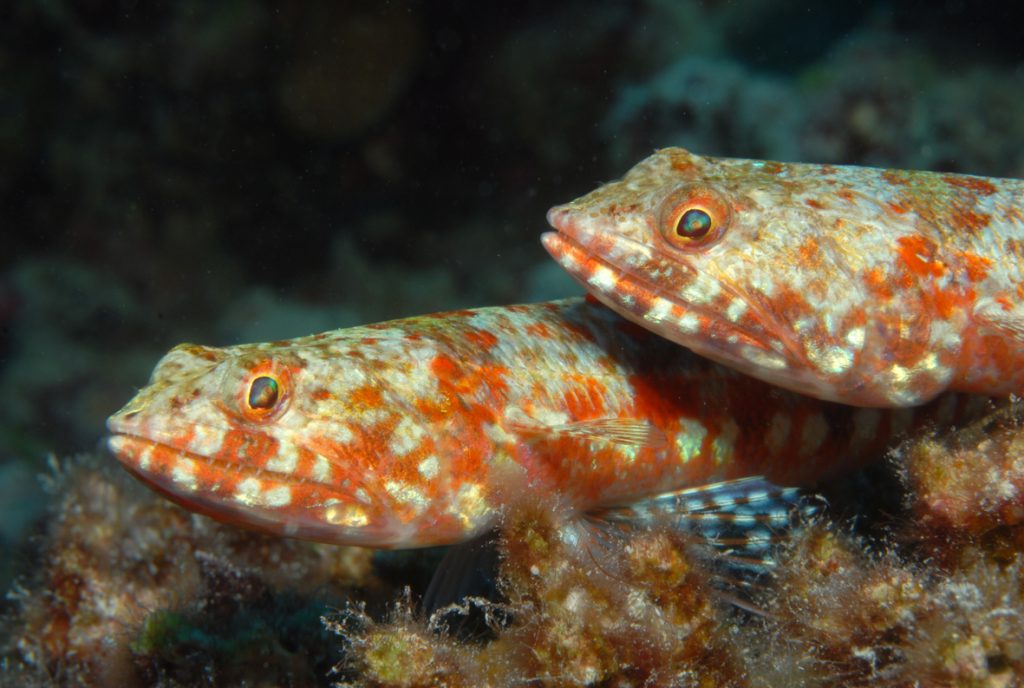
The reef seemed very healthy despite the amount of divers that head out there on a daily basis, including many that would doubtless be doing courses such as the PADI Open Water and so on. On the average dive, expect to see snappers, sweetlips and perhaps some more cryptic reef inhabitants such as octopus, scorpion fish and the occasional stingray. It’s also worth keeping an eye out for turtles and eagle rays in the blue.
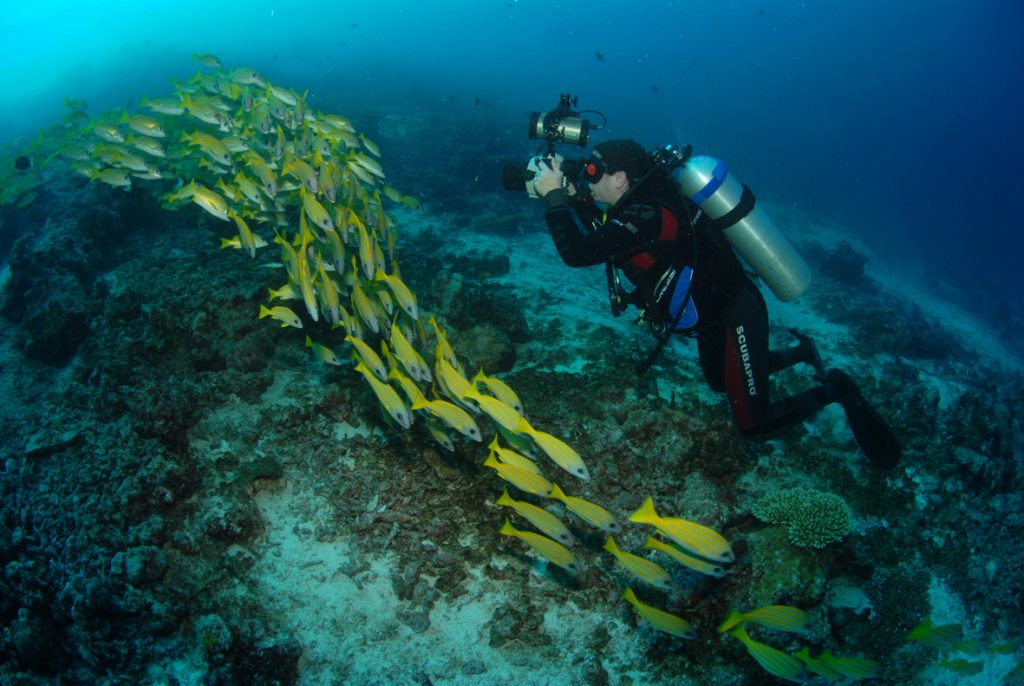
During our house reef dives we encountered a school of “diver tolerant” snappers which we soon discovered were always in the same area, and always at about 20-23m. It was a pity they weren’t in the shallows so that I could include some surface water textures into the images, but hey, you can’t have everything.
Nonetheless, it was a good opportunity, so we decided to spend a couple of dives “working the snappers”. Sometimes I would shoot images of the school against the reef, and other times Amanda would model for me, attempting to adopt aesthetically pleasing poses that were complimentary to the fish as I fired away. Other times, I would slow the shutter speed down and try some rear curtain sync blurs and rotating camera images.
Most tricky were the modelling shots, where I had to strike a balance between lighting Amanda’s eyes sufficiently for the all important diver shot “eye contact”, but not over-light the highly reflective fish. Between us we captured some acceptable images suitable for publication but if the truth be known, I wasn’t really satisfied with the resulting shots. To my mind, they were “OK”, rather than “wow”.
Anyone who spends any time around the jetty by the dive centre or in the house reef shallows is almost certain to see the resident population of black tip reef sharks. It’s a good area for these sharks, which benefit from a protected breeding area located just off the island. Judging by the amounts of young sharks cruising the shallows, it appears that the population is doing well. Divers wishing to see the “adult versions” of these sharks can often find them on the house reef where they are commonly encountered on dives, though getting close enough for photography is another challenge in itself.
I’ve seen some great images of black tip reef sharks in taken in shallow lagoons, and had it in my mind to capture something similar, perhaps even a split level. Whilst I’m sure these images may have been possible in Bandos, I didn’t get anywhere near close enough to the sharks to even start shooting. The young sharks in the shallows seemed “tolerant” until you attempted to approach them, at which point you realised that they weren’t! I probably didn’t spend enough time on this, but perhaps another visiting photographer might get the shots that eluded me.
The house reef is also very good for snorkelling, so expect to see non-divers above you over the shallow reef tops from time to time. Sometimes a co-operative snorkeller can make a very good image, so it’s worth thinking about people as well as marine life and underwater scenery as photographic subjects. I took our son Zac snorkelling here on a couple of occasions which he really enjoyed, but it wouldn’t come close to what he would do a few days later.
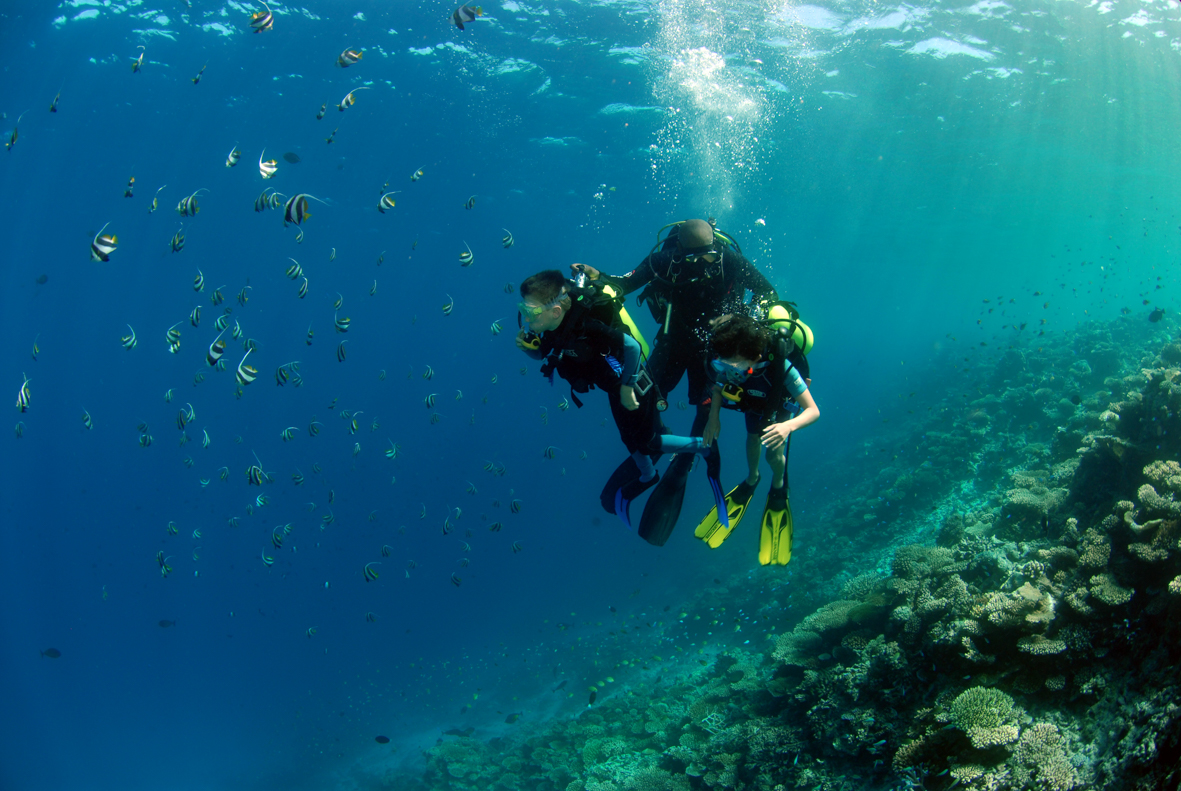
The Bandos dive centre offers the PADI Bubblemaker course for 8-9 year old children which we enthusiastically signed Zac up for, even though he didn’t need persuading. We assumed that the course would be conducted in the main swimming pool, but once he’d been briefed at the dive centre and kitted up, along with a young French lad who was also doing the course, we discovered that their dive would actually be in the sea, on the house reef.
The two boys, under tight supervision from the instructor (who Zac nicknamed “Master Shifu” from the Kung Fu Panda film) enjoyed an superb, and I think somewhat overwhelming experience along the top of the reef wall, seeing a myriad of colourful fish and even a couple of adult black tip reef sharks that cruised the reef a few meters below. After such a unique shared experience, the two boys became friends – we called them the “Bubblemaker Brotherhood”.
Capturing images of Zac’s first real dive was obviously something that I couldn’t fail to get right. With my land camera, I fired away as I stood in the shallows in full scuba kit, whilst the instructor prepared the boys to go diving. Passing the land camera back to Amanda, I then followed the boys on their maiden dive.
It wasn’t easy to capture good images, as there were lots of bubbles and chaos, and the boys weren’t exactly thinking about modelling for me. I found myself working quite hard for these images, swimming ahead of the group to get a good position in front of them as they made their way along the reef, repeating the exercise a number of times. I was pleased with the end results given the circumstances.
Good though the house reef is, the vast majority of divers put their names down for the popular boat dives that head out twice daily to a wide choice of locations, most within a relatively short journey from the island. A list of all the dive sites can be found in the dive centre, so that divers can make an informed choice about the areas they wish to visit.
The Maldives are known for drift dives, some of which achieve an almost legendary status among the dive community. We visited a site called Lankan Reef which promised a fast moving show, but when we arrived there the current was slight, almost non-existent. It also boasted a manta cleaning station which we would pass en route down the reef, but it was too early in the year for manta ray encounters (it was April, and the season is May – November). Or was it?
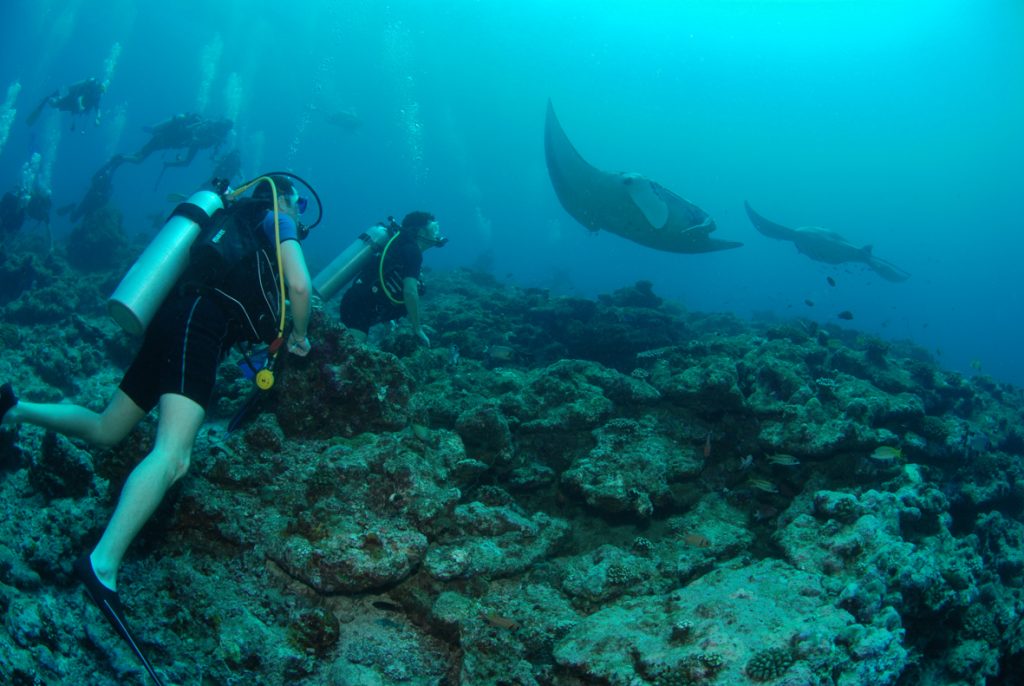
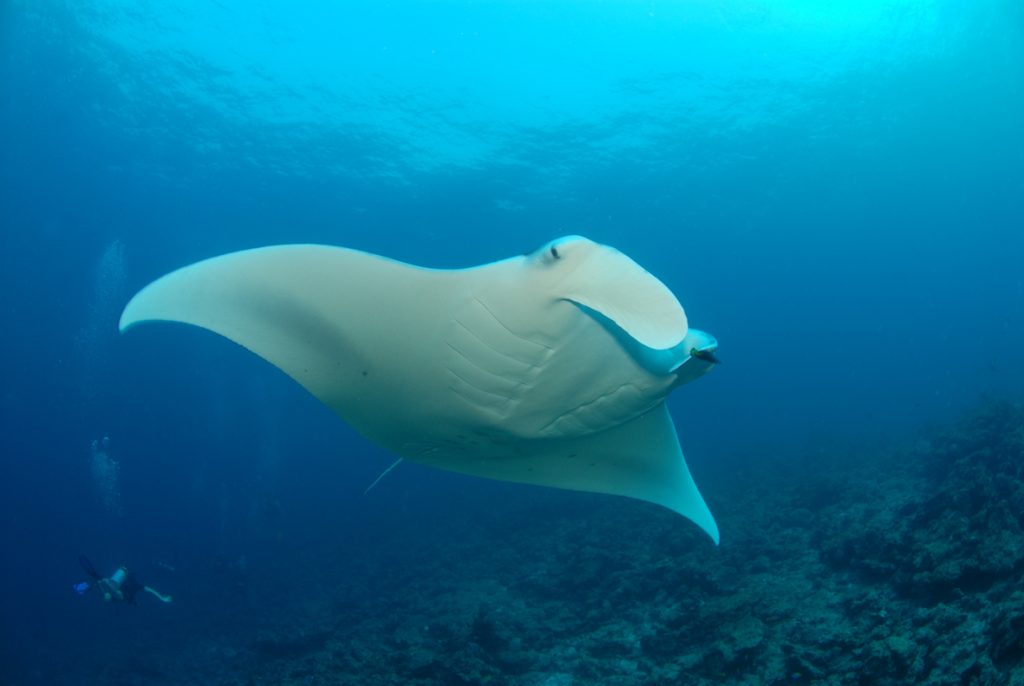
Later in the dive, someone tugged excitedly on my BCD. I turned around to find a manta approaching me. I instinctively attempted to capture an image, but it was too late to sort out my camera settings as it passed overhead. Though it was great to see a manta so unexpectedly (and so close), the photographer in me felt more than a little frustration as it cruised majestically away from me down the reef. I guessed it might be the only chance I would get.
But no, somewhere beyond the edge of the visibility it must have turned around and began heading back towards me. I didn’t notice it straight away, but when I did, there was time (though not much time) to prepare to capture an image. I quickly fired a test shot to get the water colour “in the zone” but to my horror, it was way out. Way too dark. I’d have to sort it out very quickly, adjusting the settings as the manta headed straight towards me.
This was really “staring down the barrel” as I intuitively made some changes with no time for another test shot. A quick glance up and I’m thinking “don’t panic, don’t panic, it’s not here yet” and with the adjustments frantically made, the manta was upon me. This time I captured a small sequence of shots as it soared past. Yes!
But the action wasn’t finished yet. As there wasn’t any current, we turned around and headed in the direction of the manta, back towards the cleaning station we’d passed earlier in the dive. By the time we arrived there, most divers were low on air and close to deco but there was one final spectacle to enjoy before we ascended back to the surface.
The lone manta was indeed at the cleaning station as we had hoped, but it wasn’t alone for long as it was soon joined by another. For a few minutes we watched them circle the cleaning station, with all divers behaving impeccably by respecting their space so as not to spook them. It was a great encounter.

As a manta ray could be considered a symbol of freedom, the Maldives probably doesn’t strike you as the kind of place that needs a prison, but yes, there is one. And it has its own island, which boasts a dive site called Feydhoo Caves. It makes for an interesting “wall and drift” dive, though the visibility is sometimes impaired compared to other sites in the area. What it does offer is some interesting topography and encounters. We found numerous moray eels and lobsters peering from their lairs in the wall and ledges that harboured resting turtles. Several scorpion fish and lionfish, along with healthy congregations of batfish and tuna were also enjoyable at this site. Photographically, it yielded a few interesting shots including a turtle launching off a ledge.
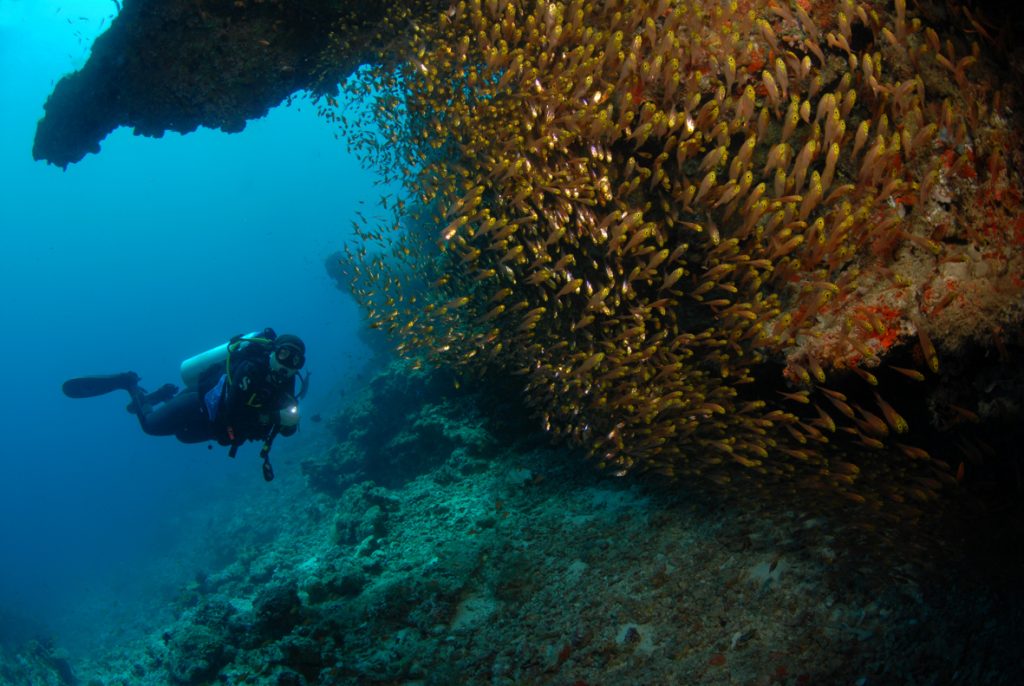
At a site close to the Thulhagiri Island Resort, which consisted of a pleasant, if unspectacular wall, we discovered a small cave with a school of soldier fish inside. The cave was large enough for me to go inside, so I went in to check out the vista “from the inside looking out”.
Unlike many soldier fish encounters, where they back into corners or disappear into crevices, these were different in that I was able to get behind them. I started to shoot away, as Amanda modelled in the cave entrance. This had great potential, and then….the camera stopped. Or more precisely, I couldn’t operate the shutter paddle on my housing. It turned out that a large grain of sand had wedged itself in the gap between the paddle and the housing. I wasn’t able to remove it until I returned to the island.
Throughout our ten day stint, we journeyed out to several of the “boat dive” sites such as Tuna Pass and Lankan Reef, but particularly impressive was Barracuda Giri, a very active site, brimming with fish and with lots going on. It was one of those dives where we realised that a single visit just wasn’t enough. We knew that we’d only scratched the surface here. Only several dives would begin to unlock the secrets contained in the numerous ledges, overhangs and gulleys that characterise this site. The steady current didn’t exactly help with our air consumption either, especially as our cameras create a lot of resistance to the water, exacerbated when you’re trying to hold steady in one place to shoot images.
It’s also worth, I think, a quick mention of the potential of swimming pools for underwater (or at least wet camera) photography. Kids enjoy being photographed in pools, often striking amusing poses for the parent photographer to capture. I often tell Zac that if he co-operates, he may end up on a magazine cover, as he once did on Sport Diver in the UK.
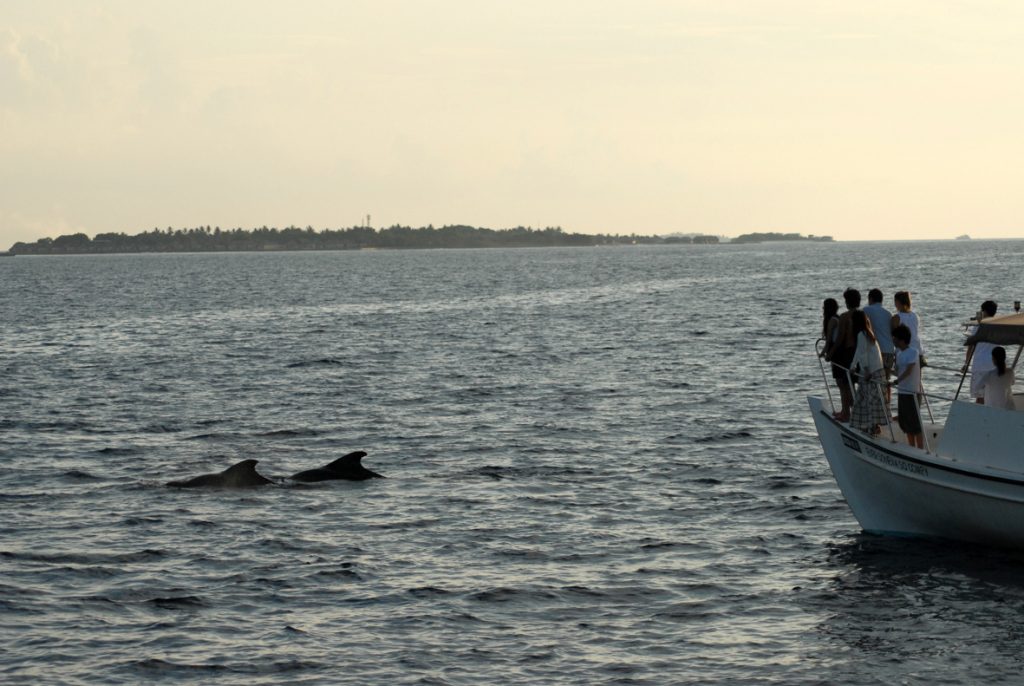
For the topside photographic opportunities on the island, it’s worth trying “diver lifestyle” shots which are popular with magazines. Or maybe try some wildlife photography of subjects such as herons, lizards or fruit bats that are commonly seen around the island. The regular dolphin cruises also worth doing and with a decent zoom lens, good images are certainly possible. And then there’s the popular photographic challenge of capturing a classic sunrise or sunset.
Overall, we thought Bandos was great choice. The house reef was good, there’s some nice dive sites nearby, the food was good and plentiful, the rooms were pleasant, the kids club was open when we needed it, the evening entertainment gave Zac a chance to race hermit crabs and practice his robotic dancing for the talent show, and it had a nice overall vibe. It was good for photography and good for the family holiday – the best of both worlds really.