

Text by Jeremy Cuff/www.ja-universe.com
Photography by Jeremy & Amanda Cuff/www.ja-universe.com
Micronesia is about as far as it’s possible to go without starting to come back. It takes four flights and around 36 hours of travelling to visit the legendary wreck diving paradise of Chuuk (Truk) Lagoon, the island of Yap famous for its manta rays and the splendid marine mecca of Palau – but it’s more than worthwhile. Once you get home, you’ll dream of going back…
If anyone says “It’s a small world,” I’ll probably tell them to go to Micronesia to discover that it certainly isn’t small. Located in the western Pacific, Micronesia is about as far as it’s possible to go without starting to come back.
Flying out across the mighty ocean, it seemed a marvel that humans had ever reached such remote locations and I wondered what must have possessed the early explorers to set out into the unknown. How many of these adventurers perished in these cruel and unpredictable seas?
Chuuk
At the airport in Chuuk, we were welcomed at the foot of the aeroplane with a box of Continental Micronesia umbrellas. Above the town, clouds bandaged the forested hills and rain poured consistently from a windless sky. It looked like it had been raining for some time judging by the standing water.
The joy experienced by simply entering a room was difficult to explain as we slumped onto the bed of room number 109 at the Blue Lagoon Resort. It was the culmination of at least 36 hours travelling. The setting was gorgeous and we had a week to enjoy it. After such a journey, we didn’t want to go anywhere for a while.
After sixteen hours of sleep, we watched the daybreak from our lanai. The towering clouds were breaking up and sun peered through the gaps, lighting some of the edges pink. It had stopped raining. A tropical breakfast and copious amounts of coffee brought us back to life and ready to go diving.
Truk Lagoon was the site of one of the largest naval losses in history – a result of the American attack on the Japanese fleet in early 1944. Despite the carnage, the war had inadvertently created a diving mecca for future generations. Nowhere else is it possible to dive so many impressive wrecks in such a small area.
Our dive guide for the week was Kellep, a Chuukese who had dived the lagoon for 20 years and knew each wreck like back of his hand. He also had an uncanny ability to pinpoint the location of each wreck, he said by using landmarks to stop the dive boat directly above the dive site. This skill is extremely useful, as no marker buoys reveal their location, apparently to make it more difficult for unscrupulous divers to find and plunder the wrecks.
Inside the lagoon, currents are very slight or non-existent but despite this, the area favours experienced divers. You’re expected to sort yourself out, deal with deco stops if necessary and although not mandatory, many of the dives involve wreck penetration, which shouldn’t be missed.
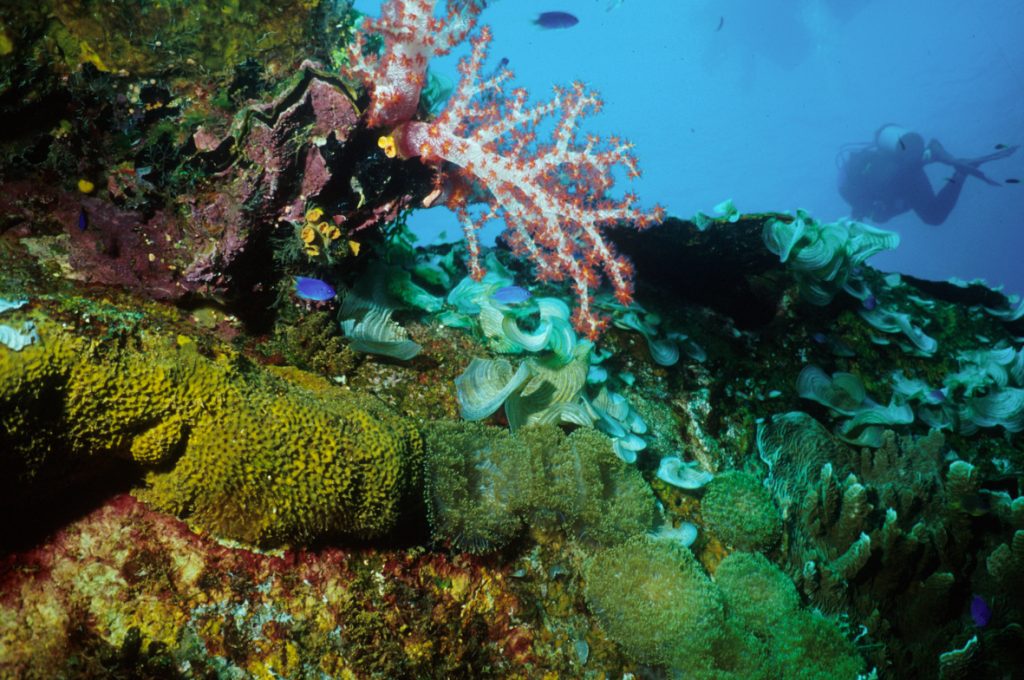
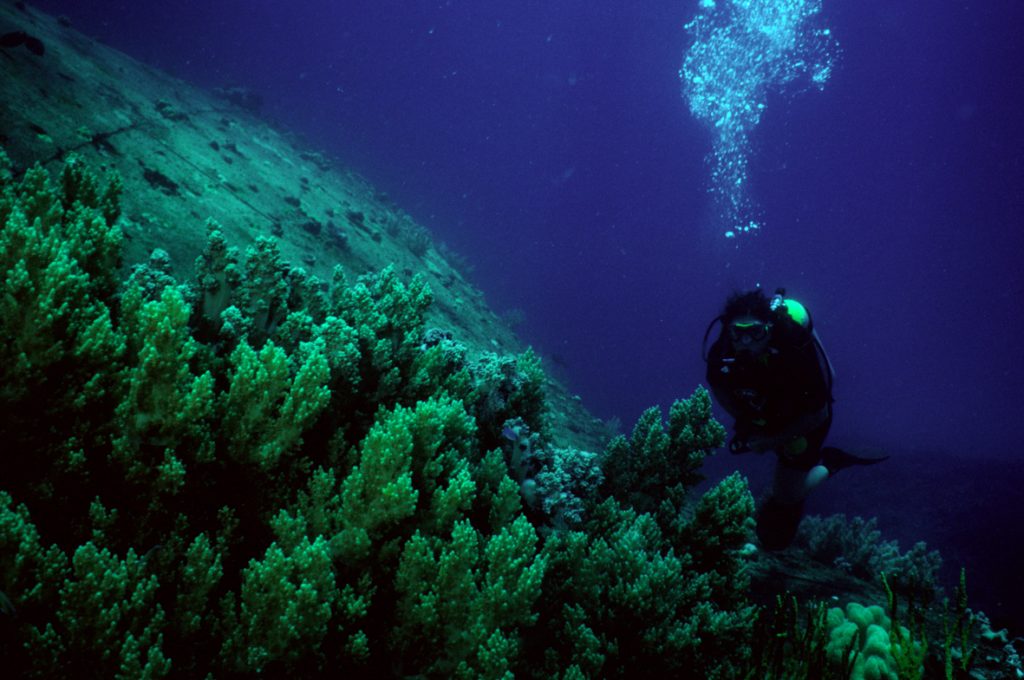
In the fifty odd years since the battle, these huge wrecks have become microcosms of the wider oceanic world. Many are now festooned with corals, sponges, clams and anemones, which in turn attract dazzling arrays of reef fish. Also, sharks, jacks, barracudas, stingrays and turtles can often be found in the vicinity of the wrecks.
Visibility around the wrecks varies considerably, dependant on their location in relation to the channels leading to the outer lagoon. Some bask in crystal clear water whereas others rest in much more murky areas, though the visibility here is by no means poor. Pulsating medusa jellyfish often inhabited these more brackish waters, but not in such concentrations that they couldn’t be easily avoided.
Kellep’s dive briefings were minimalist – “The wreck is underneath us, the bow is here, the stern is there. Top is 60 feet, bottom is 130 feet.” Basically, you just fall in backwards and descend.
Wreck divers will positively love Truk Lagoon. Many of the ships lost were supply vessels for the Japanese war effort. We dived hugely impressive wrecks each day – finding live torpedoes, bullets, sake bottles, crockery, aeroplanes and even human remains.
Heian Maru, the largest wreck in the lagoon, still with its nameplate intact, harboured live torpedoes, shells, crockery and telephones. Kellep simulated an explosion with his regulator whilst pointing to the torpedoes, in case we hadn’t guessed their use.
Kansho Maru, surrounded by a large gathering of jellyfish, allowed for an interesting wreck penetration and is actually quite a tight squeeze in parts. We visited the captain’s deck and the engine room. Fujikawa Maru boasted an aeroplane in the hold whereas Sankisan Maru yielded a cargo of jeeps. Other wrecks visited included Rio de Janeiro Maru, Momokawa Maru, Kiyozumi Maru, Gosei Maru and the Shinkoku Maru by day and night.
Skeletal remains of Japanese servicemen can still be found on some of the wrecks although the local Chuukese dive guides may or may not be prepared to reveal the location of these, depending on how they feel about it. We were shown human remains on the Fumizuki Destroyer and the Yamagiri Maru.
The Emily Flying Boat, close to Eten Island made for an easy and somewhat quirky dive, our last in Truk Lagoon. We made a close inspection of the entire aeroplane where it’s possible to study the cockpit, engines and wing structures, which are relatively intact. Amusingly, a piece of rope sponge grows on the top of the cockpit, like a set of antlers.
Above water, there’s no shortage of war relics and they’re well worth a visit. They also help visitors to understand the violent history of these islands. The Blue Lagoon Resort will organise an interesting tour of Weno Island visiting fortifications and former command centres. Eten Island was used by the Japanese as an airfield and although overgrown, it’s worth a walk to visit the bombed out command centre. Surface intervals are often taken here so it’s quite easy to organise.
Other kinds of dives are also possible at Truk although it’s assumed that wreck diving is the purpose of your visit unless you say otherwise. We visited the outer reef at the North Pass and found it to be excellent diving – a gentle drift in gin clear waters over pristine coral formations, alive with countless reef fish – the highlights including a huge puffer fish and four white tip reef sharks. I was told that manta rays and tiger sharks are occasionally seen, though they are extremely wary of divers.
Inside the lagoon, close to Eten Island, we dived at a site being developed for shark feeding. At the time of our visit, only a handful of these dives had been conducted making us feel quite privileged.
Mason Fritz – diver, entrepreneur and manager of the Blue Lagoon Resort led the dive. His briefing constantly referred to “respect” for the sharks. He also explained how he would “control” them by the amount of food he would provide. The dive attracted around fifteen sharks – grey reef sharks, white tips and black tips. Mason said afterwards that the sharks were “quite aggressive today.” It was certainly an exhilarating dive and their hyperactivity may have due to the earlier presence of spear fishermen in the area.
Yap
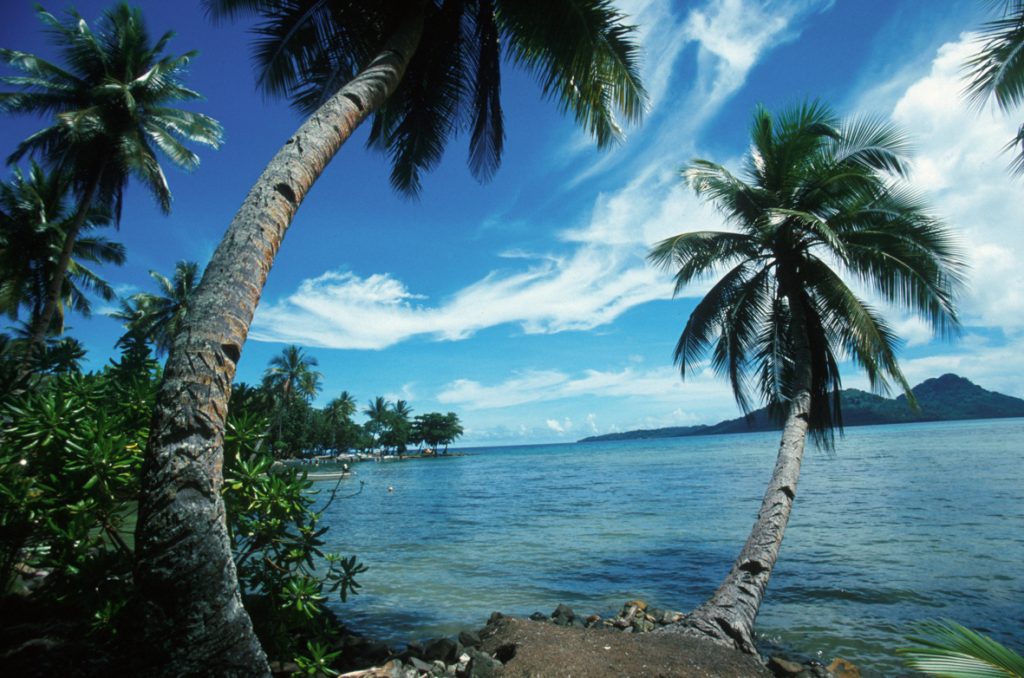
Yap is a pleasant and laid back tropical island – where some men still wear loincloths and until recently, giant stone money was still legal tender. Colonia, the tiny capital, is like a village – it’s capital status given away by the presence of a law court, a fire station, a tourist office and various government ministries.
The island was enduring some bad weather as we plummeted through the turbulent clouds and bounced onto the runway. Inside the airport, visitors were greeted by a topless Yapese girl handing out luau (garlands) to each arrival, causing a commotion amongst the male diving fraternity. Diving, of course, is the main reason for visiting this remote speck of land.
Extra to our itinerary, we had a chance to dive in the afternoon so we went for it, out into the rough squalling weather to find tranquillity and profusion beneath the waves at Yap Caverns and Gilman’s Wall. Moray eels, stunning anemones, clownfish, white tip reef sharks, lionfish, jacks, anemone shrimp and fusiliers were among the sightings on these bonus dives.
Like the majority of divers, we were based at the Manta Ray Bay Hotel, home of Yap Divers. It’s a well-run operation, managed by American expatriate Bill Acker and his friendly staff.
Yap is known the world over for its population of manta rays – thought to number around 100 individuals. Some of the better-known specimens are identified on a wall outside the dive centre, distinguished by unique spots on their undersides.
We decided to sign up for the PADI Manta Ray Awareness Specialty, offered by founder Bill Acker. He doesn’t actively promote the course, though he’s pleased when somebody asks about it. The course involves a discussion of manta behaviour (in particular the Yap population), how to dive with them, their breeding, how and where they give birth, recognising individuals, determining sexes, their intelligence and migratory habits. After the classroom session, Bill accompanies the specialty students on two dives, either in Miil Channel or Goofnuw Channel, depending on where they think the mantas will be. In their studies, they’ve discovered that the Mantas move from one side of the island to the other, depending on the time of year. For our visit, Goofnuw Channel was out, Miil Channel was in.
Although the weather cleared up and it remained good throughout our three-day visit, the conditions in Miil Channel proved difficult. The visibility was quite poor, the consequence of three weeks of heavy rain with intermittent good days. The result was lot of run-off from the land and especially into the creeks feeding Miil Channel.
Dive one yielded no mantas, though we visited both cleaning stations. We waited and waited, willing these gentle giants to materialise out of the greenish murk. Frustratingly, other groups saw several only minutes earlier. Dive two yielded a single specimen, a male; flapping through the channel towards the cleaning station we had left minutes earlier.
The following morning, we had another chance. The conditions hadn’t improved and we managed to log one manta sighting, this time a large female, although it wasn’t the close encounter we’d hoped for, making photography impossible.
There is, however, more to Miil Channel than manta rays. We encountered a number of sharks, especially in an area close to Manta Ridge, which seemed like a shark nursery with around ten small individuals clustered together. Later in the same dive, a larger grey reef shark followed us, as if it was monitoring our progress through the channel. Apparently, eagle rays are also regular visitors here.
In contrast to the murk of Miil Channel, the visibility was excellent at the Sakura Terrace site. Here, we enjoyed what must be some of the finest and most unusual coral gardens anywhere in the world – a vast assortment of exquisite towers, pagodas and fans. The fish life was good too, with the highlight being a startled nurse shark, which in turn startled some of us as it fled in blind panic across our paths.
Palau
Known locally as the “Bountiful Isles,” the Republic of Palau is stunning and unique.
Trees cling precariously to the famed Rock Islands like geckos to glass and presumably survive on very little nutrient. These strange, impenetrable forests, which rely on the abundant rainfall, contain poisonous trees, flying foxes, biting insects and endemic birds. In the centre of a few of the larger islands are some extraordinary lakes that are home to virtually stingless jellyfish.
The waters around Palau benefit from an even greater diversity of life – even salt-water crocodiles and dugong still inhabit these islands.
During our short stay in Palau, diving with the Fish n Fins Dive Centre, we enjoyed tremendous diving from the incredible Blue Hole and Blue Corner, where pelagics are virtually guaranteed to a fascinating night dive at Tweezers Reef, focusing on the “micro” reef residents – shrimp, hermit crabs, sea cucumbers, feather stars, tiny nudibranchs, sleeping reef fish and many species of starfish.
Big Drop Off is a vertigo inducing wall dive of epic proportions. There’s plenty of pelagic action here with several sharks and a turtle sighted by our group. It’s also worth getting in close to the wall itself, where prolific corals and sponges are home to a myriad of fish species, including the cryptically camouflaged scorpionfish.
German Channel is a very popular site and with good reason. We visited the manta cleaning station but instead of mantas we saw a cruising grey reef shark and resting white tips nearby. In addition to the mutual benefits of the cleaning station, a smaller scale symbiosis can also be observed in this area – where gobies and shrimp share burrows to eke out an existence in the expanses of sand. There’s also a population of unusually “tame” garden eels which allow the close approach of divers.
After the cleaning station, we began an enjoyable drift that yielded another grey reef shark, a turtle, schooling trevally and fusiliers. At the end of the dive we chanced upon a splendid leopard shark.
There are wrecks in Palau although we only visited one, the interesting “Helmet” Wreck close to the Fish n Fins dive centre. In truth, we barely scratched the surface during our three-day visit – divers could spend weeks in Palau.
* * *
Many of the vehicle licence plates in Chuuk carry the statement “Divers Haven” or the variant “Divers Heaven” – both are very true. They could just as easily be talking on behalf of Yap and Palau as well.