
Seeking out the UK’s butterfly species by motorcycle
Text & Photography by Jeremy Cuff/www.ja-universe.com
Back in October 2019, whilst knocking back some drinks one evening with an old friend, a plan was hatched to seek out the species of UK butterflies that we hadn’t seen, would like to see again, or hadn’t been sure that we’ve seen. It sounded like a good project, amplified by the booze, so we chinked glasses in a vow to make it happen. But first, a bit of history, which might explain things a bit…
I grew up in the Wiltshire village of Corsley, along with my childhood mate Simon Russell (known to friends as Fuzzy, or Fuzz). We both have vivid memories of the Summer of 1976 as boys of 9 and 10 years old; a time of seemingly endless sun, the smell of melting tarmac (forever associated with that Summer for me), and a burgeoning interest in wildlife and butterflies that were in super-abundance at that time (or so it seemed). It was, I later thought, “the Zenith” of life.
Everything was new and exciting, and every day an adventure as we explored our local environs, either on foot or using our bicycles. It was a time when kids (and especially village kids, perhaps) roamed far and wide. Nobody seemed to mind or be worried, and I think those early explorations fuelled my later (and continued) obsessions with travel and a desire to visit new places. I think it’s similar for Fuzz in this regard.
We had our treasured “ID” books, such as the Observer Book of Butterflies, to help us identify the species that we’d spotted in our gardens, in surrounding fields and hedgerows, in “the marsh” (the valley between Corsley and Chapmanslade), in Longleat Woods, on the slopes of Cley Hill and on family holidays, but there were some species described in our books that we didn’t see at any of those locations; after all, we could only go so far on our bicycles.
In the case of those unseen species, we didn’t have enough knowledge of where to find them, how to look for them, or had any means of transport to reach further flung sites and reserves where they might be present. On top of that we’d have to visit these places at the right time of year, and in the right weather. Also, older books would tend to indicate general areas where a species might be found, rather than pinpointing specific locations, so they weren’t especially helpful in that regard. And, of course, things change and the information becomes outdated.
Soon after that magical Summer, Fuzz’s parents moved the family to nearby Frome, but it may as well have been much further away, so we saw each other much less; he then went to a different school and though we later hung out as teenagers and into our early twenties at times, other things took over. However, the interest in wildlife remained with both of us, lying more fallow perhaps, but still very much present.
By the time we’d reached our mid-twenties, we’d largely lost touch save for the occasional social event to which we both might be invited, but we re-connected back in 2011 after Fuzz had read Patrick Barkham’s excellent book “The Butterfly Isles”. It connected him back to our times in the village and prompted him to get in touch with me.
We soon discovered that we’d independently developed an interest in scuba diving, which resulted in both families travelling together to Belize, the Turks & Caicos Islands, Egypt and the Maldives to dive and travel, as well as some UK trips seeking out marine life as diverse as Cuttlefish, Seahorses and Blue Sharks. We found that we still had our mutual appreciation of the natural world, and were concerned about the wider issues of conservation. And of course, there were the butterflies.
So, winding the clock forwards to October 2019, Fuzz and his wife Tonya had come up from Devon to stay for a weekend with us in Warminster (Wiltshire). We’d been out for a meal, and as was customary in our get togethers, drink was partaken, which continued into the early hours at home. During the said session, we were talking about our rejuvenated interest in UK lepidoptera, no doubt lamenting the decline of almost all species. My wife Amanda took an amusing picture on her phone that evening of Fuzz wagging his finger, probably making some point about the effects of intensive agriculture or something similar.
As we droned on, a plan took shape out of our intoxication. We would, we vowed (at around 2.13am according to Amanda’s photo) seek out all the UK butterfly species we were yet to see, would like to see again, and those that we’d like to be certain that we’ve seen. We chinked glasses and slurred away in celebration of our new aim. The project was on.
For myself, I vowed to do it all by motorcycle. Fuzz, being a motorcyclist himself, would also travel by two wheels on most occasions, though he wasn’t as avid a motorcyclist as myself, nor was his machine as conducive to spending long hours in the saddle. We would later have to discuss “riding speeds” as there’s quite a differential between us. We would eventually find a happy medium.
We came up with our butterfly hit list* and researched places to find them, along with flight times. Ideally, we thought it good if “the project” could be done in a single year as Patrick Barkham had described doing in his book, but it was unlikely due to our various commitments of work, family and other stuff that we each had going on. A certain pandemic (that wasn’t even a topic at the time of “chinking glasses”) would exacerbate these constraints, so it would be done over three enjoyable summers.
In early 2020, we enthusiastically discussed our plans just as the first species were beginning to emerge into what was to be a dry, warm (hot at times) Spring when the Covid-19 pandemic hit, hampering our “butterfly hunting” plans somewhat, as well as many other things. But it didn’t put a stop to it altogether, only delaying and protracting it. We could live with that.
* Our butterfly species “hitlist” contained as follows; Duke of Burgundy Fritillary, Marsh Fritillary, Heath Fritillary, Pearl Bordered Fritillary, Small Pearl Bordered Fritillary, Glanville Fritillary, High Brown Fritillary, Silver Washed Fritillary (valesina form), Purple Emperor, White Admiral, Large Tortoiseshell, Wood White, Cryptic Wood White (optional for Fuzz), Purple Hairstreak, White-Letter Hairstreak, Black Hairstreak, Brown Hairstreak, Swallowtail, Mountain Ringlet, Large Heath, Scotch Argus, Silver Studded Blue, Large Blue, Northern Brown Argus, Chequered Skipper, Silver Spotted Skipper, Lulworth Skipper, Essex Skipper.
Early Marsh Fritillary and Duke of Burgundy EMERGENCES, BATTLESBURY HILL – April & May 2020
The only species that I didn’t seek out using my motorcycle as a means of transport were the ones I could reach on foot from my home in Warminster. I’m fortunate in that within a 15-minute walk, I can be on Battlesbury Hill, a chalk down and former Iron Age hill fort that’s an excellent butterfly site. It sits on the edge of Salisbury Plain.
The early and warm Spring had significantly brought forward the emergences of a number of species including both the Duke of Burgundy Fritillary and Marsh Fritillary, the latter of which appeared in great abundance on Battlesbury in late April.
Fuzz and I were in touch about this, so when release from lockdown allowed, he rode up from Devon to see the spectacle for himself in what we termed a “socially distanced butterfly hunt”. Both species were past their best when he visited in May, but it meant that he saw his first ever “Duke”, plus the added bonuses of species such as the Wall Brown (commonly sighted in our childhood and now very scarce), the Brown Argus, the Green Hairstreak and the Small Blue, a species Fuzz hadn’t seen since he was a teenager.
The Highly Endangered High Brown Fritillary – The Last Day of May 2020
The plight of the High Brown Fritillary in the UK is depressing, the species having suffered a catastrophic decline in distribution, arguably making it our most threatened butterfly. We therefore had to see it whilst it was still possible to do so.
I knew that they were found on a few sites in the Southern valleys of Dartmoor, so I kept a regular eye on the Devon Butterflies social media feeds, learning that some High Browns had emerged (very) early. Aish Tor seemed like the place to go according to the blog, but Fuzz had also suggested Hembury Wood (from a book that he had).
I looked forward to this day. It was a relatively early start; I was on the road at precisely 7.48am, having cooked breakfast and checked my moth trap before setting off (a new activity for me that I’d developed in lockdown). A Small Elephant Hawkmoth was a good start to the day and it was bliss to be hitting the road (after hardly going anywhere since the beginning of “lockdown one” in late March) with the sun behind me on an eerily quiet A303. As always, I enjoyed the climb up into the Blackdown Hills, and would be at Fuzz’s place at Payhembury (near Honiton) for socially distanced tea, coffee and catch up in his garden before heading off to Dartmoor.
We took the route from Payhembury to Cullompton and jumped onto the M5 heading South West, which becomes the A38 after Exeter. It was an uneventful cruise to Ashburton, where we would turn off and head into the valleys of Dartmoor’s lower reaches. On the climb up the hill out of Newbridge, close to our destination, a large fritillary flew alongside the road. It was probably a High Brown, though it could have been a Dark Green. We both noticed it.
My “dress rehearsal” for this type of trip had worked well, with enough room in the bike’s panniers to store everything securely that we weren’t carrying, with my helmet and Fuzz’s leather jacket chained to my rear wheel with a padlock.
We didn’t know which way to go, so we walked “up and around” the Tor, catching brilliant views of the Dart Valley below. We spotted a few Small Heath and a Green Hairstreak, but no sign of any fritillaries. We suspected we were too high up, and that the best place was further downhill; we spoke to others who appeared to think the same.
We headed purposely downhill, and after crossing what seemed like an invisible line, it was spectacular. We met a butterfly enthusiast (and former motorcycle circuit racer) who had a lot of knowledge of the site; he’d just seen 30 or 40 specimens. Soon, we would see the same. Also, there were decent amounts of Small Pearl-Bordered Fritillaries still on the wing, a species I’d not seen since I was 10 years old in a glade in Longleat Woods, near where the Centre Parcs holiday park is now located. Fuzz was also with me then. There’s none there anymore.
Despite the fabulous number of sightings, we decided to up-sticks and try Hembury Wood in the afternoon a few miles away, but it was very different. We hardly saw any butterflies at all. Maybe we went to the wrong areas, but we didn’t give up on it easily, covering quite a bit of ground. I think the most promising area we found was an open area with a West facing aspect, but even there we saw virtually nothing. Things must have changed at Hembury Wood. It was a magical day nonetheless, and an ambition fulfilled.
Clanging, Picketing, Green Laning and Bissing – White Admiral, Silver Washed Fritillary, Purple Hairstreak and a Purple Emperor Perhaps? – June 2020
Though we’d both seen the White Admiral previously, we’d only seen it once; myself as a kid on a visit to the Savernake Forest near Marlborough, and Fuzz more recently at Haldon Forest Park to the West of Exeter accompanied by his youngest son Thomas. It was a species that we wanted to see again.
After a fairly unproductive visit to Ashclyst Forest not far from Fuzz’s home at Payhembury, and Haldon Forest Park later that same day (mostly thanks to cool and overcast conditions), I suggested he ride up to Wiltshire at the next opportunity so that we could visit Clanger and Picket Woods (effectively one location) and the similarly cojoined Green Lane and Biss Woods, near Westbury and Trowbridge. Being close to busy main roads and the nearby towns, these woods seem unpromising on the face of it, but there’s lots of butterfly action to become immersed in, including (reputedly) the possibility of Purple Emperor.
We had to content ourselves with several White Admirals, including one female scouting for suitable egg laying sites. We followed her into the gloom as she checked out some Honeysuckle (the foodplant). The Silver Washed Fritillaries also were in their pomp and highly visible, and I was able to show Fuzz his first Purple Hairstreak and describe how to look for them. The Purple Emperors, if any were present, eluded us.
More Attempts At Going Purple and Receiving A White Letter – June 2020
In June, the weather had turned unsettled and windy, which made it pointless going out seeking butterflies, even when time allowed.
I’d seen reports on a blog that one observer had sighted Purple Emperor specimens at West Wood near Winchester (part of the Farley Mount Country Park), which also encompasses Crab Wood and Pitt Down, so I took a drive out with Amanda on a wet and windy Sunday to find the place.
By the following weekend the weather had improved, so Fuzz rode up from Devon, meeting me at the Bird & Carter farm shop near Wilton for hot beverages; from there, we headed into Salisbury and out on the A30 to Stockbridge, then taking the Romsey road due South to the village of King’s Somborne, to ride the back roads to our destination.
We thought West Wood and Pitt Down to be excellent for butterflies and saw a lot of species; nearly everything we could hope to see except the Purple Emperor and Purple Hairstreak. We listed Comma, Small Tortoiseshell, Peacock, Red Admiral, White Admiral, Meadow Brown, Speckled Wood, Gatekeeper, Dark Green Fritillary, Silver Washed Fritillary (including matings), Holly Blue, Brown Argus, Small Copper, Brimstone, Marbled White, Small White, Large White, Green Veined White, Small Skipper, Large Skipper and the prize sighting of a singleton White-Letter Hairstreak skulking in the trees (a species from our list).
We met others looking for the Purple Emperor, all reporting no sightings. It would seem that it had been a poor season according the blogs, largely attributed to the wet and windy weather in the peak flight season, which can be disastrous for tree-topping species such as the Purple Emperor.
Check Your Own Oak Tree, There’s A Purple Hairstreak About – July 1976 and July 2020
In Corsley, we had an Oak tree in the garden, and my book said that the Purple Hairstreak spends most of its’ life on Oak trees. I figured that perhaps there’ll be Purple Hairstreaks on our Oak tree, so I staked it out. I watched and I waited, and then spotted something that could be a Purple Hairstreak; quite impressive fieldcraft for a young boy even if I say so myself. It required considerable patience; something I usually didn’t have in abundance judging by (for example) my inability to remain still whilst fishing.
But I couldn’t be certain it was a Purple Hairstreak, so I had to catch one to be sure. I ended up balanced on the top of a step-ladder with my net, watching to see if one would pitch on a closer bough whilst I wobbled precariously. Somehow, I managed to catch one, and made a positive identification. My hunch was correct.
I reminded Fuzz of this story in 2020 as we worked on our list, and encouraged him to check his own Oak tree, which he duly did. And lo and behold, he had his own Purple Hairstreak population that he was totally unaware of. He’d never even seen one until this year, and had them right under his nose (or above his nose really). The moral of the story is that if you’ve got an Oak tree nearby, you may not need to travel to see this species.
Now that he knows they’re present on his own Oak tree, he’s thinking of building a “viewing platform” as an extension to his existing treehouse, so that he can observe them at closer quarters in the future.
Seeking The Silver Spotted Skipper – Between The “Judean People’s Front” and the “People’s Front of Judea” – Early August 2020
I met Fuzz at the hilltop town of Shaftesbury, partaking of caffeine before riding to nearby Fontmell Down, home to Dorset’s only known population of the Silver Spotted Skipper. It’s a sun loving species, usually emerging in the last days of July or early August, and can only be found on the warmest and most sheltered parts of the site.
Our visit was marginal in terms of timing and weather, but we soon discovered that others had the same idea, as we noticed several individuals scouring the hillside as if looking for dropped keys. But they were, of course, looking for the Silver Spotted Skipper.
Amusingly, nobody was talking to one another, or helping one another to locate specimens. It seemed competitive, as enthusiasts jostled in splendid isolation to get the first sighting of the year. There were definite shades of the “Judean Peoples Front” and the “People’s Front of Judea” from The Life of Brian, with perhaps the “Front of the Judean People” thrown in for good measure.
One notable exception was a friendly chap called Mark (also a biker), with whom we found a freshly emerged specimen (spotted by Fuzz). He also gave us the recommendation to visit Alners Gorse for the Brown Hairstreak.
The Returning Large Tortoiseshell? – August 2020 and March 2021
The Large Tortoiseshell was considered extinct in the UK by the 1960’s following a catastrophic decline, but in recent years there’s been sporadic sightings of specimens centred around, but not limited to, the Isle of Wight and Portland.
Some controversy surrounds these sightings as it’s not known whether they’re as a result of natural re-colonisation (which is entirely possible), or releases from captive-bred stock (which is also possible). I don’t have enough knowledge to have a view as to which of these opinions are correct (perhaps it’s a bit of both?), but most recently, evidence has been found of their breeding in the form of egg clusters and larvae, as well as the semi-regular sightings of the imago.
We’d read that there’d been a few sightings at Portland in July, so we decided to pay a visit. Our first attempt was a “double header day” of Portland in the morning for the Large Tortoiseshell, followed by Alners Gorse in the afternoon for Brown Hairstreak. We decided to meet on Weymouth seafront, have breakfast and then ride over to Portland to try the Broadcroft Quarry Butterfly Conservation Reserve. The weather was good, and there were plenty of nectar sources at Broadcroft, but we had no sightings. Perhaps we weren’t looking in the most likely spots.
Time didn’t allow another visit in 2020, but in early Spring of 2021 we noticed some new online postings of Large Tortoiseshell sightings, the specimens perhaps having just emerged from hibernation. They seemed concentrated around the Church Ope Cove area, so we decided to check it out for ourselves.
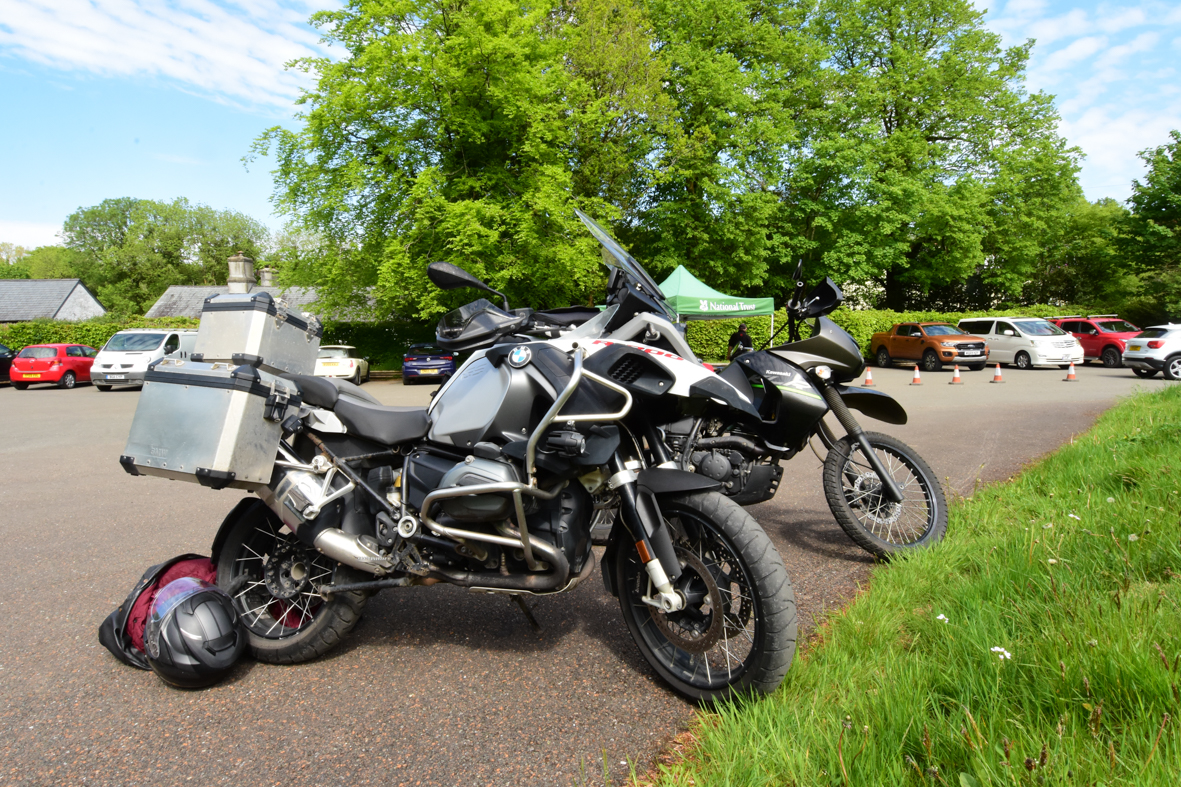
On the first of two visits, I enjoyed quiet roads en route to Weymouth, choosing the “main road” from Shaftesbury to Blandford through the valley, as opposed to the “up an over” B-road route past Fontmell Down and the Compton Abbas airfield. As always, I enjoyed an early start and hitting the road on my machine, a BMW R1200 GS Adventure.
At Portland, I had time to suss things out. I rode down to Portland Bill and then parked in the Church Ope Cove car park and went for a walk; a very interesting and promising area, I quickly concluded. When Fuzz arrived, we got started in earnest, and began combing the area. I’ve found that butterfly hunting with Fuzz is very easy; we’ve got the same interest levels and we’re prepared to “put in the hours” without worry that the other person is bored. He’s the only friend who I can do this with; he gets it (or more accurately, we get it).
We saw a Peacock and a couple of Commas, though the day teetered on the borderline of “flying temperature”. The forecast had been promising, but in the end, the sun never really broke through as it was supposed to do, despite some warmth in the air.
We were beginning to think that it wasn’t going to happen when at around 2pm, I spotted something basking on the top of a blue beach hut from our vantage point overlooking the cove. A check through my long lens confirmed that it was a Large Tortoiseshell. We were very happy, but it wasn’t the best of views. It then decided to fly off, not to be seen again. Encouraged, we said that we would go back for another look on the next Friday (Good Friday), though the weather still looked marginal.
For our Good Friday visit, we agreed to meet at Portland at around 10.30am, meaning a more relaxed start to the day. My first impression of the day was that it might be a bit warmer than forecast, even though Winter’s bite still lingered. Fuzz was a few minutes behind schedule, so I waited for him at the top of the hill overlooking Chesil Beach. I spotted him riding across the causeway.
It was fine and clear, and better than the forecast, with the promise of enough warmth to tempt early butterflies onto the wing. As we sipped a beverage by our motorcycles outside a café, an unidentified nymphalid flew past us; it was now warm enough for “things to fly”. It was our signal to start looking.
We had an enjoyable and successful day; Peacocks, Commas, various species of birds, umpteen Wall Lizards basking, chatting with fellow enthusiasts, and after testing our patience, we eventually got some great views of a Large Tortoiseshell, again in the afternoon. It patrolled the beach several times, again settling on the same blue beach hut. This time we were able to get a much better view, and a few decent photographs. What was it about the blue beach hut, we wondered; was it the colour, the temperature, or some chemical in the paint that attracted it?
Our return visit had been worth it, and saw something we never thought we’d see in the UK.
The “Elusivity” of the Brown Hairstreak – August 2020
“Elusivity” may not be a word, but I’ve decided that it is now. You could say that the Brown Hairstreak exhibits “elusivity” as do all UK Hairstreaks, with perhaps the exception of the more easily spotted Green Hairstreak.
Following on from the tips we’d received from Mark, the friendly chap from Fontmell Down (who clearly wasn’t a member of either the “People’s Front of Judea” or “Judean People’s Front”), we left Portland and rode to Alners Gorse, a Butterfly Conservation reserve near Sturminster Newton in rural Dorset.
After our early breakfast on Weymouth beachfront at The Boat café, Fuzz had developed some digestive “discomfort” which he blamed squarely on the café. Despite his grumbling belly, we got to work, seeing mostly Blues, Small Coppers, a Clouded Yellow, Whites, Meadow Browns, Gatekeepers, Small Tortoiseshells, a Silver Washed Fritillary (our last of the season), some Purple Hairstreaks and (perhaps) a Brown Hairstreak, though we couldn’t be sure. We decided not to count it as a confirmed sighting, though I’m fairly sure it was – it ticked all the boxes. To help us identify non-cooperative butterflies pitched high up on trees, we always brought binoculars on our butterfly hunts from that visit onwards.
We headed back to the bikes, as Fuzz was parched and needed a drink. We’d stowed some water in my panniers, which he hoped would help his intestinal upheaval (his plight becoming worse thanks to “The Boat”). I was surprised that he chose to go back into the reserve for a final look around, though he eventually had to disappear into the woods for some moments of privacy; he wasn’t feeling at all good, but “when you’ve got to go, you’ve got to go”. He still winces at the thought of it!
Still on the Brown Hairstreak front, in the Winter of 2020, Fuzz decided to assist Devon Butterflies with their survey work by looking for Brown Hairstreak eggs. Prior to visiting the sites they suggested to him, he watched a video on YouTube about how to look for the tiny eggs. He’s got some Blackthorn hedges at his house, so he decided to practice on them, and to his amazement, found Brown Hairstreak eggs. He had no idea they were present. To be sure, he sleeved the eggs, which resulted in two adults emerging in August 2021, both females. After releasing them, they flew up into the closest tree. He hasn’t seen any there since; clearly they’re exhibiting “elusivity”.
Warming Up With The First Pearl Bordered FritillarIES – Late April 2021
I was optimistic about catching an early Pearl Bordered Fritillary, despite the generally cold Spring, so we decided to head for Aish Tor.
I rode down the A303 to Devon, collecting Fuzz at his house before riding on to the site. This time, we had a better idea of the best areas to look following our visit to find the High Brown Fritillary the previous Summer.
The first Pearl-Bordered Fritillaries were indeed out and we were rewarded by numerous specimens patrolling the Bracken covered slopes and nectaring on Violet. Surprisingly, we had the whole site to ourselves for the several hours we spent there. We couldn’t understand why other enthusiasts weren’t out there looking.
Afterwards, we rode down from the moor into Ashburton and found a nice “art café” that had spilled out into a small square in order to operate in a socially distanced way. We sat in the sun, drank pots of tea and ate garlic mushrooms on toast with skinny fries, reflecting on our great start to the season.
Undercliff Search for the Wood White – Late April 2021
Until most recently, Fuzz tended to use books to find information about butterfly sites, but I got him more into using the immediacy of blogs and social media profiles run by the Butterfly Conservation local groups in order to find out where the sightings are occurring in real-time.
Our previous year’s visit to Aish Tor and Hembury Wood was a good example of this; bloggers had posted news of High Brown Fritillary emergences at Aish Tor, whilst Hembury Wood was listed as a High Brown Fritillary site in a book. We saw plenty at Aish Tor, but couldn’t find any at Hembury later the same day. The world had moved on, but the book hadn’t.
On the same train of thought, I’d seen a post by someone reporting a first sighting of a Wood White on the undercliff at Axmouth, on the South Devon coast. These fascinating areas between Axmouth and Lyme Regis, and between Beer, Branscombe and Sidmouth are a known stronghold for this species. On the face of it, exposed coastal cliffs seem like improbable locations to search for such a delicate, frail looking butterfly, but something about this habitat clearly works for them.
It was late April, the release from lockdown had been recently granted, and the weather was favourable, so we decided to go for a look. I set off early, deciding to go via the Somerset Levels for a change, but found the traffic was quite busy (it was a Friday), and it took longer than I thought it would. I ended up resorting to a stint on the M5 (not something I wanted to do), but it ate up the miles and I got to Fuzz’s at around 9.20am (rather than my planned 9.00am). A pot of tea in the garden was most welcome after my mad dash.
We’d both done a bit of research on the area at Axmouth we needed to visit, planning our time to search the accessible parts of the Undercliff National Nature Reserve. Though it ultimately proved unsuccessful in terms of the Wood White, we sighted various Spring species such as Orange Tip, Dingy Skippers, Green Hairstreak and even a Clouded Yellow.
As the good weather continued to hold, we took the opportunity to try again a couple of days later. This time we visited Branscombe, and sighted our first specimen within ten minutes of commencing our search, on the cliffside behind some beach huts on the Western side of the beach. I punched the air.
However, this side of the beach looked less promising overall (and certainly less accessible), so we decided to concentrate our efforts above the Eastern side of the beach in the coastal scrub and woods that forms the undercliff (which is part of the South West Coast path, as it is at Axmouth).
We searched for a while, and whilst squeezing past a group of hikers (strangely awkward in Covid times, as there wasn’t enough space to socially distance), a Wood White fluttered by. We immediately realised what we’d seen, so we decided to stay in the area and see if it would return.
It did, and we watched it patrol a small section of the coast path, sometimes pausing to nectar on a specific Vetch flower. The Wood White is described as being constantly active in suitable weather, so to capture images of it nectaring were unexpected, and we also witnessed a “near mating” when a potential suitor arrived on the scene. We watched them face each other and touch antennae, but they decided not to take the encounter any further.
Whilst we watched and photographed the action, spending nearly two hours, we were passed by various walkers, none of whom noticed what they were brushing past, and on one occasion, an oblivious walker almost stood on the nectaring insect as we crouched next to it. Nor did anyone enquire as to what we were looking at with our cameras in hand. We decided that it was metaphor for what is wrong with everything in the world; a national rarity unnoticed and ignored, and therefore not cared about. And these are people were enthusiasts of the outdoors and probably “into” nature.
Nonetheless, a very rewarding day “at the office”, we thought.
More of the Marsh’s and Dukes of Battlesbury HILL – May 2021
As our “project” gathered momentum, our interest in the photography of our sightings grew, and we tended to spend longer in the places we visited. Fuzz had also started bringing his camera, rather than relying on me to send him the best shots of the day, choosing to work on capturing good images for himself.
As a polar opposite to 2020, the 2021 Marsh Fritillary and Duke of Burgundy emergences were quite late, especially the Marsh Fritillary. I took regular walks to Battlesbury to check on the state of play and reported it to Fuzz, who took rides up to see the action for himself on two occasions.
The weather was cloudier on his first visit, and cooler than the actual forecast had predicted, which is good in that butterflies are less skittish in lower temperatures, but not good if it’s too cold for them to fly at all. It was close to that “pivot point” of degrees centigrade, and it just about remained warm enough. Our reward was some great Duke of Burgundy action, including a mating that we were able to photograph. There was no courtship whatsoever and they just got on with it; it took 2 hours 10 minutes. Whilst they did their thing, we made jokes about Sting’s supposed tantric sex sessions.
Other enthusiasts were also visiting the site; we’d dubbed them “loiterers” due to the necessity of loitering around hedges and bushes, and we recalled an amusing section in Patrick Barkham’s book about some confusion created with one man who thought (hoped) Mr.Barkham was loitering there for other reasons.
On the second visit with Fuzz, the Marsh Fritillary were well into their flight period, so we concentrated a bit more on them. Compared to the previous year, there weren’t as many, but it wasn’t by any means a population crash. We also saw an unidentified species of large moth, high on nectar, tearing full throttle across the slopes of the hill like Keith Flint from the Prodigy on one of his benders. I found it hard to forget the image of this, a brief crazy life of nectaring and mate searching. I hoped it found a partner in its’ brief window of adult life.
Making Tracks To Lydford Old Railway – June 2021
I’d seen the Heath Fritillary on a motorcycle trip around Kent back in 2017 at its’ stronghold of Blean Woods near Canterbury, but it’s also known from a few disparate sites in Essex, Somerset, Devon and East Cornwall. Like the High Brown Fritillary, it has also suffered a huge decline in fortunes due to changing land use, and is probably only still present on our fair isles due to the efforts of conservationists.
We could have chosen sites on Exmoor, but we thought that it might be easier to find this species at the very small reserve that is Lydford Old Railway, managed by Butterfly Conservation. It’ll either be on the wing or it won’t, and if it is, we’ll see it. I looked forward to this weekend, as we would visit Lydford on the Saturday, then ride up to the New Forest area before crossing over to the Isle of Wight the following day in search of the Glanville Fritillary.
I was up early, full of enthusiasm and headed down to Fuzz on the “303”. When I arrived, Fuzz’s daughter Camilla and her mates were there, having camped in the garden overnight. They were all recovering from her 30th birthday party. Fuzz himself was a bit jaded, but was still up for our weekend’s activities.
We headed the quickest way to Lydford; to Cullompton for fuel, then down to Exeter on the M5 and “up and over” Dartmoor on the A30 where we encountered a big accident involving a boat on a trailer; seems we’d just missed it. As (miraculously) nobody was seriously injured, the police kindly let us through, so we didn’t lose much time. We then rode South towards Tavistock, fringing the West side of Dartmoor before dropping down into Lydford.
We needed to access the reserve via Lydford Gorge, which is run by the National Trust. On entering the car park, we were asked the question “Have you booked?”. We, of course, hadn’t, but we persuaded them that we were visiting the butterfly reserve rather than the gorge, and that we would remain socially distanced from any National Trust visitors that we encountered. Concern about Covid transmission was the driver of these draconian measures. My National Trust membership probably helped smooth the way.
We walked hurriedly through the National Trust bit, and into the “forbidden zone”, traversing a kind of no-man’s land to reach the reserve entrance, overgrown by foliage. Technically you’re only able to visit the reserve if you’re Butterfly Conservation member which I am, but Fuzz wasn’t, so we hoped nobody would “ask the question” and send him packing (he has since joined).
As we exited the trees into the first glade along the old railway embankment, we saw a “loiterer” who turned out to be the reserve warden, a friendly man called Colin, who told us that the first Heath Fritillaries were on the wing, along with plenty of Small Pearl-Bordered Fritillaries. There weren’t many “Heaths” but it was a big tick for Fuzz to see this species as we attempted to photograph them and their Small Pearl-Bordered relatives; both species were frustratingly difficult to approach. We enjoyed a good visit nonetheless, noting how precarious the Heath Fritillary population is at this site.
A week later, I decided that I wanted another “go” at Lydford’s Heath and Small Pearl-Bordered Fritillaries. I didn’t have any meetings, the weather forecast looked good, so that was it, I was doing it. Fuzz couldn’t make it, so I got up early (6.30am, setting off at 7.30am), rode straight there, and got on site early.
It proved to be a good idea, as my best images were taken just after I arrived on site, of a Heath Fritillary warming up on a blade of grass in the first glade. Had I been the second person on site, this specimen would have been disturbed and I wouldn’t have got the picture.
I met some other “loiterers” later, one of whom expressed concern about the low numbers we were seeing, but then pacified himself that maybe they’re just late this year due to the cold Spring. His name was Dave Land, who described his involvement in the original re-introduction of the Heath Fritillary to this site. They released 800 individuals initially, to get the colony up and running.
It was a grim ride back, with heavy traffic on the run into Exeter on the A30 and onto the M5, and also on the A303. I barged my way through the congestion; “threading the needle” as I call it. It requires concentration at all times.
Island Hopping For Glanvilles – June 2021
From Lydford, we rode up to a rather contrasting location to where we’d spent the day, to a Holiday Inn Express just off a motorway slip-road by Southampton. Our original idea of stopping at the A303 diner at Sparkford was thwarted (because it was closed), so we rode on to Blandford and ate outside in a socially distanced pub beer garden, before pushing on to our destination. We quenched our thirst at the hotel bar, and after a refreshing three pints to unwind from the ride, we turned in early. I was apparently snoring loudly during the night.
On “Glanville Day”, it was an early start; we grabbed a takeaway breakfast and headed through the New Forest to Lymington to catch our ferry. I’d seen the Glanville Fritillary once, albeit only briefly, but Fuzz was yet to see it. Across the Solent, in a cafe at Yarmouth, we deliberated over tea on the best areas to try. I suggested the Compton Bay area, which we both agreed upon. And the weather was perfect.
Within a minute of parking the bikes at a small pull-in overlooking the incredibly scenic Compton Bay (the place where I’d seen it previously), we got our first sighting. And very soon, we’d seen lots of them. It took us quite a while to venture further than the car park due to the Glanville action, with the added benefit of numerous Small Blues, including a mating pair which we were able to photograph.
Eventually, we pulled ourselves away and went for a walk along the cliff-top and the undercliff beneath. We saw a huge number of specimens, and had some great photo opportunities, which included a mating pair. We also met another enthusiast called “JP” with whom we swapped numbers on the return ferry. He said that he knew of a good Black Hairstreak site in the Oxford area that he could show us.
We rode off the ferry happy with our day’s work, and headed back up through the New Forest, where we split off at Cadnam, going for home.
Let’s Drink To Swallowtails – June 2021
We had just one day to find the Swallowtail (a holy grail species for both of us), on a Sunday in early June. The weather forecast was perfect, so all we had to do was to get ourselves to the Norfolk Broads and go to the right place. Fuzz would make his way up from Devon during Saturday day, but I didn’t have the luxury of a leisurely ride.
On the Saturday, I was down in Romney Marsh in Kent with our son Zac, who was racing karts at the Lydd circuit. Once the race meeting was over, I had to drive him back to Warminster, and then jump on the bike (pre-fuelled and packed in preparation) for the long ride from Wiltshire to Stalham in the Norfolk Broads, to stay at a pub called The Harnser. It wasn’t ideal in terms of my travel arrangements, but there was no way around it.
Fortunately, the traffic back home from Lydd was good; we arrived just before 7pm and I was on the bike ten minutes later. My sat nav predicted a 10.53 arrival time at Stalham which at the time made my heart sink a little. I vowed to get there earlier, as nothing mattered more than getting there in time for last orders, for a pint or two with Fuzz. I reduced the estimated arrival time to 10.20pm (then 10.25pm after a late fuel stop), fighting the clock all the way.
Fuzz, of course, was already settled in and was quite “refreshed” by the time I arrived. I caught him up, shoehorning down some beer to unwind from the ride. Thankfully the pub was “a bit flexible” with its’ closing time to the point that we had to stop ourselves drinking any more in case we were too hungover to enjoy a good day finding Swallowtails. Whilst supping our beer, we discussed options for reserves to visit. Wisely, as it turned out, we chose the Hickling Broad reserve managed by the Norfolk Wildlife Trust.
Despite our late drinks, we were up and about for breakfast at 8.00am, aiming to get started as early as possible. There’s a visitor’s centre at the reserve, which is helpful in that they can provide maps for those unfamiliar with the place. We discussed our quest for the Swallowtail with one of the Trust’s team; she said that there’d been numerous sightings in recent days and indicated the best areas to concentrate our efforts, though they could turn up anywhere on the reserve.
Following the advice, we headed for an area facing the open water of the broad, actually seeing a Swallowtail on the way. We hung out on a semi-circle of boardwalk amongst the reedbeds, which was perfect for observing and attempting to photograph the Swallowtails, of which there were several on the wing. We noticed that they sometimes visited Yellow Iris flowers to nectar.
A few other enthusiasts were also drawn to the same spot, when this large gentleman approached the activity. He exuded unfriendliness and bad attitude to such a degree you could sense it at a distance.
In amongst this melee of butterfly enthusiasm, one Swallowtail specimen settled on a Yellow Iris flower next to the boardwalk. As it was closest to me, I had the best opportunity to capture an image so I went for it, needing to get quite close to the subject as a consequence of my 40mm macro lens’ characteristics. I managed to shoot two or three images before it flew off.
As our portly gentleman also wielded a camera, I presume he was upset at not having his turn at the photo opportunity, describing me as a “w****r” under his breath as a result. Fuzz had heard this, but wisely didn’t share with me the adjective he used until afterwards, thus a potential altercation was averted.
I’ve encountered these types of individuals before, in places as diverse as Ranomafana National Park in Madagascar and Brownsea Island in Poole Harbour. Clearly disliking other human beings, they never cease to amaze me as to why they think the creature that they’re looking at, or the place they’re visiting should only be enjoyed by themselves. He could be the most uptight and surly butterfly enthusiast ever to walk the earth.
After a great morning’s sightings, we retreated back to the Harnser for lunch, and then returned to Hickling Broad for the afternoon. Outside of the visitor’s centre, a Swallowtail obsessed over some blooms in the flower box; it bemused us that none of the visitors seemed to notice it. Back inside the reserve, we re-visited the same area where the dynamic had changed, with one specimen dominating the scene by patrolling up and down the edge of the reedbeds, energetically chasing off any interlopers invading its’ personal space (such as dragonflies). We watched this action for as long as we could before hitting the road for our long journeys home.
Small Large Blues – June 2021
A good few years ago, Amanda and I had taken our son Zac on a Butterfly Conservation guided walk of the Green Down Reserve to see the Large Blue. Back then, it was a “closed reserve” in that you needed permission in order to enter. The weather was grizzly that day (persistent rain), but our host David Simcox (one of the driving forces behind the successful Large Blue re-introduction) did manage to find us a couple of specimens taking shelter, as well as some eggs laid on the Wild Thyme foodplant.
I’d therefore not seen the species in flight and being active, and Fuzz hadn’t seen it at all. Geography-wise, Green Down and the better-known Collard Hill (both in Somerset) were quite easy for both of us to reach, so it was just a case of trying to fit it into our schedules.
Our first visit to Collard Hill involved meeting up for breakfast at nearby Glastonbury first thing. The weather was overcast and quite gloomy but we gave it a go nonetheless. Relatively quickly, we saw a “blue” but it was a Common Blue, and we could find no sign of any Large Blues despite checking the hill thoroughly. It was either too cool, or too early for their emergence, or both. We would have to try again.
The day after our successful Swallowtail pilgrimage to the Norfolk Broads, we both had another “window of time” that we could dedicate to finding the Large Blue. The weather wasn’t too bad, so we arranged to meet on Collard Hill in the early afternoon.
As before, we checked the hill in the most likely areas, as were a few other enthusiasts, but there was still no sign of them (only Common Blues). I’d seen a post that they were definitely on the wing at Green Down a few miles away, so I suggested we try there and Fuzz agreed.
The Green Down reserve is located in quite an obscure spot, so I had to “do it from memory”. At the village of Charlton Mackrell, we rode up a farm track that looked vaguely familiar to me, and (pleasingly) found the reserve entrance at first attempt. We parked the bikes and went in. This time we were in luck, as there were several specimens on the wing. There were also Common Blues on the wing, which looked to be the same size as the Large Blues (perhaps we were seeing “Small Large Blues”, we joked).
Later in our visit, as the afternoon became early evening, we followed a couple of specimens that became easier to approach as the temperatures lowered. We captured images, and were even rewarded with a brief opening of the wings, seeing the distinctive patterning of black spotting and black fringing against the “background” colouration of deep blue.
Going Purple; Entering A World of ObsessionS, Secrets, Lies AND MADNESS – June & July 2021
After our half-hearted and failed attempt at Clanger, Picket, Green Lane and Biss Woods in West Wiltshire, and our more focused but ultimately unsuccessful search at West Wood the previous year, we simply had to see the Purple Emperor in 2021. We started with an unsuccessful visit to Bentley Wood and West Wood on an overcast day in June, but it was too early (the season being very late getting going).
Somewhat inevitably, our quest for the Purple Emperor led us to the Knepp Wildlands in the South Downs to come up with the goods, the current epicentre of the “Purple World of Emperoring” – a world of passions and obsessions than can even lead to lies, and arguably madness. It was a world we were being drawn into.
On the lead up to our Knepp visit, we’d been following (and been entertained by) the Purple Empire blog (dedicated to all things Purple Emperor), and Matthew Oates’ Twitter feed (with many informative and humorous tweets updating followers as to the progress of the Purple Emperor season). Matthew Oates is, of course, the author of “In Pursuit of Butterflies” and “His Imperial Majesty” (a labour of love about the Purple Emperor), both of which Fuzz and I had read.
Matthew had been posting regularly about the lateness of the emergences, and concerned himself as to whether the population had suffered a cataclysmic crash following the poor weather that hit the peak flight season the previous year. Knepp’s popular Purple Emperor safaris were also in full swing, but no Emperors had been seen to date, no doubt disappointing many paying punters. Would it change when we arrived?
The Knepp ownership and team of volunteers, in conjunction with Matthew Oates and Neil Hulme had created a “Purple Emperor Trail” for visitors during the flight season, indicated by purple ribbons tied to branches and backed up by a printed map. The aim is to guide visitors to the areas of the wildlands where this elusive insect might most likely be sighted (or glimpsed), though its’ “tree topping” nature means you’ll probably have to work for it.
Our ride to Knepp was a pleasant one; meeting early at the Bird & Carter farm shop for beverages, then heading East on the A303, South on the A34 to Winchester to pick up the iconic A272, taking us past Petersfield, to Midhurst for breakfast, then through Petworth and Billingshurst. We headed straight to Knepp, to make the best of the favourable weather which was forecast to worsen over the next two days.
Although we could have booked ourselves onto a Purple Emperor safari when the dates were released, it wasn’t really our style; instead, we’d vowed to locate each of our target species (including the Purple Emperor) using our own fieldcraft, observation skills and guile. We got to work, looking for the purple ribbons and checking out any areas that we thought might be promising. As with all the species we sought out, we would learn a lot as we went along.
We’d joked that we might bump into Matthew Oates in the Knepp wildlands, as he was bound to be there somewhere. On deciding to check out a promising looking glade, Oak trees on one side, Sallow (the Emperor’s foodplant) on the other, a lone figure with an electric bicycle, a purple sweatshirt and a hat appeared at the other end. We noticed that he was looking up into the trees quite a lot. We gradually moved towards each other and met halfway along the glade. He had a name badge identifying him as a certain Matthew Oates; Fuzz and I glanced at each other and smiled.
He seemed to be in quite a state of distress about the non-appearances of H.I.M. (His Imperial Majesty, the Purple Emperor). We told him that we’d read his book, but the only thing that that seemed to matter to him was the disturbing lack of action in the boughs of the Oak trees above. We couldn’t help him with any “purple lead” to follow up, so we went our separate ways, continuing our respective searching. Due to his preoccupation, we suspected he wouldn’t remember our encounter.
“Seen any Purple Emperors?” we would say to each other. We’d stroke our chin and go “Nope, ain’t seen none of them, but we did find this spoon (or another random object)”, amusing ourselves with Monty Pythonesque banter around our experiences. Perhaps the surviving Pythons could reform to create a scene called The Competitive Butterfly Spotters, to go alongside The Ministry of Silly Walks and Upper-Class Twit of the Year Award.
In addition to bringing my long lens and binoculars, I’d also brought along a jar of shrimp paste that I’d purchased in an Asian supermarket; male Purple Emperors are drawn to “things that are rancid”, so I plastered a generous serving on the branch of a fallen tree in the hope it might attract H.I.M. down to sample its’ delights. We would re-visit the paste whenever we were nearby but there were no sightings. But it did attract a Comma, which having spent some time imbibing the paste, appeared to have regrets about what it had done, ending up sat on a nearby branch for quite a while with its’ proboscis out, like someone that had wolfed down a vindaloo, thinking that they’d ordered a korma. It clearly couldn’t take its’ shrimp paste.
Our determined search for H.I.M. continued into the afternoon. We tried a trail fringed by Oaks and Sallows when Fuzz spotted a large butterfly gliding across the gap between two Oaks, high up. We scrambled to get the binoculars out of my backpack, training it on the subject which had helpfully settled where we could easily see it. We’d done it; it was a male Purple Emperor, and the first sighting of the season at Knepp, and the first of our lifetimes.
We weren’t going anywhere in a hurry, so we commenced some “loitering”, happily watching this newly emerged specimen on what was probably the first day of its’ adult life; one likely to be filled with aggression, womanising and narcotic consumption. Whilst we watched, other visitors gathered to see what we’d spotted, when as if my magic, Matthew Oates also appeared on the scene. His relief was palpable from our earlier encounter with him, and we’re still not sure whether he’d recalled meeting us three hours earlier.
In Matthew’s book, names were given to Knepp’s Purple Emperor territories, with the males that patrol this spot being dubbed the “Pond Oak Thugs”. He quickly took to Twitter, announcing the beginning of Knepp’s Purple Emperor season to the world on his tweet dated the 2nd July 2021. But we’d spotted it. We texted our wives, declaring ourselves to be “(expletive deleted) legends”.
By early evening, we dragged ourselves away from Knepp to ride to our hotel several miles away at Hickstead, just off the A23. It was a strange place, described by Fuzz as being like the hotel in The Shining. Very few people appeared to be staying there despite its’ size, and despite the fact that most places were fully booked in this year of staycations. We ate at an equally strange pub nearby in which we were the only customers. It had a Chinese restaurant and a car park full of DPD delivery vans at the rear. In the hotel bar, we celebrated our success by drinking some violet-coloured gin (the closest to a purple drink they had on offer).
The entire following day was spent in Knepp, though the weather was less favourable, resulting in no Purple Emperor sightings, even in the Pond Oak Thugs territory. We hoped that our specimen had survived his first night, but perhaps he hadn’t. Butterflies have brief, perilous lives, even if you’re a Pond Oak Thug.
Afterwards, we had dinner at the Countryman Inn just outside the wildlands, which was recommended to us by a Knepp volunteer as serving decent food, whilst cautioning us that the landlord was a miserable sod. They were right on both counts. Back at The Shining hotel, we slumped on our beds and fell asleep without even visiting the bar. We’d been on our feet for twelve hours.
We had given ourselves the option of a third day at Knepp, but the weather had closed in, with rain and cool temperatures forecast. Knowing there’d be no chance of Emperors on the wing in those conditions, we made our way back along the A272 in the showers, stopping at Petersfield for lunch.
With our first sighting under our belt, neither of us were done with “The World of Emperoring”, as we both felt an inescapable pull into its’ insidious clutches. The following weekend, I would travel alone to Knepp for a day, rising early to sweep through the flowing roads of the South Downs again on my R1200 GS Adventure (always a pleasure). My reward was eight and possibly ten Purple Emperor sightings (the season was now getting up and running), and an impromptu stint walking with Matthew Oates on a timed transect walk. Again, it was unclear as to whether he remembered me from the previous week. In the end, I left him to it and went my own way. None of the specimens came to the ground, which I was told could be a bit hit and miss at Knepp.
A week later again, Fuzz managed to squeeze in a visit to Fermyn Woods in Northamptonshire with Tonya, a renowned “Purple Emperor wood” especially famed for “groundings” whilst I attended the British Grand Prix at Silverstone with Amanda and Zac (not a million miles from Fermyn Woods). He reported plenty of “loiterers”, noticing various deployments of baits such as shrimp paste and other nasties. The place had a competitive air about it among some of the Emperor hunters, to the point that one man deliberately said things “to put Fuzz and Tonya off the scent”, saying that he was going home as all of the best action was finished, only to be discovered three hours later in a glade still looking for Emperors. Tonya said, “That man lied to me.”
One enthusiast, however, had a better attitude to the sightings and showed Fuzz and Tonya a “tired and shagged out” male that had pitched almost unnoticed at the side of a path. He was probably in his final day and tolerated Fuzz picking him up. It was a great day for him (and perhaps for H.I.M.).
Despite our successes, we were still feeling the gravitational pull of “The World of Emperoring” and there was a final opportunity that we had. We chose a return visit to Bentley Wood from where news of sightings had since been posted online. Yet again, we met at Bird & Carter, and spent a whole day in this excellent wood, sighting five and possibly seven specimens, mostly in the area beyond Donkey Copse (it’s not easy to tell whether you’re seeing the same specimens more than once). Our sightings included, we think, an Empress (a female). At the end of the day, whilst loading up the motorcycles and putting on our leathers in the car park, I looked up to see a large specimen high up in the trees above us. It was a great way to end our Purple Emperor season.
Meeting Valesina in the Woods – July 2021
Our last bout of “2021 Emperoring” at Bentley Wood was also memorable for some other sightings. There were plenty of species on the wing that day, and no shortage of fellow “loiterers” in the glades, with some regulars giving us tips as to which areas of this large woodland complex were the most productive to visit.
We saw several White Admiral specimens, another of the woodland favourites, with its’ characteristic gliding flight and habits of spending time in both bright sunlight and deep shade. Their markings are similar to Purple Emperors, but they’re usually much easier to observe than their more illustrious relatives. We enjoyed watching one particular specimen that visited Bramble blossom in between stints of sunning itself higher up on a nearby tree. I would imagine that there’s some mis-identification between the Admirals and the Emperors that occurs in some butterfly recording efforts.
We also spotted some Purple Hairstreak specimens high up on the Oaks, but they wouldn’t come down to the lower boughs. Fuzz was getting irritated with this, as his efforts to capture a close-up image came to nought; I told him that our butterfly obsession was starting to drive him insane.
Up there with the best of the day, and almost comparing with the Emperor sightings themselves were two valesina specimens of the Silver Washed Fritillary. This form, which neither of us had seen before, is known mostly from the woods of Southern England, and is silvery green in appearance rather than the usual orange-brown colouration. Frustratingly they were both hyperactive, and eluded our efforts to photograph them.
I felt lethargic and dopey on the ride home from Bentley Wood, but happy at having seen Emperors and Admirals, and meeting valesina in the woods for the first time. Fuzz was also feeling the effects of our day in the sun, and stopped in for a coffee to perk himself up before riding back to Devon. Amanda was going out that evening, so it was an early night for me (I was knackered).
Faded Devon Silver – July 2021
I’m fairly sure that that I’d seen Silver Studded Blues on the New Forest heaths as a boy, but the memory plays tricks and I couldn’t be certain. Because of this, the species made it onto our list.
Due to unfavourable weather and other commitments, I thought I’d missed the chance of this species in 2021, but Fuzz had done a couple of solo visits to the Bystock Ponds Nature Reserve area and the adjoining heathland, near Exmouth in Devon. He’d met someone who showed him where to find them.
Though the flight season could well be over, I thought it worth a try to find some late stragglers, so we planned a Sunday visit in marginal weather. I rode down the A303, getting into a bit of rain as I neared Honiton, but not enough to warrant a roadside stop for waterproofs.
We headed off to Bystock Ponds, and onto the neighbouring heath where we managed three specimens, including a small faded female that I was able photograph. We later saw a couple of males, including one pugnacious individual jousting with a pair of Small Coppers. They were too skittish for photography.
The highlight of the day turned out to be avian in nature when we disturbed a Nightjar resting next to the path, taking flight to vanish deeper into the heath. Rain was in the air, which forced us to take shelter from a heavy downpour underneath an Oak tree at one point, though we saw a Grayling, a Silver Washed Fritillary and a White Admiral despite the worsening conditions. We thought that the upper meadow, bordered by Oaks and Sallows, looked like a good place for the Purple Emperor with mature Oaks and Sallow, but are they even present in Devon? Nobody seems sure.
Still THEY Rise UP, and WE RAISE A GLASS IN CELEBRATION; The Scotch Argus and A CUMBRIAN Pub STAY – August 2021
I’d never really thought much about the Scotch Argus, a seemingly remote and unknown species to me, but as we approached the flight season, I suggested to Fuzz that we seize the moment and head up North to search for it. We could either visit the iconic butterfly site of Arnside Knott near the coast just South of the Lake District, or try the Smardale Gill National Nature Reserve near Kirkby Stephen further inland. After some online research, I preferred the idea of Smardale Gill, primarily due to the historic “numbers” in the reported sightings. Someone counted 447 specimens a few days before our visit, for example.
The pandemic had resulted in very few people travelling abroad (even when it became possible to do so), with most choosing UK staycations instead. Despite many places being fully booked, I found the perfect base for our Scotch Argus search in the lovely village of Dent; a real ale and food-serving pub called the George and Dragon (about 20 miles from Smardale Gill). We booked three nights.
For the ride up, I decided to set off the evening before, taking in some areas to the West of the Cotswolds (Stroud, Tewkesbury and Pershore) before stopping overnight beside the M6 on the edge of Birmingham at Walsall. This gave me the option of having a decent ride up through the Peak District and Pennines the following day, whilst still allowing time for an afternoon “reconnaissance” visit to Smardale Gill weather permitting.
My route from Walsall took me via Cannock Chase, then Rugely, Uttoxeter, Cheadle, Buxton, Sparrowpit, the spectacular Winnats Pass, then Castleton and up across the moorland landscape near the fabulously named Wigtwizzle, up through Huddersfield, Halifax and Keighley to Skipton where I stopped for a break. Fuelled by cake and caffeine, I pushed towards Dent where the milestone of precisely 30,000 miles was reached on the R1200 GS Adventure as I pulled up at the George and Dragon pub; it was a nice moment.
The weather forecast fluctuated wildly on the lead-up to our visit, and though the outlook was not perfect, I was confident we’d get our sightings. As I progressed North through the Pennines, the weather was warm and still, so Fuzz (who’d driven up) agreed to meet me at the reserve and spend an hour or so. Anything we saw then would be a bonus.
I checked in at the pub, took my bags to our room and rode on to Smardale Gill to meet Fuzz. It was a nice ride, through Dentdale to Sedbergh, then continuing amid great scenery and good biking roads to Kirkby Stephen, and through the back lanes to the reserve. We saw our first Scotch Argus specimens and retreated happily back to the George and Dragon, hungry for food and thirsting for a beer or two.
Next morning, we made our commute to the reserve, Fuzz having brought his biking gear so that he could ride pillion with me. It was very windy, and worse than the forecast had suggested, but we had a good day nonetheless, seeing many Scotch Argus specimens as well as fresh Painted Ladies, Small Tortoiseshells, Red Admirals and Peacocks in some of the more sheltered spots.
That evening, we deliberated over our options at the George and Dragon, considering a visit to Arnside Knott the following day rather than Smardale Gill, but in the end we went for Smardale again. This time, the weather was better than the forecast. We revisited some areas of the reserve that were productive from the first full day, as well as some new areas that we didn’t check the previous day, such as the abandoned kilns and quarry alongside the old railway track. We were also hoping for a very late Northern Brown Argus (another species on our list), but it wasn’t to be, though we did find a singleton Common Blue that had been battered by the wind and rain to the point of being almost unrecognisable.
Before we left the reserve, we visited the bird hide and saw several Tree Sparrows feeding on the peanuts put out by the wardens (a scarce species, and a first for Fuzz), and just before we walked out, a pristine Red Squirrel capped off a great weekend of wildlife.
This time we didn’t ride straight back to the George and Dragon, as we had a table booked for dinner at the “famous” Tan Hill Inn, the UK’s highest altitude pub, and perhaps the only one that possesses a snow plough. We enjoyed our pub grub, and headed back to Dent across the moors, scattering Grouse and avoiding unpredictable sheep to cap off our visit with some more beers at the George and Dragon.
In Peter Eeles recent landmark book “Lifecycles of British & Irish Butterflies”, he describes the Scotch Argus’ habits as “retreating among grasses as soon as clouds appear, only to reappear again when the sun comes out …it is fascinating to watch an apparently dormant landscape come alive with butterflies as the clouds move away.” This was what we witnessed, on those three magical days in the fickle weather of Eastern Cumbria; still they rise up in the warmth of the sun. And in celebration, we raised a glass and had a drink.
On the Sunday, it was time for the long ride home. I decided to make a day of it, stopping at Settle to hatch a route plan over a pot of tea. My ride for the day (in mixed conditions) took me through Colne, Trawden, Hebden Bridge, Ripponden, Denshaw, Delph, Holmfirth, Glossop, Buxton, Leek, Stoke-on-Trent, then across to the West, skirting south of Shrewsbury, then Church Stretton, Craven Arms, Hereford, Monmouth, the Wye Valley, across the Severn on the M48, then along the M4 to Bath and home. I was very much in the zone, no mistakes, the riding feeling very intuitive. A great weekend all round.
Return To Alner’s Gorse – August 2021
On a Sunday in late August, I wasn’t sure what to do, but I wanted to do something. One thought was that I could go to Alners Gorse looking for Brown Hairstreaks, though the weather was marginal and Fuzz couldn’t come. With no better ideas coming to me, I decided to bomb down there and give it a try anyway.
As it turned out, the weather was a bit better than was forecasted, with some decent intervals of sun. I had a wander through the reserve to the area where we almost certainly saw a specimen the previous year, but I only saw a few Purple Hairstreak specimens high up on the Oak trees.
A couple of enthusiasts who’d I’d met (it somehow doesn’t seem right to describe women as “loiterers”), had met someone earlier in the day who’d seen some Brown Hairstreak activity on a specific Ash tree, known as an “assembly tree”. I walked to the place they described and watched for a while, then success!
I’d got a positive “ID” through the binoculars, and was very pleased. The treetopping action ebbed and flowed depending on the cloud cover and resulting temperature, and I saw as many as four individuals. I also checked an area where White Letter Hairstreaks have been seen in the past, though it was almost certainly too late in the year for them; one to remember for a future visit, perhaps.
I almost went home after the Ash tree sightings, but decided on one more check of the woodland edge towards the bottom of the reserve. I don’t know why, but I zoned in on a particular cluster of Bramble blossom next to the path, and there nectaring, was a species of hairstreak. I managed three pictures (none great) before it returned to the “safety” of the trees. I checked the images immediately afterwards, not entirely sure what I’d seen. It turned out to be a male Brown Hairstreak, apparently more seldom seen than the female.
I texted Fuzz, who wished he’d been able to come and rode home happy. It was effectively the end of our butterfly season in terms of our list. Any species we’d not seen would have to wait until 2022.
MAKING PLANS OVER THE “WINTERLUDE” – Late 2021 and Early 2022
Over the Winter months (something I called the “Winterlude”), Fuzz and I had been bantering a fair bit about the upcoming season and how to go about tackling our project of finding the remaining species on our list. It’s no accident that most of them are geographically remote from where we live, are localised or rare in the areas where they’re found, or are elusive in habits, and in some cases a mixture of all of those things.
Our list for the year was as follows; Cryptic Wood White (optional for Fuzz, though I was “working on him”), Chequered Skipper, Black Hairstreak, Mountain Ringlet, Northern Brown Argus and Large Heath, plus we wanted to “certify in the field” the identity of the Lulworth and Essex Skippers even though we were both near certain that we’d seen these species in the past, though our opinion later changed about the Lulworth Skipper about which we were less certain having found it, but that’s for later.
Also, very much on my personal list was a “grounded” Purple Emperor (an experience that Fuzz wouldn’t mind repeating either after his success at Fermyn Wood the previous year), and we were keen when time allowed to revisit some species that we’d already “ticked off”, whether at places we’d visited previously, or in other locations where they can be found (especially the one’s new to us).
As was the case over the previous two years, we would have to fit things in, juggle them alongside other things going on in our lives, be as flexible as possible, hope for good weather in the time windows of our availability (optimum dates had been pencilled in) and basically, to get out there and make it happen.
CIRCLING BACK, RETRACING STEPS AND TAKING SOME NEW STEPS – March, April, May & June 2022
As Winter turned into early Spring, it was time to “get our antennae out” and to connect with the new season’s sightings. I’d noticed that one observer had posted on Dorset Butterfly Conservation’s Twitter feed that the Large Tortoiseshell had been spotted again in Portland, presumably meaning that a second brood had overwintered, even though I could find no postings of any sightings of them from July and August the previous year. Maybe they’d been seen then but they hadn’t been reported, or perhaps nobody had noticed them, as they were likely to be few in number.
Portland
We had two visits to Church Ope Cove (both in late March), the site of our previous year’s success. Our first visit was short and in marginal weather temperature-wise, and though we heard that two specimens had been sighted the previous day, our efforts produced no results. We tried again in earnest a few days later in sunnier and warmer weather, but it was the same outcome, despite us concentrating our efforts on the “famous” blue beach hut that inexplicably seems to attract it. We met others who’d travelled to the area for the same reason who also went home empty handed. We hoped that it wouldn’t be a metaphor for the season ahead.
Branscombe & Aish Tor
Undeterred by such negative thoughts, our next “circle back” would be in mid-April. In the wake of my “discovery” of Branscombe the previous year, I’d booked a week for the Easter break at the spectacularly located Sea Shanty “holiday park”, a group of cabins set into the undercliff with amazing views.
The weather outlook for the week was warm and springlike, so it gave the possibility of the local Wood White population emerging early, and whilst in Devon and being fairly close to Fuzz’s place near Honiton, we could also take a day out to look for the first Pearl-Bordered Fritillaries of the year, as we had done the previous Spring. En route to Branscombe and too early to check-in, I made a detour to see him to make the arrangement, where we decided upon the reliable Aish Tor site, even though there are numerous other possible locations for this species in Devon.
The stay at Branscombe was magical, with flat calm seas, fresh greenery and nectar-bearing flowers sprouting everywhere, insects buzzing and birdsong filling the air as the shackles of Winter were well and truly cast off. At our cabin, we noticed migrant birds arriving from France, somewhere over the horizon. All was set for early emergences.
On our first full day, Amanda and I took a walk along the undercliff on part of the South West Coast Path close to Sea Shanty, to the area where Fuzz and I had found and observed the Wood White the previous year. We didn’t see any, but there were plenty of butterflies on the wing, most notably a super-abundance of Holly Blues. I suspected that the Wood Whites would emerge later that week.
On the Easter Sunday, I rode over to Payhembury to collect Fuzz and we set off for Aish Tor whilst Amanda had a much deserved chill-out day at the cabin catching sun and reading a book. The weather was very similar to our visit the previous year, though I think slightly warmer.
At Aish Tor, it didn’t take long for our hunch to be proved correct, as some freshly emerged “April Fritillaries” (as they were once known) patrolled the Bracken covered slopes. The big difference was that they were virtually impossible to approach and therefore to photograph, only settling for a few seconds (at most) to nectar on Violet and Dandelion flowers before launching back into action. Was the slightly higher temperatures the reason for this? I suspect so.
Another difference compared to the previous year was that we met a couple of “loiterers” (rather than having the place to ourselves) who arrived separately but seemed to know each other. We chatted with them a bit whilst we all engaged in our futile pursuit of the energised insects. Nobody captured any decent images, but we did learn from them about the prevalence of ticks at the site, the transmitter of Lyme’s disease.
Fuzz had recently contracted Covid-19, and was a long way from his “A-game”. As he recovered, he’d suffered with bouts of extreme tiredness, and had one of those episodes at “Aish”. He sat down on the slope and promptly fell asleep.
To a passer-by, he looked like some unfortunate individual who’d been dispatched and dumped there by his assailant, or a scrumpy soaked drinker who’d got lost and collapsed there after his bender. Happily, Fuzz did wake up and I’m pleased to report that at the time of writing he’s exhibited no symptoms of Lyme’s disease. Afterwards, we stopped on the way back for a beverage at the Haldon Services just West of Exeter, and made a plan for Fuzz to visit me at Branscombe on the Friday, checkout day from the cabin.
After the Easter Bank Holiday weekend, Amanda had to return home for a work commitment, so I would have the cabin (named “Puffin”) to myself for the rest of the week. When she set off, I asked her to drop me in Sidmouth so that I could walk the Coast Path back to Branscombe.
I had an enjoyable few hours, relishing my presence in the unspoilt nature (relatively speaking) of the area. It was a good day weather-wise, with regular sun and warm temperatures, perfect for Spring butterflies. Near Salcombe Regis, I saw my first Wall Brown of the year, which as is the norm for this notoriously skittish species, again eluded my efforts at photography.
Later, I texted Fuzz with the news of my sightings from the walk; Comma, Wall Brown, Speckled Wood, Red Admiral, Small Tortoiseshell, Peacock, Holly Blue, Orange Tip and yes, Wood Whites, three of them. The first sighting was above Salcombe Regis, then another above Weston Mouth, and the final sighting just above Branscombe. The Weston Mouth specimen proved to be a great photo opportunity. I was happy.
During my remaining days in Branscombe, the aim was to be outdoors as much as possible and to make the most of the location. I tramped the Coast Path (including a walk to Beer and back) and captured images of the butterflies I encountered (and anything else that was interesting).
These were good days, and I saw twelve Wood Whites on the return leg from Beer (the day after my first trio of sightings), and noted similar numbers over following days; their flight season, though early, was very much up and running. On one occasion, at the Branscombe Beach Café, I had one amusing sighting of a Wood White specimen that fluttered by a throng of oblivious tourists and daytrippers sat around outside. A national rarity unnoticed.
The most frustrating moment of this magical week was encountering a Wood White pair that looked very interested in one another, right on the side of the Coast Path. It looked as though I might get an opportunity to capture images of a mating as they settled contentedly on a flower facing one another and touching antennae, when suddenly, a group of walkers appeared out of nowhere and barged past, scattering the flirtatious Wood Whites. They didn’t regroup afterwards, or at least not where I could see them; which was a pity, as I think the “photo ops” might have been great.
Onto the Lycaenidae family, I’ve always found the Holly Blue to be a very “flighty” species that is often difficult to approach and photograph, so any opportunities must be gladly taken. I managed a few decent pictures of them at Branscombe through a combination of observation and persistence, though the highlight was finding some individuals that had died, but how had that happened?
Well, next to the path, I noticed what appeared to be a cluster of them pitched on the flower of a Wayfaring Tree, and initially thought that I was seeing a mating pair. I started taking pictures and eased closer, expecting them to take flight, but they didn’t. I put the camera to one side and craned in for a better look; they were all dead, but why? The reason was a Flower Crab Spider that had been hunting them, perfectly camouflaged by adopting the same creamy white colour of the bloom; there were three dead specimens, though one fell off as I got closer and shot more images. Looking at the pictures afterwards, I could even see the tiny male spider sat on the female’s body. A rare find and great subject for photography.
On the Friday, I showed this to Fuzz, though the deceased Holly Blues had since fallen into the foliage beneath. It would seem that the spider hadn’t managed to catch any more, or didn’t want to. I described the scene to Fuzz as “Silence of the Lambs for Holly Blues”.
Back in the land of the living, the Wood White action continued in the micro-climates of the Branscombe undercliff despite it being cooler. Fuzz was happy, even though he decided to “call time” on our loitering early due to his Covid tiredness kicking in again. These were satisfying days, and “Puffin” was hard to leave.
Meeth Quarry
After Branscombe, Fuzz and I bantered about him coming up to Wiltshire for a visit to Battlesbury Hill; the warm Spring weather had brought out early emergences (I’d already seen the first Duke of Burgundies), but in the end we fancied somewhere new, where neither of us had been before. Our mutual wanderlust was satisfied by Meeth Quarry Nature Reserve in North Devon, another renowned Wood White site.
Our visit to Meeth involved what had become my “semi-regular” commute down the “303” to Fuzz’s house, and then an onward ride to the site, in this case passing Exeter and heading onto the A30 to the North of Dartmoor, peeling off before Okehampton. The weather was good, with very little wind, though it was likely to become more overcast and cooler as the day unfolded.
In the reserve car park, as we unloaded the bikes and re-packed them with our leathers, another car pulled up and parked next to us. In it was one of the “loiterers” that we’d met at Aish Tor two weeks previously. We didn’t recognise him (Nick) until he spoke to us; he was there with his friend and fellow wildlife enthusiast Teresa.
We went our separate ways on the reserve, but ended up meeting up on one of the paths later on. Nick and Teresa showed us Orange Tip eggs on a Cuckoo Flower, and also shared knowledge of a Lesser Spotted Woodpecker site (at Yarner Wood on Dartmoor) – a “bucket list” bird species that I’m yet to find.
As Fuzz continued to chat, a Wood White fluttered towards us along the glade, so I sloped off in pursuit. I captured some really nice images as it became increasingly docile in the cooling temperatures. After we’d gone our separate ways, I said to Fuzz “why didn’t we share our numbers” so we ended up leaving our details on their windscreen and we’ve since been in touch. All in all, it was quite a sociable day; we met other visitors to the reserve, even becoming impromptu guides to three friends by showing them the rare Wood White, of which we saw several.
We returned home via the same route, detouring into the tiny historic town of Hatherleigh in search of caffeine, but nothing was open at 5pm, so we stopped at the A30 services as a disappointing alternative, drinking takeaway machine coffee on the grass bank. We rode together to the Ottery St. Mary turnoff where Fuzz pulled off, and then home on my lonesome back up the “303”. It was a good day, and the only decent day of weather on the May Day Bank Holiday weekend.
Battlesbury Hill
Between the Branscombe and Meeth visits, I had a walk up to Battlesbury Hill to see what was flying. Originally, I was supposed to meet an interested friend (Ange) to give her a guided walk I’d promised over the Winter and show her the key species, but she got delayed and had to cancel.
In the tiny Duke of Burgundy lekking area (now well-known among butterfly circles, it would seem), I encountered a couple of loiterers. We had a brief chat and I left them to it for while, returning to find them still there. They were watching the first “Duke” of the season which had probably emerged that morning. They’d also noticed a Flower Crab Spider kill, this time a Green Veined White which they kindly showed me. No Marsh Fritillary had emerged as yet, but Dingy and Grizzled Skippers were about. Maybe it’d be better for Ange when the Marsh Fritillary are out, I concluded.
Bentley Wood
Making the most of the Spring weather over a weekend, I also took a solo visit to the excellent Bentley Wood to the East of Salisbury, mainly for the possibility of capturing Pearl-Bordered Fritillary images that I’d been unable to pull off successfully at Aish Tor. I encountered a man named Wurzel (Rich), a wildlife enthusiast from the area who runs a butterfly and photography blog, and also met regular Wiltshire Butterfly Conservation recorders Melanie and Wayne; Melanie said that she lived in my home town of Warminster though I didn’t recognise her. There were several fritillaries on the wing, but like Aish Tor, they were highly active and difficult to approach. I didn’t add any good images to my portfolio.
Battlesbury Hill, Again
The day after Bentley Wood, Ange was free, so she came to our house and we walked up to Battlesbury in perfect Spring weather. Within minutes she’d seen her first ever Duke, and very quickly got into shooting images of them. The first Marsh Fritillaries were also out, as well as other springtime species such as Small Blue and Wall Brown. Ange had regularly walked her dog at Battlesbury, but she was unaware of the rare species that were present literally around her feet. It was, I think a revelation for her that opened some doors in her thinking.
We were also joined by a solo loiterer from all the way up in Cheshire, a nice chap called Mark, who was visiting the area for a couple of days. I helped him with my local knowledge of the hill and nearby Cotley Hill (another renowned butterfly site) which he appreciated, and in return, he offered to guide Fuzz and I at Whixall Moss, an extensive reserve in North Shropshire with a Large Heath population. He also mentioned a Black Hairstreak site called Glapthorn Cow Pasture that I was unaware of.
OUT TO SEA; A VOYAGE IN SEARCH OF THE CRYPTIC WOOD WHITE – May 2022
The Cryptic Wood White is virtually identical to the Wood White in appearance, and can only be found in the UK by visiting Northern Ireland, as well as over the border in the Irish Republic. To add further confusion, the Wood White itself can also be found in a few parts of Ireland, though it’s thought that there’s no overlap in their respective distributions.
I was determined to head out across the Irish Sea in search of this species, a quest that pandered to my tendencies of completism. Fuzz, perhaps less “completist” as an individual, was always more ambivalent about looking for this species, though I’d been “working on him” as the flight season approached and he’d agreed to come with me (my intense lobbying having worked). That was until he fell foul of the dreaded Covid-19 virus, meaning that he’d sadly have to miss out.
Being a dentist, Fuzz only gets paid if he works, so following his “Covid experience” and the extreme tiredness he suffered in the aftermath, he’d been unable to work for nearly a month. He’d built up quite a backlog of cancelled client appointments and needed to get his income streams going again, so he reluctantly decided to pass on our trip.
My research led me to choose the species’ hotspot of Craigavon Lakes in County Armagh as the place to go, and as the Winter and Spring had been mild, I expected a prompt appearance of this species. This prediction turned out to be correct, with the first specimen of the year being reported early. In anticipation of this, I’d planned the trip for late April, though I ended up bailing out of it as the weather forecast got worse and worse as the dates approached. Sensibly, I’d booked a flexible ticket which allowed me to amend dates before the point of no return. I pushed it back to mid-May.
To get to Northern Ireland by ferry, it was a choice of either Holyhead or Liverpool as a departure point; I chose Liverpool. My itinerary was a ride up from Wiltshire to Liverpool where I would stay overnight, then a morning ferry to Belfast arriving there early evening followed by a ride of about thirty miles to Portadown (close to Craigavon Lakes), where I would stay for three nights Before re-crossing the Irish Sea, I would stay a night in Belfast ahead of the morning ferry back to Liverpool from where I would ride South back down to Wiltshire.
In the right weather during the flight season, a single day at the lakes would be sufficient to get the sighting, but I didn’t want to risk marginal weather causing me to not get the sighting, hence the longer stay; it’s a long way to travel to return home empty handed.
As I rode from Belfast to Portadown in the early evening, I checked out Craigavon Lakes en route to get my orientation in preparation for my first visit the following morning. I was happy to be there and pleased that it looked really straightforward, and had parking for the bike at what looked like a brand-new sports centre at the Western corner of the South Lake.
Next morning, I was up early, had a decent breakfast and rode the few miles to the lakes. I secured the bike and headed determinedly into action. It was fairly apparent that the best areas would be the “central strip” either side of the railway between the two lakes; it was dominated by luxuriant and damp tussocky grass intertwined with abundant vetch (the foodplant), and interspersed by scrub. I concentrated my efforts there.
None of the weather was exactly as per the original forecast. The first day, which promised a breeze and sunny intervals turned out to be windy and cool, with little sun for most of the day. The second day, forecast to be overcast, turned out to be warm and sunny, and the third day, originally supposed to be the best day, turned out to be rather mixed with showers being possible. I decided to visit Craigavon Lakes on the first and second days, and take advantage of having a “ride and explore” to some places that I’d not visited before on the third.
On the first day, I experienced what I called “nearly weather”; a bit too windy, a degree or two too cold, not sunny enough and nothing was flying. I thought that if it carried on being unfavourable, it was going to be a struggle. I had visions of coming all this way only to return home without the sighting.
There were hardly any gaps in the clouds, and it just wasn’t warm enough, and it concerned me that the forecast for the following day looked similar to the weather I was experiencing on a day when the weather was supposed to be better. It would require some determination and a bit of fieldcraft to get the job done.
I spent time loitering around the most promising areas, watching for gaps in the clouds, and waiting for that all-important rise in the temperature. And then it happened, for only two or three minutes, the sun fought through and as if by magic, a Cryptic Wood White and then a another took to the wing. And once you’ve seen it, you can follow it, even if it retreats back to pitching down in the foliage. I was happy, I’d done it, and I punched the air. Then it was about photography.
As soon as the sun went behind the clouds, one of the specimens pitched amongst the grass in a place I could get to, so I laid against one of tussocks and began shooting images; that was until I realised that the tussock was an ants’ nest. They were quickly all over me and I leapt up, brushing myself wildly as the ants showed me who was boss. I avoided lying across any tussocks thereafter.
After the morning’s hard-fought success, I had a lunch break at the sports centre café, and as I munched a sandwich, noticed that it seemed a bit brighter outside. It had definitely warmed up a bit, and though it remained mostly overcast, I saw probably fifteen specimens and captured good images by the end of the afternoon in the slightly improved conditions. I called Fuzz, giving him news of my success.
With the “pressure off” of having got sightings and photographs, my second day at the lakes would be whatever it would be. Before going to bed, I checked the forecast; it predicted less wind, but was likely to remain overcast.
I stirred early again, and quickly perceived that sunny skies were on the other side of the curtains. I got up quickly, scoffed my breakfast, and commuted to the site in order to make the best of the unexpected conditions. I decided that if I had a good morning, I could go exploring in the afternoon.
It seemed that the forecasters had got this one wrong, as it was mostly sunny throughout the whole day, with the odd bit of cloud from time to time. The improvement in the weather made a huge difference to the sightings, and I noticed that the “Cryptics” flew out in the open a lot more when compared to the Wood Whites we’d seen at Branscombe in Devon. I didn’t take many photos this time, as they were much more “flighty”, but hoped to get a mating which I could then concentrate on, though in the end there was no joy on that front, despite witnessing numerous flirtations.
It was actually quite spectacular; I probably saw seventy-five plus specimens. Fuzz would have been really into this. I called him and mischievously suggested that he fly out from Exeter to Belfast with his biking gear, from where I would pick him up. I know he seriously thought about doing it.
In the afternoon, I visited the Oxford Island National Nature Reserve on the South shore of Lough Neagh where I parked up and went for a walk on one of the trails. Amusingly, I chatted with a wildlife enthusiast in one of the bird hides, telling her that I’d been to Craigavon Lakes which I pronounced “Craig-Ay-Von”. She corrected me by telling me it’s pronounced “Crag-Avvon”. I was suitably chastened.
But my day wasn’t yet done; I set off for a longer ride, heading East to Armagh, then into the Republic passing through Monaghan and Clones, and back into the North to Lisnaskea and Enniskillen, where I had just about enough time for a pot of tea before I was kicked out of the coffee shop at closing time. My return ride to Portadown was on flowing roads via Clogher and included a quick detour into Dungannon.
On the final full day, all I had to do was to get from Portadown to Belfast, which is around thirty miles by the most direct route; I could have returned to the lakes for more Cryptic Wood White encounters, or go for another ride as an alternative.
In the end I chose the ride, first through Armagh to Keady, and then into the Republic, passing through Castleblayney and Lough Egish, briefly back into the North at Crossmaglen, back into the Republic at Dundalk, then around the peninsula to Carlingford. I crossed back into the North at Newry and had an enjoyable detour through the Mourne Mountains, returning to the coast road just before Newcastle, and on to Belfast. It was a good day; pleasant riding in a green and pleasant land.
FINESHADING FOR THE CHEQUERED SKIPPER, COW PASTURING AND MONKING FOR THE BLACK HAIRSTREAK – Late May 2022
Over the Winter, the location of England’s Chequered Skipper reintroduction site had been made public by Butterfly Conservation; revealed to be at Fineshade Wood in the Northeast of Northamptonshire.
Fuzz and I preferred the idea of seeing this species in the Western Highlands of Scotland where it had never died out, but we just didn’t have the time. To see it up there, we would have needed the best part of a week to ensure getting the sighting if you factor in all the travel and the possibility of “unhelpful weather events”. We gladly accepted the easier option of visiting Fineshade as an alternative.
I kept an eye out for news on any emergences, and noticed a posting on the Butterfly Conservation website that the earliest 2022 sighting of the Chequered Skipper was recorded at Fineshade on the 9th May, though this wasn’t posted until ten days after the event. That meant that the flight season must have been well up and running. I decided to go, even though Fuzz couldn’t come.
On the Friday afternoon (of the 20th May), I had to travel down to Bournemouth for a family event arranged by the mother-in-law, so I packed the bike, fulfilled my social obligation, and then rode from there up to the East Midlands to spend the night at a hotel on Corby’s ring-road, a few miles from Fineshade. I would have the Saturday and Sunday to search for this charismatic Skipper.
Fineshade Wood is part of the original Rockingham Forest and covers a large area, so I figured it would be easy to waste precious time looking in all the wrong areas. I sat in the café by the visitor centre and made an executive decision to join the free of charge Skipper Walk that was being run daily by Butterfly Conservation in the flight season (weather permitting). I wouldn’t normally do something like that, but thought it would be helpful in getting me up to speed with the best areas to look, and of course, to get the sighting.
The weather on the Saturday was “so so”; cloudy, but warm-ish, though the sun did break through at times. The Skipper Walk attracted a number of enthusiasts and was led by a young volunteer called Ellie, who guided the group around the main trails in the Westhay Wood section of Fineshade.
We saw Dingy and Grizzled Skippers, and late in the walk, there was one possible Chequered Skipper sighting seen by a couple of people in the group, but it vanished not to be seen again. By talking to others that I met, I learned that a few of specimens had been seen during the day, so it was promising. I tried again in the afternoon, but the weather had deteriorated a bit and it ultimately proved unsuccessful. Throughout my day of Skipper searching, it was great to hear Cuckoos calling out across the woods.
On the Sunday, I was up early, and finding that the sun was out (at odds with the forecast of overcast conditions), I quickly upped sticks and made a beeline to Fineshade and straight into the Westhay section. I made it to what I considered was the most promising glade at 8.40am, and got my first sighting just before 9.00am. I captured pleasing images of fresh-looking specimens.
As I continued with the photography, two enthusiasts called Neil and Pete appeared on the scene; they were also searching for the Chequered Skipper. They were both very grateful that I was able to help them in their quest. We saw (I think) four specimens, and had two productive hours before retreating back to the café just as the Skipper Walk was setting off.
With the Chequered Skipper “in the bag” my thoughts immediately turned to the Black Hairstreak, so I decided to head off to the Glapthorn Cow Pasture Reserve, just a few miles from Fineshade. It’s quite a small place, but I could see why it’s such a renowned site for this species; lots of Blackthorn (the foodplant), Ash trees, nectar sources and sheltered micro-climates.
As I thought might be the case, I didn’t get any sightings as it was slightly too early, but I suspected that they’d begin their emergence over coming week or so. Afterwards, I stopped in nearby Oundle for a tea break and a check of my days’ images, and then rode all the way home without stopping, happy with my weekend’s work.
I’d been in touch with Fuzz regularly throughout the weekend, and suggested to him that we ought to get up to Fineshade the following weekend to ensure he got his Chequered Skipper sighting. I suspected that it was peak season and that the time was now. The weather during the week ahead was forecast to be mixed, but improving again by the weekend, so we made our plan. With the benefit of that extra week, we’d also have a reasonable chance of an early Black Hairstreak sighting, either at Glapthorn or at another site in that general area.
After work on the following Thursday, I fired up the bike (pre-packed and ready) and rode up to Corby, succumbing to some fish and chips at Faringdon between Swindon and Oxford en route. The centre seemed deserted, not untypical of market towns in the post-Covid world. It seemed sad and unsustainable for the pubs and restaurants that had survived the pandemic.
Fuzz would follow somewhat later, arriving just after last orders, though I’d bought him a pint in anticipation of this. I suggested we get up early and try to replicate my successful morning from the previous weekend. We had our beers and crashed out.
The morning was very similar to the previous Sunday; sunny and clear, but with more wind and slightly cooler. We hurried to the spot, but for a while, nothing, except for a few moths and some Dingy and Grizzled Skippers (the wrong Skippers). It was tempting to move on elsewhere, but I said to Fuzz that we should stick around, and after half an hour, our patience was rewarded with a single specimen climbing out of the grass onto a Bugle flower to feast on a breakfast of nectar. Fuzz was delighted, we did a high-five and he repeatedly thanked me for it. This was one species he really wanted to see.
Later, on the main path, we encountered a chap who’d spotted another specimen nectaring on Bramble, which he kindly showed us. It stuck around for a while as we shot images and chatted with fellow loiterers who stopped by to have a look, except one individual who looked (and behaved) disturbingly like the surly and disagreeable chap we encountered at Hickling Broad the previous Summer. He said nothing as we eyed each other suspiciously; after clicking off a few snaps, he bumbled on like a bear with a toothache. In terms of the Skippers, the wind and rain over the mid-week days had taken its’ toll on the two specimens we saw, looking much less pristine than the those I encountered the previous weekend. It was the right decision to go there when we did.
With the Chequered Skipper now “in the bag” for both of us, we agreed to move onto the Black Hairstreak with immediate effect. Fuzz feared that we might fail to find this species due to the secretive habits of Hairstreaks in general, though I thought that if it was “right time, right place, right weather” we would find it. We travelled the few miles from Fineshade to Glapthorn Cow Pasture, but there was still no sign of any early emergences despite a concentrated effort.
In the evening, after an early dinner at Oundle, we retreated back to the Corby ring-road hotel, where we trawled the internet whilst supping a couple of pints. We checked the Northamptonshire and Bedfordshire, Upper Thames, and Cambridgeshire and Essex Butterfly Conservation websites and social media profiles for any reports of the first Black Hairstreaks of the year and to our delight, four specimens had been seen that day at Monks Wood, a National Nature Reserve near Huntingdon in Cambridgeshire.
We decided we would go there the following day, and if nothing was happening, we would return to Glapthorn in the afternoon to try our luck there. Monks Wood is considerably larger than Glapthorn, but thankfully the reporter gave detail on where in the wood he’d had the sightings, noted as Main Ride and Stocking Close Ride. We found a map of the wood online and headed to that area.
As we checked the Blackthorn along the ride edges, the actual reporter of the previous day’s sightings had returned to the wood for another look with a friend, so we hung around with them. Then bingo!
In the sporadic sun, we saw several specimens. There weren’t any opportunities for good photography, but we were very happy. As we left the reserve, the sun came out briefly again, so we stopped to look at some Blackthorn on the woodland edge, and there it was; another newly emerged specimen. Their flight season was just starting.
We stopped again in Oundle (our new favourite town) for hot beverages and milkshakes to reflect on our weekend’s success before heading our separate ways. I rode with focus and a warm glow back to Wiltshire, arriving in time for a school reunion.
CLOSING IN; UP NORTH FOR THE MOUNTAIN RINGLET, NORTHERN BROWN ARGUS AND LARGE HEATH – Early June 2022 (Queen’s Jubilee Weekend)
The Queen’s Jubilee came at a great time for our “project”, giving us a double Bank Holiday around the possible start of the Mountain Ringlet and Northern Brown Argus flight season, though we’d need them to emerge on the early side of the average and some good weather if our trip was to be a success. We also hoped for the Large Heath, but that seemed more of a long shot, our dates probably being slightly too early. We booked our trip; travelling up on the Wednesday evening to stay four nights, basing ourselves out of Kendal.
I looked forward to this trip, and after an intensive day at work, I rode to my favourite motorway services for tea (the eco-friendly Farmshop near Gloucester), before facing the long ride North to the Lake District. The journey was tiring but uneventful, and I glugged a late pint when I arrived to unwind from the ride. Fuzz had no choice but to travel up later, choosing to drive, and didn’t arrive until the early hours.
In advance of the trip, I’d been corresponding with Chris Winnick, the Chairman of Butterfly Conservation’s Cumbria branch who’d provided some really helpful information. The only realistic option for Mountain Ringlet sightings at the beginning of June would be Irton Fell, historically the earliest emergence site in the Lakes, and for the Northern Brown Argus, he recommended two reserves; either Latterbarrow just off the main road near Witherslack or Warton Crag near Carnforth.
We were bleary-eyed at breakfast after our late arrivals, but knew that we’d have to get going to benefit from the weather, which looked promising for the day, though as Cumbria residents will surely know, it isn’t always an accurate science in the Fells. Fuzz had brought his motorcycling gear so he could ride pillion with me, so we set off on my machine for Irton Fell, a full hours’ ride from Kendal on enjoyable roads.
We parked up at the pull-in that Chris had described, secured the bike and followed the instructions up through the woods and out onto the open fell above, though it was hot work for Fuzz in his motorcycle leathers; he’d left his jeans in the hotel room back in Kendal. Getting near to the area we needed to visit, we concentrated our efforts as a Cuckoo called out in the valley below, and saw our first ever Mountain Ringlet at precisely the place our instructions suggested we might find it.
They were hyperactive in the sun, but if you could follow one when it clouded over, they would plummet down into the grass and become very docile, even tolerating being picked up on your finger. We spent a while watching these early season specimens and captured good images, and we actually got the first UK sighting of this species for 2022.
Flushed with our success, we decided to head back towards Kendal to stop at the Cumbria Wildlife Trust’s Latterbarrow Reserve in search of the Northern Brown Argus. It was warm, still and humid, but overcast, and though the site was full of nectar sources, there were few butterflies on the wing except some Small Pearl-Bordered Fritillaries which we enjoyed seeing. But no sign of the Northern Brown Argus. I became a bit concerned about finding this species, as the following day’s weather forecast had changed from being fine to rainy and cool, perhaps only clearing up in the early evening.
Back in Kendal, we had a good meal in our new favourite pub, the Shakespeare Inn, and decided that we’d have to “go birding” the following day in response to the inclement weather, choosing to visit the RSPB’s excellent Leighton Moss Reserve. We had a really good day there, seeing many species such as Sand Martin, Sedge Warbler and Marsh Harrier, with the highlight being an incredible four Bitterns flying together over the reeds. Even the visitor centre staff were talking about it.
Our real mission, however, was the butterflies, and we really needed to track down the Northern Brown Argus whilst on this visit, as planning another trip up-North was going to be difficult for both of us to squeeze in. Given that “pressure”, we stayed at Leighton Moss until well into the afternoon, so that we could head to the nearby Warton Crag Reserve in hope of the forecasted better weather becoming a reality.
At Warton Crag as the afternoon became early evening, the clouds were indeed starting to thin and break up. Worryingly we were seeing very few butterflies. Our search had an increasing air of desperation about it when I spotted what looked like a “blue that wasn’t blue”. We tried hard to keep sight of it, and when it settled, we thought we’d done it. But no, it was a female Common Blue, the traces of blue colouration giving the game away. We kept searching for a while longer but to no avail, so we headed back to Kendal to regroup. We had one more day, but at least the forecast was good for our last day.
Our plan for the final day was as follows; visit Latterbarrow first thing, then ride to Irton fell for another go at the Mountain Ringlets, and if we were unsuccessful at Latterbarrow in the morning, either revisit again in the afternoon or try Warton Crag instead, or even both. Depending on how we got on, and whether any time was left, there was also the possibility of a visit to Foulshaw Moss for the Large Heath.
We arrived at Latterbarrow quite early and got to work. It was sunny and warm, and we searched diligently as the clock ticked. Suddenly, I saw something. I called over to Fuzz, who came running. I’d found it; a single freshly emerged Northern Brown Argus basking in the morning sun.
We followed it as it visited various nectar sources and we captured images, and also photographed the Small Pearl-Bordered Fritillaries whilst there. We spent an hour and then rode on to Irton Fell, where we saw perhaps ten Mountain Ringlets, up from the five or so we’d seen a couple of days previously. They were very skittish and impossible to approach in the bright sun, so we watched them for a while before deciding to head back towards Kendal; and there was still enough time to stop by at Foulshaw Moss.
On the way, we detoured into the historic little town of Broughton for tea and cake. Under the clear blue skies filled with cavorting Swifts, Swallows and House Martins, I thought it had a European vibe about it if you ignored the Jubilee celebration happening in the square below. I could imagine White Storks tending a nest on one of the chimney stacks.
With our target species successfully found and photographed, the question was, could we ride our luck with a very early Large Heath sighting at the Foulshaw Moss Reserve? The bird action was good, with Osprey, Marsh Harrier and Lesser Redpoll topping our billing, but there were no Large Heath sightings. We would have to wait, with our hopes pinned on an upcoming visit to the Whixall Moss Reserve in Shropshire.
GROUNDED IN KNEPP: A SOLO VISIT – Mid-June 2022
One of my personal quests for 2022 was seeing and photographing a “grounded” Purple Emperor, an experience that Fuzz had enjoyed at Fermyn Wood with Tonya the previous Summer.
We had our plan to visit Whixall Moss in Shropshire for the Large Heath, but the weather forecast for that area was dire, so we postponed it. However, the weather in the Southeast was holding up, so this opened up a late opportunity for a “day-trip” in search of His Imperial Majesty (Fuzz had since made alternative plans).
I’d been checking Matthew Oates’ Tweets and blog posts leading up to the Purple Emperor flight season, seeing that the first sightings of the year had been reported online from the previous day at the Knepp Wildlands. Armed with that news, there was nothing else for it, I would head to the centre of the “Purple Universe” like a moth to light or a male Purple Emperor to a fresh turd! (I much prefer the moth analogy).
I was on the road early and enjoyed riding across “the Serengeti” (Salisbury Plain) and the flowing roads of the South Downs on the iconic A272 in minimal traffic. The weather was warm, still and humid, with hazy sun, though the forecast was for more cloud and possible rain later in the afternoon.
I was onsite at the “Purple Empire” by 8.30am and got straight to work. I saw an early Grass Snake basking in the morning sun beside a path and several of the resident (reintroduced) White Storks as I headed to the areas where I’d encountered His Imperial Majesty the previous Summer, noticing the Purple Ribbons tied to branches in anticipation of the new season.
I had two possible (fleeting) sightings in the morning, but good encounters were proving difficult to come by. The only thing I could do was to keep trying; walking the trails, scouring the paths in front of me for groundings, looking up in the Oaks and Sallows for any specimens taking flight, and talking to any loiterers I encountered for any “purple intel”. His Imperial Majesty was being elusive.
Emperoring is bloody hard work, and if you’re persistent, you’ll be on your feet for long periods of time. By the early afternoon, my energy levels had waned in the humidity, so I stopped for rest. Whilst I sat next to a path, I spoke to a chap who walked past; he casually told me of seeing a “grounded” Purple Emperor taking minerals from a puddle. I qualified him (where exactly? how long ago? was it still there when you left?), thanked him profusely and was swiftly up on my feet and gone. It wasn’t far away from where we were, and when I got there, another couple had stumbled upon it, observing it carefully so as not to frighten it. I’d seen my first grounded Purple Emperor.
I think it had been there a while, as it seemed unsettled and was walking around; I suspected it was already sated with the minerals it was seeking. The couple left me to it, so I gave thought to the best angle of approach, and then got in there with the camera. I didn’t get many photo opportunities, as it flew off at speed as I edged closer, hurtling down the path in the direction I’d just come from.
I waited by the puddle a while, hoping that it might return when a group of visitors came along. They asked me what I was looking for and I showed them my (few) images of the grounded specimen. They waited a bit with me, but with no reappearances of H.I.M. being forthcoming, they continued on their walk in the direction I’d come from, and the general direction that the specimen had flown.
As I continued my puddle-side vigil, one woman from the group came back to find me; they’d spotted a grounded Purple Emperor. She led me to the spot and pointed out what I suspected was the same specimen imbibing more minerals at another puddle, rather like a drunk being tempted into a late bar on the way home from a drinking session. It was close to where I’d originally rested. I thought it very kind of her to make the effort. I managed a few images, but it didn’t stay long.
Later, I encountered Matthew Oates (as I suspected I might); I wondered if he might have remembered me from the previous Summer, but there was no time waste re-living past glories. He told me of another grounding on the path a couple of hundred yards away; the specimen was being observed and photographed by his fellow Emperor devotee, Neil Hulme. I hurried to the spot, but by the time I arrived on the scene, it had gone back to the trees. Neil said it had been there for an hour and had barely moved.
Afterwards, I sat for a while at the Stork Café, drank plenty of tea and water to recharge from my exploits, bought Tonya an Emma Bridgewater mug (which she collects), and noticed the changing weather. It was time to get going.
My ride home was much less enjoyable due to the traffic, and I eventually hit rain at the Hawk Conservancy turn-off near Andover where I pulled over to jump into my wet gear. It had been a good day as I’d got my grounding, though I didn’t capture the purple sheen in any of my images. It must have been the angles and the light. This was unfinished business.
WHIXALL MOSS AND PREES HEATH IN SHROPSHIRE, THEN FERMYN WOOD IN NORTHAMPTONSHIRE – Late June 2022
Our trip to Cumbria at the beginning of June had been slightly too early for Large Heath sightings at either Foulshaw or Meathop Mosses, but we had a back-up that didn’t involve returning to Cumbria, or sites slightly to the South in nearby Lancashire such as Heysham Moss. Our “Plan B” was to visit the most Southernly site for this species, namely Whixall Moss in North Shropshire, a reserve recommended by Mark, the friendly enthusiast I’d met at Battlesbury Hill earlier in the Summer. He’d also kindly offered to guide us.
After our aborted visit due to the poor weather, Fuzz and I had rearranged for the following weekend (thankfully with a much better forecast), basing ourselves at Shropshire’s historic county town of Shrewsbury.
I was up early, full of enthusiasm and hit the road, devising a route that took in the Western side of the Cotswolds, dropping down into Stroud, then a brief stint on the M5 (for a brunch stop at the Farmshop Services), then fringing Gloucester to head to Ledbury, across to Leominster and up past Shrewsbury to the reserve via a slightly convoluted route which made me slightly late (I should have checked the map more carefully). I’d also noticed on recent rides that my brakes were really starting to drop off (metal on metal), so I had to be careful with my riding and eke them out ahead of my visit to the bike dealership late the following month where the pads and discs would be replaced.
I’d been in touch with Mark, who was able to meet me at the reserve; he had time to show and describe the best areas to look, but couldn’t stay for long due to a commitment later that afternoon.
After Mark left, I spent a bit of time checking out the reserve on my own before Fuzz arrived in the mid-afternoon. The Large Heath was not difficult to find, so getting the sighting was somewhat of an anti-climax, though hearing the call of a distant Curlew was a nice and rare experience, reminding us of when they once lived in “the marsh”, the damp valley between Corsley and Chapmanslade close to where we grew up.
Over the two days we visited Whixall Moss, Large Heath photo opportunities were almost impossible to come by in the hot weather. They hardly ever stopped, and if they did, it would be for seconds, and always in a boggy area that you couldn’t get to. The best images I could manage was of one tired looking specimen that settled briefly near the path, but it was frustratingly obscured by blades of grass. Despite its’ world-weariness, this specimen didn’t rest for long either, choosing to fly off across the bog to expend the remainder of its’ life force.
Whilst in the area, we also chose to visit the nearby Prees Heath Butterfly Conservation Reserve on both afternoons after Whixall, the most Northerly site in the UK for the Silver Studded Blue. We found spectacular amounts of them on the wing, increasing our lifetime sighting counts of this species many-fold. It’s tragic that despite their abundance on the reserve, it’s their “last stand” in this part of the country, wedged in a fork between two busy main roads. How could it have come to this?
Our two-night stay in Shrewsbury (based at the Prince Rupert Hotel where I’d once stayed before with Amanda and Zac) was also amusing and enjoyable; on our first night we went in search of well-earned beers after our long rides up to the area and visits to the reserves, and quickly found the Loggerheads pub just around the corner from the hotel, an ancient “drinking” pub with lots of rooms and alcoves to get settled into.
Of all things that could have happened, we actually got chatted up by some (over) friendly man who pinned us into one of the corners (metaphorically). We were happy to chat with him for a while, so when he asked of our reason for visiting Shrewsbury, we happily told him of our quest to find a dull brown butterfly in a local bog. Thinking that this might change his perception of us from potential participants in an impromptu same sex orgy to unappealing and fusty “butterfly twitchers” was wishful thinking; he was undeterred and continued his attempts to rouse (arouse) any latent bi-curiosity that may have lied dormant in either of us.
In the end, amid strategic mentions of our wives Amanda and Tonya, we made our excuses and left; we later joked that he must have been desperate to have wanted to pull both of us, poor chap. It was our version of the amusing encounter Patrick Barkham had described in The Butterfly Isles. Afterwards, we wandered around the centre looking for food, finding many places closing early despite it being a Thursday evening. We ate at a restaurant called the Loopy Shrew.
On our second night, we’d arranged a meet up with Carl, a mutual old friend from Corsley who now lives in Church Stoke just over the Shropshire border into Wales, about 25 miles away. After some beers in a different pub (where no attempts at chatting us up occurred), we returned again to the Loopy Shrew. It was good for the three of us to catch up; Fuzz hadn’t seen Carl for many years.
On the Sunday morning, and with the Large Heath in the bag, Fuzz had to return South for a family commitment but I had a free day, so the question was, “what would I do with it?” In actual fact, I’d already decided to travel due East to Fermyn Wood in Northamptonshire, as the first Purple Emperor sightings of the season had been reported there. The weather forecast was a bit marginal, and actually looked ominous at one stage, as the overcast conditions morphed into a dark grey gloom, threatening rain.
This wasn’t flying weather, but I kept riding towards Fermyn to find an improvement in conditions when I arrived; warm-ish and overcast with occasional breakthroughs of sun. It was good enough for “things to fly”.
Fuzz had given me some good information about Fermyn Wood following his visit the previous Summer. Rather than park up at the busy Country Park main entrance, he suggested riding up a nearby lane called Harley Way, past the Lyveden Airfield to where there’s a gated gravel track that leads into a less visited section of the wood. I secured the bike there and got straight into action, feeling focused and positive.
Fermyn Wood is another legendary location in the Purple Empire, and is particularly famed for “groundings”, which is why I made the effort to travel there following my “unfinished business” from Knepp the previous weekend. I headed down the wide gravel track, scouring the ground ahead of me for fox scat and dog deposits, and for the “shape” of a pitched butterfly. Within minutes, there was something promising ahead of me that I assumed was His Imperial Majesty, but no, it was a Red Admiral.
I walked on, and for an hour or so, the weather improved. I knew this might be the weather window I needed. I concentrated hard, and found a “lay-by” on the trail that looked as though some fresh gravel had been laid there recently. Fresh gravel has fresh minerals, and male Purple Emperors seek out minerals, I deduced. I decided to hang around there for a while and wait.
I turned away from the gravel for a minute or two, and then looked back; and there it was, a pristine male Purple Emperor imbibing minerals. I crept towards him with the camera, kneeling on painful sharp stones to capture images. He took flight at my intrusion, but returned, and I was able to capture further images at places along the gravel track before he left for good. I was happy, I had got my “grounding” and had captured some of the purple sheen in my images.
After this specimen had returned to the trees, the cooler overcast conditions returned, so I went for a wider exploration of the wood, finding other promising glades, but no more Emperors. I was surprised to have place to myself. I expected other loiterers, wielding various fetid and pungent baits.
MORE OF H.I.M. AT BENTLEY WOOD – July 2022
I had an opportunity for a solo day visit to “somewhere” on a weekend in early July (Fuzz had some other commitment). The Purple Emperor season was up and running everywhere (the blogs were alive with postings), so I decided to head to Bentley Wood to try my luck for a late-season grounding in the incredible temperatures of the record breaking Summer heatwave.
Rather like us humans, butterflies can tire of endless heat, so I was up early and headed off into the rising sun across “the Serengeti” to make the best of morning. I stopped at Amesbury for water supplies, crossed onto the “Allington Track” past the Boscombe Down military runway, then up and over Porton Down, and through the village of Winterslow to Bentley Wood.
I met other loiterers searching for His Imperial Majesty, including a friendly chap called Julian who I realised Fuzz and I had met there the previous Summer, and also a nice lady and talented wildlife photographer called Jenny who was attempting to see all 59 species of UK butterflies in a single season.
The Emperor sightings were fleeting and sporadic in the intense heat, and Jenny somehow missed out on being at the right place at the right time. Julian and I staked out a fresh dog deposit for a while, which frustratingly “only” attracted the attentions of a Comma and a Red Admiral. I managed a few glimpses of three or four Emperors during the day, and one clearer encounter of what I believe might have been an Empress, close to the well-observed dog turd. I later learned that Jenny got her sighting at Knepp.
Despite no groundings, it was a good day nonetheless, with sightings including Purple Hairstreak, White Admiral, Silver Washed Fritillary and a possible Essex Skipper (a cautious “yes” for the hit list).
Fuzz was eager to hear about my visit; I reported that I’d seen H.I.M. but not “him” (“him” being Matthew Oates). I also asked if he knew why I could still smell the shrimp paste that I deployed the previous Summer (does nasal muscle memory exist?). It now happens to me whenever I search for Purple Emperors. This strange phenomenon is at least as mysterious as the Emperor himself.
MAKING SURE OF IT; IDENTIFYING THE LULWORTH AND ESSEX SKIPPERS – Mid-Late July 2022
We could have settled for having achieved our aim of seeing all of the UK butterfly species at Whixall Moss where we saw the Large Heath for the first time (putting aside Fuzz being unable to visit Ireland for the Cryptic Wood White), but two species of Skipper troubled us somewhat; the Lulworth and the Essex.
At the time, we were both fairly certain that we’d seen both of these species in the past, but couldn’t be 100% sure, and we wanted to identify them in the field. There was only one thing to do, we would have to go out and find them.
Earlier in the Summer, we’d met an enthusiast who spoke of the Tout Quarry Nature Reserve and Sculpture Park on Portland in Dorset as being a good place for the Lulworth Skipper. We headed there under blue skies and high temperatures, hopeful that they’d still be on the wing; we knew that their flight season had long since started and we were concerned that the protracted hot weather might have brought the curtain down on them earlier than usual.
Fuzz and I decided to meet at the Lobster Pot café at Portland Bill before doing our Skipper search, and he surprised me by turning up on a brand-new motorcycle, a Triumph Speedmaster, which I knew he’d put a deposit on, but didn’t expect him to arrive on. I ribbed him about the name “Speedmaster” as he certainly isn’t a Barry Sheene or Valentino Rossi.
The Tout Quarry Reserve is located behind a small industrial estate, and we found it to be a great place for butterflies. We got to work looking for Skippers, attempting to photograph any that we could find. It would turn out that most of the Skippers we saw were Lulworths, with one sheltered gully being especially productive, and providing us with the opportunity we needed to make a positive identification. Though we’d both thought that we’d seen the Lulworth Skipper in the past, our positive identification made us less confident about our previous assertion, so it was a good decision to seek it out. We’d edged one step closer. But there was still one bit of unfinished business, the Essex Skipper, a species that we’d surely already seen, or had we…?
The Essex Skipper is supposedly quite common in many areas in the South, so should in theory be fairly easy to find, but it looks virtually identical to the Small Skipper, flies at roughly the same time of year, is found in similar habitat, and both species can sometimes be on the wing “side by side” at the same sites.
It’s interesting to see on the sightings blogs, such as on Butterfly Conservation’s Wiltshire Branch website as to how these two species are reported by some recorders; often as “Small/Essex Skipper” rather than “Small Skipper” or “Essex Skipper”. The main differences for the purposes of identification are the antennae, which are really difficult to tell apart in the field. Photography is therefore a great help in distinguishing between the two species.
During the ongoing heatwave, I’d squeezed in a “solo trip” to Bentley Wood (described above) where I encountered several enthusiasts, most of whom were searching for the Purple Emperor, as was I. For a while, a few of us walked and talked our way along one of the glades as His Imperial Majesty rested somewhere out of sight in the stifling heat.
One of the assembled enthusiasts pointed to a Skipper that he’d viewed through a small scope that he was carrying, identifying it as “an Essex”. This specimen eluded my attempt at photography by deciding to whizz off not to be seen again, so I couldn’t verify it. I had to trust that my fellow loiterer was correct in his identification, and of course Fuzz wasn’t there. For those reasons, it wasn’t satisfactory, nor definitive.
Fuzz and I had discussed this and knew we’d have to go out in search of it if we were to complete our “project”. I suspected that the Essex Skipper was probably present on Battlesbury Hill close my home, and the thought of positively identifying it became a mini-obsession. On a rare Sunday afternoon spent at home (the 24th July to be precise) I watched the French Formula 1 Grand Prix, and noticed during the race that the sun had come out, after a dull and cloudy start to the day.
Rather than watch the podium ceremony and punditry after the race, I grabbed my camera and headed for Battlesbury, vowing to photograph every Skipper I could find. I photographed several, and concluded that they were all Small Skippers, except one, which I suspected was an Essex.
I sent images of this specimen to the Butterfly Conservation’s Wiltshire County Recorder Mike Fuller, who concurred with me that it was almost certainly an Essex; he said “I’d say it’s an Essex Skipper although not 100% certain, say 90%”. This was a great step forward.
I now knew almost for sure that I could find the Essex locally to my home but also asked Mike to recommend any other sites for this species; he said that it’s common on Salisbury Plain, and suggested trying an area known as The Bustard, between Shrewton and Larkhill.
The following weekend, Fuzz travelled up from Devon so that we could hunt down the Essex Skipper and get the job done. We had a meal on the Saturday night, and were slow getting going on the Sunday thanks to the amount of drink consumed, but it didn’t matter; the worst of the weather was in the morning.
We rode out to the area Mike had suggested and parked up. There wasn’t anywhere specific that we had to go; it was just a case of going for a walk through the grassland and having a look. We took shelter under a tree as some drizzly rain blew through, and then got searching in earnest as the weather improved.
Before long we’d discovered our first Skipper, docile and approachable in in the overcast conditions. Our photographs revealed what we hoped to find, it was almost certainly an Essex, with distinctly black-tipped antennae as if dipped in ink, and we later found others. We high-fived each other.
After the weekend, I sent some images of our “Essex” Skippers to Mike. He replied with,
“Thanks for sending the pictures which I’m sure are Essex Skippers. Your pictures clearly show the black-tipped antennae.” I called Fuzz to give him the excellent news.
We were therefore very happy to report to anyone who would listen that our “project” had been successfully completed, officially rubber stamped as being on Sunday 31st July 2022 at The Bustard on Salisbury Plain.
TIDYING UP; RETURN VISITS TO ALNERS GORSE – Late July 2022
Fuzz referred to the need for a bit of “tidying up” in terms of the completion of our project. What he meant by this was getting better sightings and encounters of two elusive Hairstreaks; namely the White-Letter and Brown.
Our White-Letter Hairstreak sightings from the previous Summer at Knepp were fleeting and unsatisfactory, and if we’re completely honest, less than 100% conclusive. With the Brown Hairstreak, Fuzz had sleeved eggs that he’d found on his own Blackthorn hedges and released two resulting females, but he found it difficult to count this as a sighting, having not found the adult butterflies “in the field”.
Late the previous Summer, I’d managed my own Brown Hairstreak sightings on a solo visit to Alners Gorse in Dorset, where I conclusively identified a female basking high up on a “master tree” and photographed a male nectaring on Bramble. There was only one thing for it; a return to Alners Gorse.
I met Fuzz at the tiny reserve car park, and by the time he’d arrived I’d already seen a tattered White Admiral and a Purple Hairstreak. The omens for the day were good, and we agreed to work our way along the tree-lined edge of the reserve, spending time in the area of the “master tree” I’d been shown the previous Summer. There was plenty of Hairstreak action; a decent number of Purples, some coming onto low boughs, an early Brown Hairstreak which confusingly pitched on Oak, and a probable but inconclusive White-Letter Hairstreak.
Around midday, we left the reserve for a lunch break and some re-hydration, heading to nearby Kings Stag where there’s a nice pub and adjoining coffee shop. We discussed our morning’s sightings, and decided that we would concentrate our afternoon’s efforts in the same areas of the reserve.
The afternoon was stiflingly hot, and though we continued to get some Hairstreak sightings, nothing was conclusive with regards to the White-Letter. Sometimes, when we’re struggling to find things, Fuzz and I will sometimes split up but remain within calling distance in case one of us finds something. We decided to do this as the clock ticked away.
Suddenly, I saw what we were looking for, a White-Letter Hairstreak nectaring at head height; I shouted to Fuzz, who came running. I decided not to try and approach it until he arrived on the scene, but I hadn’t factored in the abundant Meadow Browns, one of which gazumped our Hairstreak off the flower. Instead of jumping onto the next flower, it disappeared back up into trees and out of sight, not to be seen again. Fuzz had just missed it. It was frustrating.
After we’d got home, I sent this email to him;
Hi Fuzz,
Enjoyed the weekend at Portland and Alners Gorse over the weekend.
It was a real shame that you didn’t see the White Letter Hairstreak nectaring as reward for our days’ efforts. You can thank the Meadow Brown for that – if it hadn’t jumped onto the same flower, I think it would have stayed for longer.
Still on the topic of the White Letter, in the Peter Eeles book, there’s some opinion in the “Imago” section about their supposed preferences for nectar sources – one study “demonstrated” that they preferred (or visited most frequently) the Creeping Thistle (see pic attached). Interestingly, this was the flower that it was visiting at Alners.
Also, yesterday evening I headed up the check the trees (including some Elm) and nearby nectar sources along the field edges, but didn’t see anything I could conclusively say was a Hairstreak (White Letter or otherwise) – I’ll keep checking when I can.
In terms of butterflies in general, this heatwave will have the effect of “burning out” a lot of the flying adults. I think that with a few exceptions, there might be some species that are few and far between in the late summer. Interestingly though, started to see a few Peacocks up here, and Commas seem to be having a good brood.
Cheers
Jere
The following weekend, I returned to Alners Gorse for an enjoyable solo visit, in a final push to photograph the White-Letter and the Brown Hairstreaks. The Browns (freshly emerged) and the White-Letters (some tatty) were more cooperative than on the previous visit, tending to pitch and nectar lower down, where they could be more easily seen and photographed. I captured some decent images.
I met some interesting characters that day, who were there for the same thing, but it was shame that Fuzz wasn’t there. I called him whilst packing up to leave the reserve and told him of my sightings. Unbeknownst to me, he decided there and then to abandon whatever he was doing and headed straight there from Devon with Tonya in tow. The weather held, and during the afternoon, he also got the sightings. We had “tidied up” as best we could.
(I suppose, there’s still the Cryptic Wood White for Fuzz, to be completist about it; something we might do in 2023, time allowing).
__________________
Anyone with even a passing interest in wildlife and the environment can’t fail to be aware of the plight of many species of animals and plants, and the entire ecosystems upon which they depend, both here in the UK and around the world.
Our “butterfly project” has certainly shown us in much sharper focus the sheer precariousness of some of the species that we sought out and subsequently found, but for how much longer will these species survive in their “enclaves” unless there is concerted change to reverse at least some of the damage caused by humankind.
Many nature reserves in the UK are like small oases in large expanses of biological desert, so the opportunities for outward re-colonisation for most species found in them are often slight. Though these reserve “oases” are better than none at all, what is needed are landscape-scale projects to create natural corridors for species to disperse into other suitable areas (joining the dots, so to speak), and the re-wilding of larger tracts of land such as that which has been facilitated by the owners of the Knepp Estate in Sussex.
On a personal level, projects such as ours can be very interesting in that you can meet other naturalists who are prepared to share their experiences and knowledge (or not, in case of a few strange individuals). Fuzz and I always make the effort to talk to people we meet; they may or may not always reciprocate, but you can learn of the best spots to visit, how to look for a particular species and many other things besides from those who do talk back, and they too can benefit from our own (limited but growing) knowledge.
Each year, I produce a “Diving Dreams” calendar containing my underwater photography, so for 2022 and again for 2023, I decided to create some UK butterfly calendars containing images captured on our travels around country. I called it “The Butterfly Effect – Butterfly Images from Around The UK”. I enjoyed putting them together and was pleased with the outcome, representing another spin-off from our “project”.
In fact, the entire project has been very rewarding. It contained almost everything we needed really; travel to new places, motorcycling, acquiring knowledge, being outdoors in nature, photography, meeting people and pub visits.
We also finished what we started as boys back in the 1970’s, building on that foundation of curiosity and wanderlust to continue moving forwards and learning new things as we navigate “middle age”. We are, I suppose, the latest link in the chain of the long lineage of the “Aurelians”. We had great fun doing it, and most importantly, we’d “Returned to the Zenith of Life” connecting ourselves back to the magical Summer of 1976.
The question is; “What Now?”
And yes, I could have titled this story “Motorfly Buttercycle“.
The introduction text and stories of our 2020 and 2021 sightings were written in October and November 2021. The stories from our 2022 travels were written at different times, from May through to December 2022.
*Our butterfly species “hitlist” contained as follows; Duke of Burgundy Fritillary, Marsh Fritillary, Heath Fritillary, Pearl Bordered Fritillary, Small Pearl Bordered Fritillary, Glanville Fritillary, High Brown Fritillary, Silver Washed Fritillary (valesina form), Purple Emperor, White Admiral, Large Tortoiseshell, Wood White, Cryptic Wood White (optional for Fuzz), Purple Hairstreak, White Letter Hairstreak, Black Hairstreak, Brown Hairstreak, Swallowtail, Mountain Ringlet, Large Heath, Scotch Argus, Silver Studded Blue, Large Blue, Northern Brown Argus, Chequered Skipper, Silver Spotted Skipper, Lulworth Skipper, Essex Skipper.
In the “process” of seeing all of these species, we would also encounter all of the rest, namely Dingy Skipper, Grizzled Skipper, Small Skipper, Large Skipper, Orange-Tip, Large White, Small White, Green-Veined White, Clouded Yellow, Brimstone, Wall Brown, Speckled Wood, Small Heath, Ringlet, Meadow Brown, Gatekeeper, Marbled White, Grayling, Dark Green Fritillary, Red Admiral, Painted Lady, Peacock, Small Tortoiseshell, Comma, Small Copper, Green Hairstreak, Small Blue, Holly Blue, Brown Argus, Common Blue, Adonis Blue, Chalk Hill Blue.