
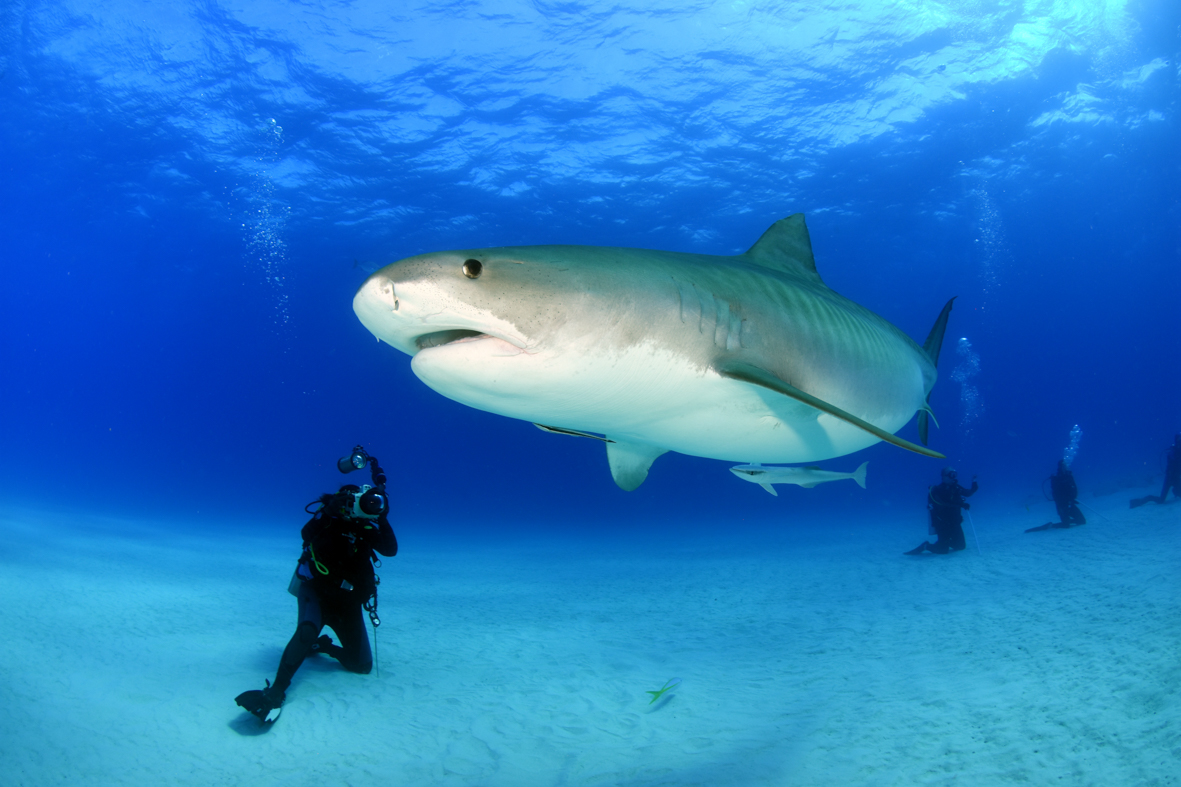
Text by Jeremy Cuff/www.ja-universe.com
Photography by Jeremy & Amanda Cuff/www.ja-universe.com
This Bahamian trip has its’ roots back in the Covid-19 pandemic, when we were originally supposed to go to the island of Bimini in search of Great Hammerheads, but for reasons we all know too well, a lot of plans were cancelled, put on hold, and many things changed. Here’s our story about rolling with the changes brought upon us by what came along. Instead of “Hammertime”, we would end up “Earning our Stripes”…
For quite some time, it had been on our “must do list” to visit the Bahamas in search of the Great Hammerhead, which we’d learned about from various scuba diving magazines in years gone by. Our research led us specifically to look at going to Bimini, the only place where seasonal encounters with this species were as near as it’s possible to get to being “guaranteed”, given the unpredictable nature of scuba diving and marine encounters in general.
We’d already seen the spectacle of schooling Scalloped Hammerheads on dives around Darwin Island in the Galapagos, but Great Hammerheads (the largest of all the Hammerhead shark species) are a different proposition, being more solitary, rarely encountered on dives, and so far as anyone knows, not known to form schools like their smaller counterparts. Added to that, they’re now sadly designated as Critically Endangered.
As the Great Hammerhead was at or near the top of Amanda’s “bucket list”, I booked it for a significant birthday that she celebrated in 2019, with the trip itself planned for February 2021, but when the Covid-19 pandemic struck in March 2020, the world changed and everything went on indefinite hold, or was cancelled altogether, including our trip.
I’d made our booking with Epic Diving, an experienced operator run by shark devotees Vinnie and Debra Canabal, a husband and wife team who at the time of booking worked out of both Bimini (for the Great Hammerheads) and Grand Bahama (largely for the Tiger Sharks).
However, things changed for them during this tumultuous time, both in the water in terms of the sharks, and out of the water in terms of dealing with the pandemic. Put simply, they decided to pull out of Bimini due to a combination of things; reduced sightings of Great Hammerheads at that time (though its’ increased again since), coinciding with the operational difficulties of running their trips amidst the pandemic restrictions and uncertainties.
They got in touch with us about this and offered us the alternative of basing out of Grand Bahama, to dive the Tiger Shark mecca of Tiger Beach, where they’d also been getting regular Great Hammerhead visitations, most notably from a huge female known as “Queen”. We could have cancelled it given the changed location, but we chose to go with the flow; we would now have the opportunity to see both Great Hammerheads and Tiger Sharks, right?
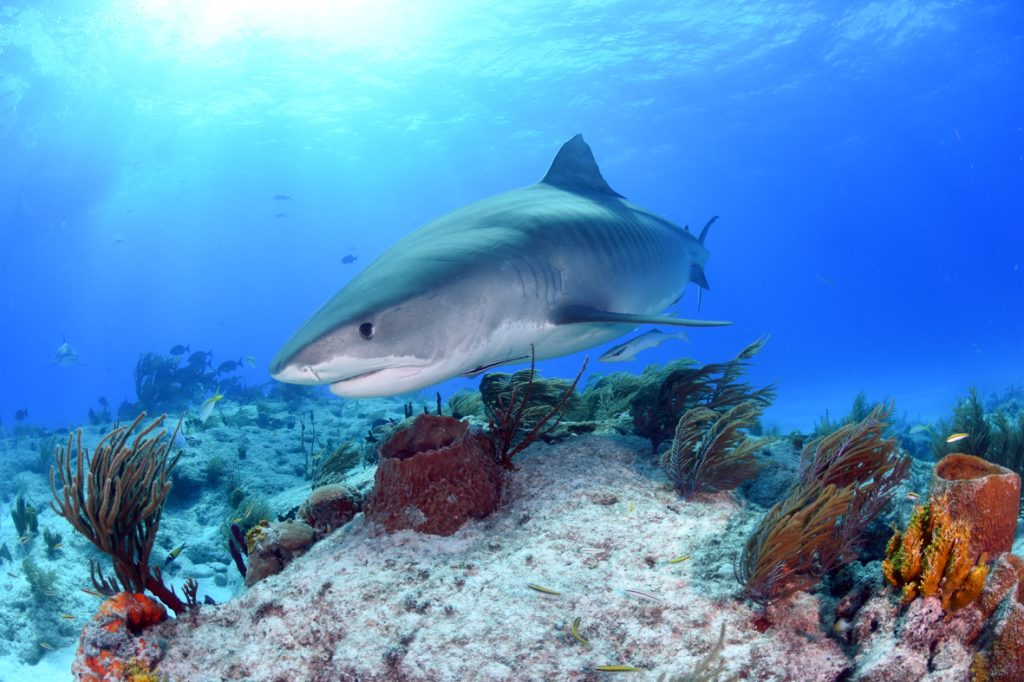
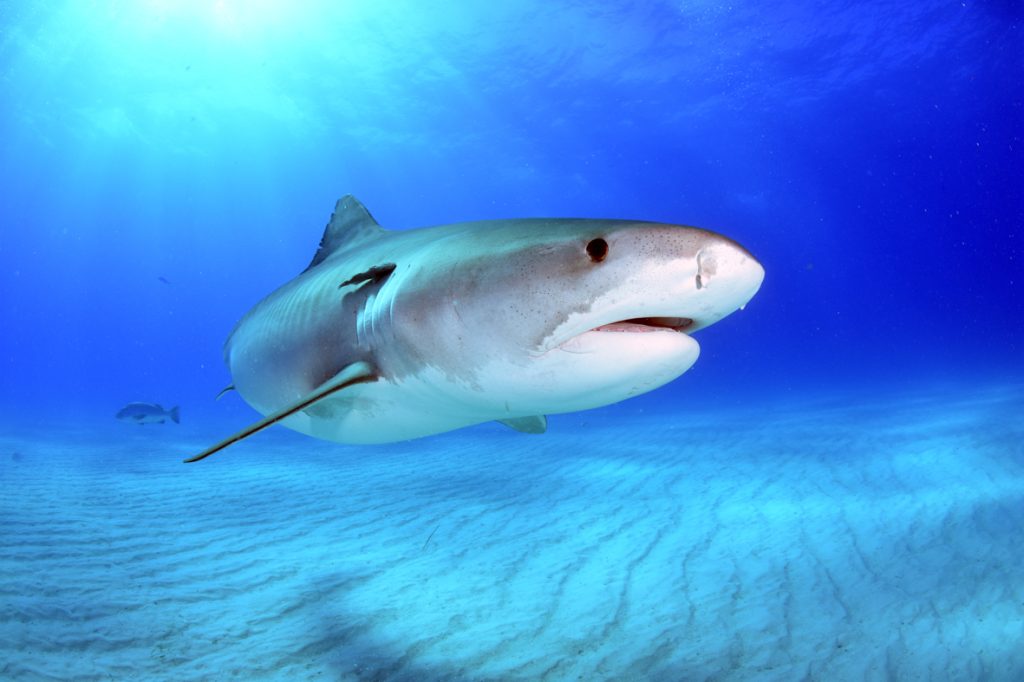
After the original cancellation, we suffered a second postponement in 2022 due to ongoing Covid restrictions, and eventually travelled out there in February 2023, benefitting from direct flights to the Bahamas from the UK, rather than going via somewhere in Florida, such as Miami.
To begin with, we chose to spend a couple of nights in Nassau (the Bahamian capital) before travelling over to Grand Bahama on one of the regular internal flights to Freeport. Though Grand Bahama is one of the larger Bahamian Islands, it isn’t the largest despite what its’ name suggests.
On Grand Bahama, the Epic Diving team are based at the Blue Marlin Cove, a well set-up aparthotel, with spacious accommodation featuring decent self-catering facilities, a bar and restaurant, a swimming pool, and a marina that shelters boats from the elements; it’s located in what is known as the West End.
To get there, it’s a good half an hour by road from the airport by a taxi minibus, which aren’t cheap, so it’s worth asking around to see if anyone else is heading in that direction and wants to share. Also before setting off, it’s worth considering your food and drink supplies for the duration of your stay; unless you intend to eat and drink only what the restaurant and bar offers, it’s a good idea to stock up from one of supermarkets in the vicinity of the airport, as the West End (a fairly remote area) has little in the way of shops.
Over our years of dive travel, Tiger Shark encounters have tended to be fleeting on dives and none were up close; just as often, we’ve seen them from dive boats whilst travelling to and from sites. Though we’ve seen them in destinations as disparate as Walker’s Cay in the Bahamas (not far from Tiger Beach), Ningaloo Reef in Western Australia, the Socorro Islands off Mexico’s Pacific side, and North Male Atoll in the Maldives, these dives would get us fully up-close and personal with these sharks.
To talk about the diving itself, the place that is Tiger Beach is not actually a beach, or even near a beach; it’s a remote area of shallow sandy expanses and scattered coral patches on the Little Bahama Bank, completely exposed to the elements. At some point in the past, mostly as a result of fishermen visiting the area, it was noticed that it was frequented by Tiger Sharks, which gradually led to scuba divers travelling to the area to see what was happening there, which then led to regular shark diving trips being offered, such as those run by Epic Diving.
From Blue Marlin Cove, it’s a full 2-hour voyage to Tiger Beach each way, and is only visited by dive operators in good conditions. Getting in and out of boats in rough seas is difficult and potentially dangerous, it can be quite “seasicky” with the boat bobbing up and down on the swell (take some tablets, you’ve got nothing to lose), and then there’s the conditions underwater to consider. Put simply, if the visibility is poor, diving with bait around large sharks such as Tigers and Bulls (which are also often seen there) is asking for something to go wrong; the conditions have to be right.
Sustained winds, and the residual swells that persist after periods of wind usually cause poor visibility underwater and are the enemy for diving this area; it’s not unusual for days or even successions of days to be “blown out” until conditions improve, even if the conditions around Grand Bahama itself seem good. It thus makes sense to be in the area for as many days as your budget or diary allows to guard against unhelpful weather events.
On our trip, we arrived on Grand Bahama under clear blue skies, with the forecast for the week ahead looking positive, but a period of less settled windy weather had preceded our visit. So, for our first diving day, the decision was taken not to go out there, as the residual conditions were deemed unsuitable for the diving to take place. We had four further days booked, so weren’t particularly concerned, and also, Vinnie seemed confident that conditions should improve enough to allow the trip to happen from “dive day two” onwards.
As an alternative to our cancelled Tiger Beach visit, the Epic team hastily arranged a shark dive at different location with another dive operator, on the South shore in the area of Freeport. It’s frequented mostly by Caribbean Reef Sharks and there’s also a small wreck to check out as well. Quite a few sharks turned up for the feed and it was good to get a chance to get into the water, see a bit of action, and to get rid of any dive rustiness.
One of quirks of this kind of shark diving (where you need to be firmly planted on the bottom) is the need to be heavily overweighted, which if you’ve never experienced it before, takes a bit of getting used to. You particularly need to manage your descents, to avoid plummeting at high speed to the bottom and being unable to equalise your ears quickly enough. Ensuring you enter the water with a fully inflated BCD and gradually dumping air is the way to go, combined with using the line to hang onto. It’s also important to ensure that your weight belt is done up tightly, as they have a habit of slipping down thanks all the extra lead.
To return to my previous point about the dangers of diving with these sharks in poor conditions, this isn’t a risk-free endeavour even in ideal conditions. These dives are potentially dangerous at all times, and one should never underestimate or be blasé about what you’re getting involved with. It’s a personal choice as to whether you do it or not and it’s certainly not for everybody. I can remember Vinnie saying that even some very experienced divers can find these dives unnerving. You must remain vigilant at all times. It would irresponsible to say otherwise. You take a certain risk. It’s up to you if you want to take it. People have died there.
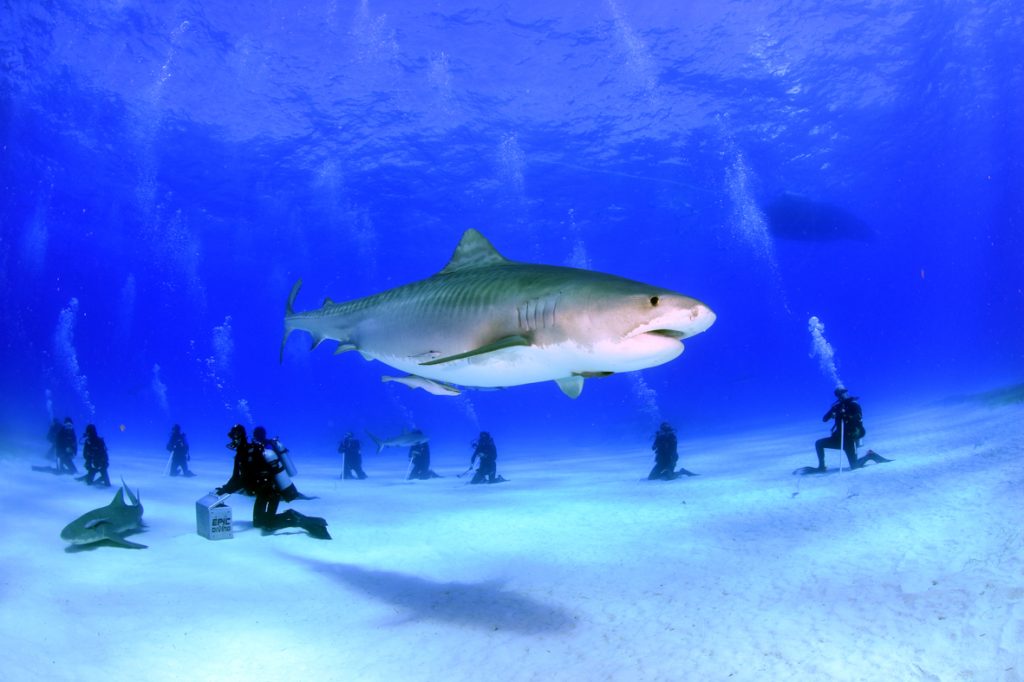
And so, from “dive day two” onwards, we had four uninterrupted days of diving with the Tiger Sharks of Tiger Beach in good conditions. The format of the diving is as follows; it’s a two-tank dive day (each dive is circa 1 hour) preceded by an extensive briefing by the crew about the sharks and what to expect. One very important aspect is the need for all divers to look out for each other by indicating the presence of any sharks approaching unseen from behind, so understanding the language of hand signals are essential to everyone’s safety.
Once the boat is secured and whilst the briefing is underway, other members of the dive team place the metal bait box in a suitable spot on a sandy expanse and wait for sharks to turn up, which usually doesn’t take long. It’s then a case of divers entering the water and finding a suitable spot in the general area of the bait box, but not directly up-current in the “chum trail” which leads the sharks to the bait.
These dives are what could only be described as a “big experience”, and it’s at once awe-inspiring and humbling to see these incredible predators up-close, adorned with their distinctive body stripes unique to the species. It’s also intense and relentless in that the shark action continues without stop as long as bait is present in the water, and even if it’s removed, they will usually remain in the area. In terms of the bait, Vinnie or Debs take turns in feeding the sharks with food stashed in the bait box; their incredible understanding of these animals is something to behold.
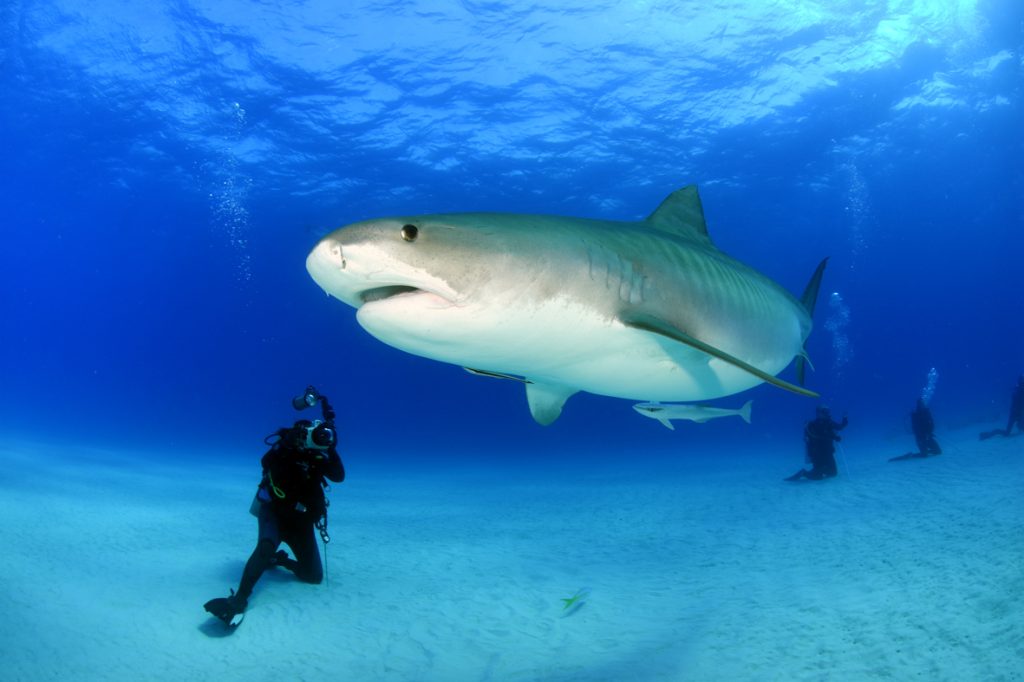
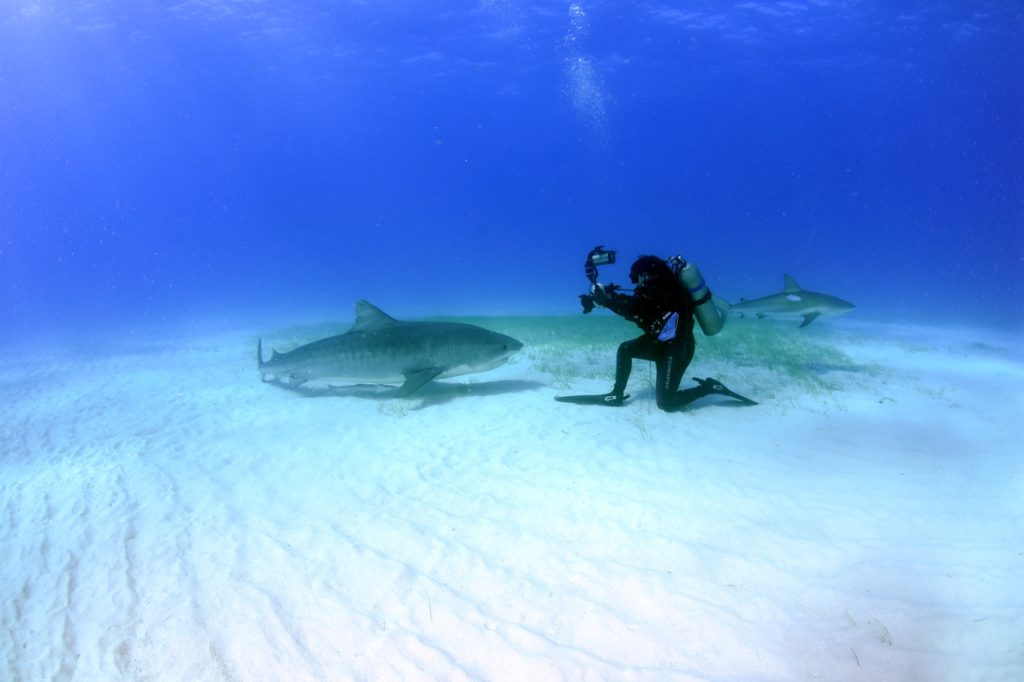
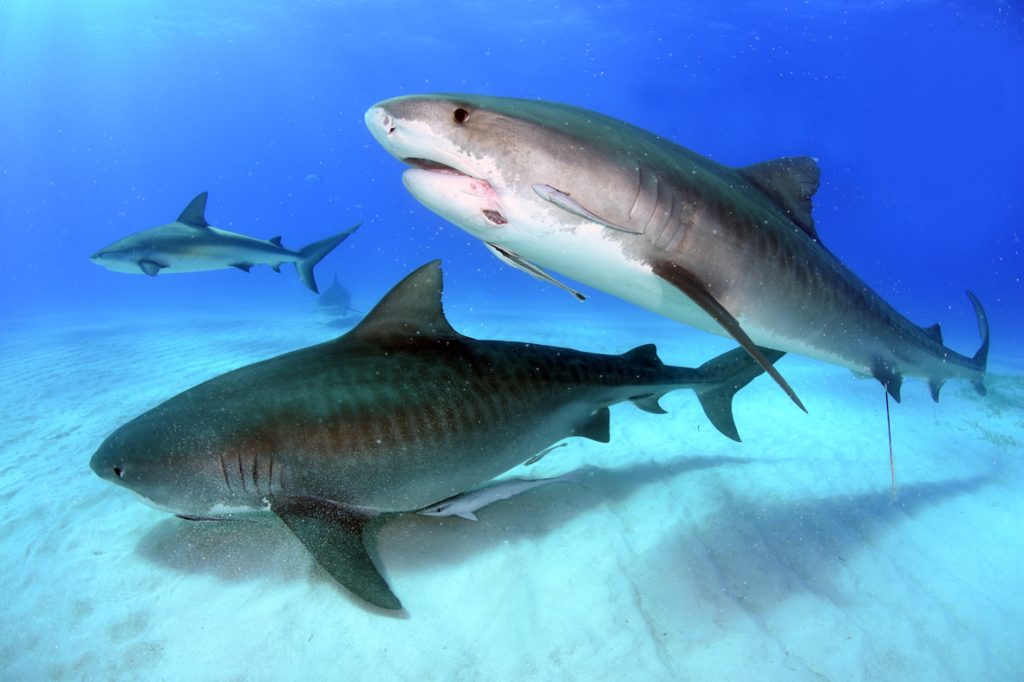
Most of the “feeders” (the sharks that participate in the feed) are known to the dive crew and have been given names to aid recognition. Among them are some enormous specimens measuring around fifteen feet in length such as Emma, but it’s usually the smaller individuals, such as the delightfully named Buttface that you have to be more wary of, as they can be more unpredictable and feisty.
On my very first dive, one of the smaller Tigers came directly towards me; it would turn away wouldn’t it? But it didn’t, requiring me to “manage” it out of harms way with my camera rig. It could probably sense I wasn’t completely “settled”. It was testing me; they probably know which divers are new on the “beach”.
Of the other sharks that turn up at Tiger Beach, you can expect to see Caribbean Reef Sharks, Lemon Sharks, perhaps a Nurse Shark or two, and also Bull Sharks, which will usually swim around the periphery of the feeding area, though everyone needs to keep an eye on them as they’re constantly seeking opportunities. Unfortunately, neither “Queen” or any other Great Hammerheads were seen during our visit, though one of the crew reported seeing a “non-feeding Hammer” from the boat whilst divers were in the water; nobody glimpsed it. Since then, it would seem that the “Hammers” have stopped visiting Tiger Beach on a regular basis, though their absences might not be permanent.
Hammerheads or not, we’d had a great experience, one where we had “Earned Our Stripes” by diving with one of the ocean’s great predators, and one that had set the scene for a return visit to the Bahamas. At the end of the trip, we again had a couple of days at Nassau to chill out before heading home, where we settled on a plan to return a couple of year’s later.
With the Tiger’s indelibly stamped into our psyches, it was time to turn the page and look forwards again. We would roll the dice one more time for getting our Great Hammerhead encounters, and if it was going to happen, it was going to happen in Bimini, come what may…